This is the multi-page printable view of this section. .
Patroni 4.1.5 Documentation
- 1: Introduction
- 2: Installation
- 3: Patroni configuration
- 4: Patroni REST API
- 5: patronictl
- 6: Replica imaging and bootstrap
- 7: Replication modes
- 8: Standby cluster
- 9: Watchdog support
- 10: Pause/Resume mode for the cluster
- 11: DCS Failsafe Mode
- 12: Using Patroni with Kubernetes
- 13: Citus support
- 14: Convert a Standalone to a Patroni Cluster
- 15: Integration with other tools
- 16: Security Considerations
- 17: HA multi datacenter
- 18: FAQ
- 19: Release notes
- 20: Contributing guidelines
Running Patroni on memory-restricted systems with Python 3.11+
If you run Patroni on a system with strict memory limits, for example with vm.overcommit_memory=2 (recommended for PostgreSQL), and use Python 3.11 or newer, you may observe unexpected behavior:
- Patroni appears healthy
- PostgreSQL continues to run
- Patroni REST API becomes unresponsive
- The operating system reports that Patroni is listening on the REST API port
- Patroni logs look normal; however, following messages may appear once:
Exception ignored in thread started by: <object repr() failed>,MemoryError - Kernel logs may contain messages such as
not enough memory for the allocation
This behavior is caused by a bug in Python 3.11+. Under strict memory conditions, starting a new thread may hang indefinitely when there is not enough free memory.
Recommended solution
Recent Patroni releases (4.1.1+, 4.0.8+) reduce the impact of this issue by starting all required threads early during startup, before the system is under memory pressure.
Additional recommendations (Linux, glibc)
When running with vm.overcommit_memory=2 (recommended for PostgreSQL), we also recommend starting Patroni with the following environment variables configured:
MALLOC_ARENA_MAX=1- reduces the amount of virtual memory allocated by glibc for multi-threaded applicationsPG_MALLOC_ARENA_MAX=- resets the value ofMALLOC_ARENA_MAXfor PostgreSQL processes started by Patroni.
In addition, you may tune the following Patroni configuration parameters:
thread_stack_size- stack size used for threads started by Patroni. Lowering this value reduces memory usage of the Patroni process. The default value set by Patroni is512kB. Increasethread_stack_sizeif Patroni experiences stack-related crashes; otherwise the default value is sufficient.thread_pool_size- size of the thread pool used by Patroni for asynchronous tasks and REST API communication with other members during leader race or failsafe checks. The default value is5, which is sufficient for three-node clusters.restapi.thread_pool_size- size of the thread pool used to process REST API requests. The default value is5, allowing up to five parallel REST API requests. Note that requests involving SQL queries are effectively serialized because a single database connection is used, so increasing this value typically provides no benefit.
Patroni is a template for high availability (HA) PostgreSQL solutions using Python. For maximum accessibility, Patroni supports a variety of distributed configuration stores like ZooKeeper, etcd, Consul or Kubernetes. Database engineers, DBAs, DevOps engineers, and SREs who are looking to quickly deploy HA PostgreSQL in datacenters — or anywhere else — will hopefully find it useful.
We call Patroni a “template” because it is far from being a one-size-fits-all or plug-and-play replication system. It will have its own caveats. Use wisely. There are many ways to run high availability with PostgreSQL; for a list, see the PostgreSQL Documentation.
Currently supported PostgreSQL versions: 9.3 to 18.
Note to Citus users: Starting from 3.0 Patroni nicely integrates with the Citus database extension to Postgres. Please check the Citus support page in the Patroni documentation for more info about how to use Patroni high availability together with a Citus distributed cluster.
Note to Kubernetes users: Patroni can run natively on top of Kubernetes. Take a look at the Kubernetes chapter of the Patroni documentation.

1 - Introduction
Source: https://patroni.readthedocs.io/en/latest/README.html
Patroni is a template for high availability (HA) PostgreSQL solutions using Python. Patroni originated as a fork of Governor, the project from Compose. It includes plenty of new features.
For additional background info, see:
- PostgreSQL HA with Kubernetes and Patroni, talk by Josh Berkus at KubeCon 2016 (video)
- Feb. 2016 Zalando Tech blog post
Development Status
Patroni is in active development and accepts contributions. See our Contributing section below for more details.
We report new releases information here.
Technical Requirements/Installation
Go here for guidance on installing and upgrading Patroni on various platforms.
Planning the Number of PostgreSQL Nodes
Patroni/PostgreSQL nodes are decoupled from DCS nodes (except when Patroni implements RAFT on its own) and therefore there is no requirement on the minimal number of nodes. Running a cluster consisting of one primary and one standby is perfectly fine. You can add more standby nodes later.
2-node clusters (primary + standby) are common and provide automatic failover with high availability. Note that during failover, you’ll temporarily have no redundancy until the failed node rejoins.
DCS requirements: Your DCS (etcd, ZooKeeper, Consul) has to run with 3 or 5 nodes for proper consensus and fault tolerance. A single DCS cluster can store information for hundreds or thousands of Patroni clusters using different namespace/scope combinations.
Running and Configuring
The following section assumes Patroni repository as being cloned from https://github.com/patroni/patroni. Namely, you will need example configuration files postgres0.yml and postgres1.yml. If you installed Patroni with pip, you can obtain those files from the git repository and replace ./patroni.py below with patroni command.
To get started, do the following from different terminals: :
> etcd --data-dir=data/etcd --enable-v2=true
> ./patroni.py postgres0.yml
> ./patroni.py postgres1.yml
You will then see a high-availability cluster start up. Test different settings in the YAML files to see how the cluster’s behavior changes. Kill some of the components to see how the system behaves.
Add more postgres*.yml files to create an even larger cluster.
Patroni provides an HAProxy configuration, which will give your application a single endpoint for connecting to the cluster’s leader. To configure, run:
> haproxy -f haproxy.cfg

> psql --host 127.0.0.1 --port 5000 postgres
YAML Configuration
Go here for comprehensive information about settings for etcd, consul, and ZooKeeper. And for an example, see postgres0.yml.
Environment Configuration
Go here for comprehensive information about configuring(overriding) settings via environment variables.
Replication Choices
Patroni uses Postgres’ streaming replication, which is asynchronous by default. Patroni’s asynchronous replication configuration allows for maximum_lag_on_failover settings. This setting ensures failover will not occur if a follower is more than a certain number of bytes behind the leader. This setting should be increased or decreased based on business requirements. It’s also possible to use synchronous replication for better durability guarantees. See replication modes documentation for details.
Applications Should Not Use Superusers
When connecting from an application, always use a non-superuser. Patroni requires access to the database to function properly. By using a superuser from an application, you can potentially use the entire connection pool, including the connections reserved for superusers, with the superuser_reserved_connections setting. If Patroni cannot access the Primary because the connection pool is full, behavior will be undesirable.
Testing Your HA Solution
Testing an HA solution is a time-consuming process, with many variables. This is particularly true considering a cross-platform application. You need a trained system administrator or a consultant to do this work. It is not something we can cover in depth in the documentation.
That said, here are some pieces of your infrastructure you should be sure to test:
- Network (the network in front of your system as well as the NICs themselves)
- Disk IO
- file limits (nofile in Linux)
- RAM. Even if you have oomkiller turned off, the unavailability of RAM could cause issues.
- CPU
- Virtualization Contention (overcommitting the hypervisor)
- Any cgroup limitation (likely to be related to the above)
kill -9of any postgres process (except postmaster!). This is a decent simulation of a segfault.
One thing that you should not do is run kill -9 on a postmaster process. This is because doing so does not mimic any real life scenario. If you are concerned your infrastructure is insecure and an attacker could run kill -9, no amount of HA process is going to fix that. The attacker will simply kill the process again, or cause chaos in another way.
2 - Installation
Source: https://patroni.readthedocs.io/en/latest/installation.html
Pre-requirements for Mac OS
To install requirements on a Mac, run the following:
Psycopg
Starting from psycopg2-2.8 the binary version of psycopg2 will no longer be installed by default. Installing it from the source code requires C compiler and postgres+python dev packages. Since in the python world it is not possible to specify dependency as psycopg2 OR psycopg2-binary you will have to decide how to install it.
There are a few options available:
- Use the package manager from your distro
- Specify one of
psycopg,psycopg2, orpsycopg2-binaryin the list of dependencies when installing Patroni with pip.
General installation for pip
Patroni can be installed with pip:
where dependencies can be either empty, or consist of one or more of the following:
etcd or etcd3
python-etcd module in order to use Etcd as Distributed Configuration Store (DCS)
consul
py-consul module in order to use Consul as DCS
zookeeper
kazoo module in order to use Zookeeper as DCS
exhibitor
kazoo module in order to use Exhibitor as DCS (same dependencies as for Zookeeper)
kubernetes
kubernetes module in order to use Kubernetes as DCS in Patroni
raft
pysyncobj module in order to use python Raft implementation as DCS
aws
boto3 in order to use AWS callbacks
jsonlogger
python-json-logger module in order to enable logging in json format
systemd
systemd-python in order to use sd_notify integration
all
all of the above (except psycopg family)
psycopg3
psycopg\[binary\]\>=3.0.0 module
psycopg2
psycopg2\>=2.5.4 module
psycopg2-binary
psycopg2-binary module
For example, the command in order to install Patroni together with psycopg3, dependencies for Etcd as a DCS, and AWS callbacks is:
Note that external tools to call in the replica creation or custom bootstrap scripts (i.e. WAL-E) should be installed independently of Patroni.
Package installation on Linux
Patroni packages may be available for your operating system, produced by the Postgres community for:
- RHEL, RockyLinux, AlmaLinux;
- Debian and Ubuntu;
- SUSE Enterprise Linux.
You can also find packages for direct dependencies of Patroni, like python modules that might not be available in the official operating system repositories.
For more information see the PGDG repository documentation.
If you are on a RedHat Enterprise Linux derivative operating system you may also require packages from EPEL, see EPEL repository documentation.
Once you have installed the PGDG repository for your OS you can install patroni.
Patroni packages are not maintained by the Patroni developers, but rather by the Postgres community. If you require support please first try connecting on Postgres slack.
Installing on Debian derivatives
With PGDG repo installed, see above, install Patroni via apt run:
Installing on RedHat derivatives
With PGDG repo installed, see above, install patroni with an etcd DCS via dnf on RHEL 9 (and derivatives) run:
You can install etcd from PGDG if your RedHat derivative distribution does not provide packages. On the nodes that will host the DCS run:
You can replace the version of RHEL with 8 in the repo to make pgdg-rhel8-extras if needed. The repo name is still pgdg-rhelN-extras on RockyLinux, AlmaLinux, Oracle Linux, etc…
Installing on SUSE Enterprise Linux
You might need to enable the SUSE PackageHub repositories for some dependencies. see SUSE PackageHub documentation.
For SLES 15 with PGDG repo installed, see above, you can install patroni using:
With the SUSE PackageHub repo enabled you can also install etcd:
Upgrading
Upgrading patroni is a very simple process, just update the software installation and restart the Patroni daemon on each node in the cluster.
However, restarting the Patroni daemon will result in a Postgres database restart. In some situations this may cause a failover of the primary node in your cluster, therefore it is recommended to put the cluster into maintenance mode until the Patroni daemon restart has been completed.
To put the cluster in maintenance mode, run the following command on one of the patroni nodes:
Then on each node in the cluster, perform the package upgrade required for your OS:
Restart the patroni daemon process on each node:
Then finally resume monitoring of Postgres with patroni to take it out of maintenance mode:
The cluster will now be full operational with the new version of Patroni.
3 - Patroni configuration
Source: https://patroni.readthedocs.io/en/latest/patroni_configuration.html
There are 3 types of Patroni configuration:
-
Global dynamic configuration.
These options are stored in the DCS (Distributed Configuration Store) and applied on all cluster nodes. Dynamic configuration can be set at any time using patronictl_edit_config tool or Patroni REST API. If the options changed are not part of the startup configuration, they are applied asynchronously (upon the next wake up cycle) to every node, which gets subsequently reloaded. If the node requires a restart to apply the configuration (for PostgreSQL parameters with context postmaster, if their values have changed), a special flagpending_restartindicating this is set in the members.data JSON. Additionally, the node status indicates this by showing"restart_pending": true. -
Local configuration file (patroni.yml).
These options are defined in the configuration file and take precedence over dynamic configuration.patroni.ymlcan be changed and reloaded at runtime (without restart of Patroni) by sending SIGHUP to the Patroni process, performingPOST /reloadREST-API request or executing patronictl_reload. Local configuration can be either a single YAML file or a directory. When it is a directory, all YAML files in that directory are loaded one by one in sorted order. In case a key is defined in multiple files, the occurrence in the last file takes precedence. -
Environment configuration.
It is possible to set/override some of the “Local” configuration parameters with environment variables. Environment configuration is very useful when you are running in a dynamic environment and you don’t know some of the parameters in advance (for example it’s not possible to know your external IP address when you are running insidedocker).
Important rules
PostgreSQL parameters controlled by Patroni
Some of the PostgreSQL parameters must hold the same values on the primary and the replicas. For those, values set either in the local patroni configuration files or via the environment variables take no effect. To alter or set their values one must change the shared configuration in the DCS. Below is the actual list of such parameters together with the default and minimal values:
- max_connections: default value 100, minimal value 25
- max_locks_per_transaction: default value 64, minimal value 32
- max_worker_processes: default value 8, minimal value 2
- max_prepared_transactions: default value 0, minimal value 0
- wal_level: default value hot_standby, accepted values: hot_standby, replica, logical
- track_commit_timestamp: default value off
For the parameters below, PostgreSQL does not require equal values among the primary and all the replicas. However, considering the possibility of a replica to become the primary at any time, it doesn’t really make sense to set them differently; therefore, Patroni restricts setting their values to the dynamic configuration.
- max_wal_senders: default value 10, minimal value 3
- max_replication_slots: default value 10, minimal value 4
- wal_keep_segments: default value 8, minimal value 1
- wal_keep_size: default value 128MB, minimal value 16MB
- wal_log_hints: on
These parameters are validated to ensure they are sane, or meet a minimum value.
There are some other Postgres parameters controlled by Patroni:
- listen_addresses - is set either from
postgresql.listenor fromPATRONI_POSTGRESQL_LISTENenvironment variable - port - is set either from
postgresql.listenor fromPATRONI_POSTGRESQL_LISTENenvironment variable - cluster_name - is set either from
scopeor fromPATRONI_SCOPEenvironment variable - hot_standby: on
To be on the safe side parameters from the above lists are written into postgresql.conf, and passed as a list of arguments to the postgres which gives them the highest precedence (except wal_keep_segments and wal_keep_size), even above ALTER SYSTEM
There also are some parameters like postgresql.listen, postgresql.data_dir that can be set only locally, i.e. in the Patroni config file or via configuration variable. In most cases the local configuration will override the dynamic configuration.
When applying the local or dynamic configuration options, the following actions are taken:
- The node first checks if there is a
postgresql.base.conffile or if thecustom_confparameter is set. - If the
custom_confparameter is set, the file it specifies is used as the base configuration, ignoringpostgresql.base.confandpostgresql.conf. - If the
custom_confparameter is not set andpostgresql.base.confexists, it contains the renamed “original” configuration and is used as the base configuration. - If there is no
custom_confnorpostgresql.base.conf, the originalpostgresql.confis renamed topostgresql.base.confand used as the base configuration. - The dynamic options (with the exceptions above) are dumped into the
postgresql.confand an include is set inpostgresql.confto the base configuration (eitherpostgresql.base.confor the file atcustom_conf). Therefore, we would be able to apply new options without re-reading the configuration file to check if the include is present or not. - Some parameters that are essential for Patroni to manage the cluster are overridden using the command line.
- If an option that requires restart is changed (we should look at the context in pg_settings and at the actual values of those options), a pending_restart flag is set on that node. This flag is reset on any restart.
The parameters would be applied in the following order (run-time are given the highest priority):
- load parameters from file
postgresql.base.conf(or from acustom_conffile, if set) - load parameters from file
postgresql.conf - load parameters from file
postgresql.auto.conf - run-time parameter using
-o --name=value
This allows configuration for all the nodes (2), configuration for a specific node using ALTER SYSTEM (3) and ensures that parameters essential to the running of Patroni are enforced (4), as well as leaves room for configuration tools that manage postgresql.conf directly without involving Patroni (1).
PostgreSQL parameters that touch shared memory
PostgreSQL has some parameters that determine the size of the shared memory used by them:
- max_connections
- max_prepared_transactions
- max_locks_per_transaction
- max_wal_senders
- max_worker_processes
Changing these parameters require a PostgreSQL restart to take effect, and their shared memory structures cannot be smaller on the standby nodes than on the primary node.
As explained before, Patroni restrict changing their values through dynamic configuration, which usually consists of:
- Applying changes through patronictl_edit_config (or via REST API
/configendpoint) - Restarting nodes through patronictl_restart (or via REST API
/restartendpoint)
Note: please keep in mind that you should perform a restart of the PostgreSQL nodes through patronictl_restart command, or via REST API /restart endpoint. An attempt to restart PostgreSQL by restarting the Patroni daemon, e.g. by executing systemctl restart patroni, can cause a failover to occur in the cluster, if you are restarting the primary node.
However, as those settings manage shared memory, some extra care should be taken when restarting the nodes:
-
If you want to increase the value of any of those settings:
- Restart all standbys first
- Restart the primary after that
-
If you want to decrease the value of any of those settings:
- Restart the primary first
- Restart all standbys after that
Note: if you attempt to restart all nodes in one go after decreasing the value of any of those settings, Patroni will ignore the change and restart the standby with the original setting value, thus requiring that you restart the standbys again later. Patroni does that to prevent the standby to enter in an infinite crash loop, because PostgreSQL quits with a FATAL message if you attempt to set any of those parameters to a value lower than what is visible in pg_controldata on the Standby node. In other words, we can only decrease the setting on the standby once its pg_controldata is up-to-date with the primary in regards to these changes on the primary.
More information about that can be found at PostgreSQL Administrator’s Overview.
Patroni configuration parameters
Also the following Patroni configuration options can be changed only dynamically:
- ttl: 30
- loop_wait: 10
- retry_timeout: 10
- maximum_lag_on_failover: 1048576
- max_timelines_history: 0
- check_timeline: false
- postgresql.use_slots: true
Upon changing these options, Patroni will read the relevant section of the configuration stored in DCS and change its run-time values.
Patroni nodes are dumping the state of the DCS options to disk upon for every change of the configuration into the file patroni.dynamic.json located in the Postgres data directory. Only the leader is allowed to restore these options from the on-disk dump if these are completely absent from the DCS or if they are invalid.
Configuration generation and validation
Patroni provides command-line interfaces for a Patroni local configuration generation and validation. Using the patroni executable you can:
- Create a sample local Patroni configuration;
- Create a Patroni configuration file for the locally running PostgreSQL instance (e.g. as a preparation step for the Patroni integration);
- Validate a given Patroni configuration file.
Sample Patroni configuration
Description
Generate a sample Patroni configuration file in yaml format. Parameter values are defined using the Environment configuration, otherwise, if not set, the defaults used in Patroni or the #FIXME string for the values that should be later defined by the user.
Some default values are defined based on the local setup:
- postgresql.listen: the IP address returned by
gethostnamecall for the current machine’s hostname and the standard5432port.- postgresql.connect_address: the IP address returned by
gethostnamecall for the current machine’s hostname and the standard5432port.- postgresql.authentication.rewind: is only defined if the PostgreSQL version can be defined from the binary and the version is 11 or later.
- restapi.listen: IP address returned by
gethostnamecall for the current machine’s hostname and the standard8008port.- restapi.connect_address: IP address returned by
gethostnamecall for the current machine’s hostname and the standard8008port.
Parameters
configfile - full path to the configuration file used to store the result. If not provided, the result is sent to stdout.
Patroni configuration for a running instance
Description
Generate a Patroni configuration in yaml format for the locally running PostgreSQL instance. Either the provided DSN (takes precedence) or PostgreSQL environment variables will be used for the PostgreSQL connection. If the password is not provided, it should be entered via prompt.
All the non-internal GUCs defined in the source Postgres instance, independently if they were set through a configuration file, through the postmaster command-line, or through environment variables, will be used as the source for the following Patroni configuration parameters:
- scope:
cluster_nameGUC value;- postgresql.listen:
listen_addressesandportGUC values;- postgresql.datadir:
data_directoryGUC value;- postgresql.parameters:
archive_command,restore_command,archive_cleanup_command,recovery_end_command,ssl_passphrase_command,hba_file,ident_file,config_fileGUC values;- bootstrap.dcs: all other gathered PostgreSQL GUCs.
If scope, postgresql.listen or postgresql.datadir is not set from the Postgres GUCs, the respective Environment configuration value is used.
Other rules applied for the values definition:
- name:
PATRONI_NAMEenvironment variable value if set, otherwise the current machine’s hostname.- postgresql.bin_dir: path to the Postgres binaries gathered from the running instance.
- postgresql.connect_address: the IP address returned by
gethostnamecall for the current machine’s hostname and the port used for the instance connection or theportGUC value.- postgresql.authentication.superuser: the configuration used for the instance connection;
- postgresql.pg_hba: the lines gathered from the source instance’s
hba_file.- postgresql.pg_ident: the lines gathered from the source instance’s
ident_file.- restapi.listen: IP address returned by
gethostnamecall for the current machine’s hostname and the standard8008port.- restapi.connect_address: IP address returned by
gethostnamecall for the current machine’s hostname and the standard8008port.
Other parameters defined using Environment configuration are also included into the configuration.
Parameters
configfile
Full path to the configuration file used to store the result. If not provided, result is sent to stdout.
dsn
Optional DSN string for the local PostgreSQL instance to get GUC values from.
Validate Patroni configuration
Description
Validate the given Patroni configuration and print the information about the failed checks.
Parameters
configfile
Full path to the configuration file to check. If not given or file does not exist, will try to read from the PATRONI_CONFIG_VARIABLE environment variable or, if not set, from the Patroni environment variables.
--ignore-listen-port | -i
Optional flag to ignore bind failures for listen ports that are already in use when validating the configfile.
--print | -p
Optional flag to print out local configuration (including environment configuration overrides) after it has been successfully validated.
3.1 - Dynamic Configuration Settings
Source: https://patroni.readthedocs.io/en/latest/dynamic_configuration.html
Dynamic configuration is stored in the DCS (Distributed Configuration Store) and applied on all cluster nodes.
In order to change the dynamic configuration you can use either patronictl_edit_config tool or Patroni REST API.
- loop_wait: the number of seconds the loop will sleep. Default value: 10, minimum possible value: 1
- ttl: the TTL to acquire the leader lock (in seconds). Think of it as the length of time before initiation of the automatic failover process. Default value: 30, minimum possible value: 20
- retry_timeout: timeout for DCS and PostgreSQL operation retries (in seconds). DCS or network issues shorter than this will not cause Patroni to demote the leader. Default value: 10, minimum possible value: 3
when changing values of loop_wait, retry_timeout, or ttl you have to follow the rule:
- maximum_lag_on_failover: the maximum bytes a follower may lag to be able to participate in leader election.
- primary_race_backoff: postpones leader race on standbys by
primary_race_backoffseconds if WAL replication from the primary is still advancing. It allows to minimize unnecessary failovers caused by briefly unresponsive Patroni. Default value: 0 (disabled). - maximum_lag_on_syncnode: the maximum bytes a synchronous follower may lag before it is considered as an unhealthy candidate and swapped by healthy asynchronous follower. Patroni utilize the max replica lsn if there is more than one follower, otherwise it will use leader’s current wal lsn. Default is -1, Patroni will not take action to swap synchronous unhealthy follower when the value is set to 0 or below. Please set the value high enough so Patroni won’t swap synchrounous follower frequently during high transaction volume.
- max_timelines_history: maximum number of timeline history items kept in DCS. Default value: 0. When set to 0, it keeps the full history in DCS.
- primary_start_timeout: the amount of time a primary is allowed to recover from failures before failover is triggered (in seconds). Default is 300 seconds. When set to 0 failover is done immediately after a crash is detected if possible. When using asynchronous replication a failover can cause lost transactions. Worst case failover time for primary failure is: loop_wait + primary_start_timeout + loop_wait, unless primary_start_timeout is zero, in which case it’s just loop_wait. Set the value according to your durability/availability tradeoff.
- primary_stop_timeout: The number of seconds Patroni is allowed to wait when stopping Postgres and effective only when synchronous_mode is enabled. When set to > 0 and the synchronous_mode is enabled, Patroni sends SIGKILL to the postmaster if the stop operation is running for more than the value set by primary_stop_timeout. Set the value according to your durability/availability tradeoff. If the parameter is not set or set <= 0, primary_stop_timeout does not apply.
- synchronous_mode: turns on synchronous replication mode. Possible values:
off,on,quorum. In this mode the leader takes care of management ofsynchronous_standby_names, and only the last known leader, or one of synchronous replicas, are allowed to participate in leader race. Synchronous mode makes sure that successfully committed transactions will not be lost at failover, at the cost of losing availability for writes when Patroni cannot ensure transaction durability. See replication modes documentation for details. - synchronous_mode_strict: prevents disabling synchronous replication if no synchronous replicas are available, blocking all client writes to the primary. When this option is set and no eligible replica is streaming, Patroni keeps
synchronous_standby_namespointing to the last known synchronous nodes from the/syncDCS key, or uses the internal placeholder__patroni_strict_sync_replica_placeholder__when no prior sync state exists. The nodenameinpatroni.yamlmust not be set to__patroni_strict_sync_replica_placeholder__. See replication modes documentation for details. - synchronous_node_count: if synchronous_mode is enabled, this parameter is used by Patroni to manage the precise number of synchronous standby instances and adjusts the state in DCS and the
synchronous_standby_namesparameter in PostgreSQL as members join and leave. If the parameter is set to a value higher than the number of eligible nodes, it will be automatically adjusted. Defaults to1. - failsafe_mode: Enables DCS Failsafe Mode. Defaults to
false. - postgresql:
- use_pg_rewind: whether or not to use pg_rewind. Defaults to
false. Note that either the cluster must be initialized withdata page checksums(--data-checksumsoption forinitdb) and/orwal_log_hintsmust be set toon, orpg_rewindwill not work. - use_slots: whether or not to use replication slots. Defaults to
trueon PostgreSQL 9.4+. - recovery_conf: additional configuration settings written to recovery.conf when configuring follower. There is no recovery.conf anymore in PostgreSQL 12, but you may continue using this section, because Patroni handles it transparently.
- parameters: configuration parameters (GUCs) for Postgres in format
{max_connections: 100, wal_level: "replica", max_wal_senders: 10, wal_log_hints: "on"}. Many of these are required for replication to work. - parameters_primary: (optional) role-specific parameter overrides for primary. These values are merged with and override the base parameters.
- parameters_replica: (optional) role-specific parameter overrides for replica. These values are merged with and override the base parameters.
- parameters_standby_leader: (optional) role-specific parameter overrides for standby_leader. These values are merged with and override the base parameters.
- pg_hba: list of lines that Patroni will use to generate
pg_hba.conf. Patroni ignores this parameter ifhba_filePostgreSQL parameter is set to a non-default value.- - host all all 0.0.0.0/0 md5
- - host replication replicator 127.0.0.1/32 md5: A line like this is required for replication.
- pg_hba_primary: (optional) role-specific pg_hba entries for primary. These completely replace pg_hba (no merging). If not defined, pg_hba is used.
- pg_hba_replica: (optional) role-specific pg_hba entries for replica. These completely replace pg_hba (no merging). If not defined, pg_hba is used.
- pg_hba_standby_leader: (optional) role-specific pg_hba entries for standby_leader. These completely replace pg_hba (no merging). If not defined, pg_hba is used.
- pg_ident: list of lines that Patroni will use to generate
pg_ident.conf. Patroni ignores this parameter ifident_filePostgreSQL parameter is set to a non-default value.- - mapname1 systemname1 pguser1
- - mapname1 systemname2 pguser2
- pg_ident_primary: (optional) role-specific pg_ident entries for primary. These completely replace pg_ident (no merging). If not defined, pg_ident is used.
- pg_ident_replica: (optional) role-specific pg_ident entries for replica. These completely replace pg_ident (no merging). If not defined, pg_ident is used.
- pg_ident_standby_leader: (optional) role-specific pg_ident entries for standby_leader. These completely replace pg_ident (no merging). If not defined, pg_ident is used.
- use_pg_rewind: whether or not to use pg_rewind. Defaults to
- standby_cluster: if this section is defined, we want to bootstrap a standby cluster.
- host: an address of remote node
- port: a port of remote node
- primary_slot_name: which slot on the remote node to use for replication. This parameter is optional, the default value is derived from the instance name (see function
slot_name_from_member_name). - create_replica_methods: an ordered list of methods that can be used to bootstrap standby leader from the remote primary, can be different from the list defined in postgresql_settings
- restore_command: command to restore WAL records from the remote primary to nodes in a standby cluster, can be different from the list defined in postgresql_settings
- archive_cleanup_command: cleanup command for standby leader
- recovery_min_apply_delay: how long to wait before actually apply WAL records on a standby leader
- member_slots_ttl: retention time of physical replication slots for replicas when they are shut down. Default value:
30min. Set it to0if you want to keep the old behavior (when the member key expires from DCS, the slot is immediately removed). The feature works only starting from PostgreSQL 11. - slots: define permanent replication slots. These slots will be preserved during switchover/failover. Permanent slots that don’t exist will be created by Patroni. With PostgreSQL 11 onwards permanent physical slots are created on all nodes and their position is advanced every loop_wait seconds. For PostgreSQL versions older than 11 permanent physical replication slots are maintained only on the current primary. The logical slots are copied from the primary to a standby with restart, and after that their position advanced every loop_wait seconds (if necessary). Copying logical slot files performed via
libpqconnection and using either rewind or superuser credentials (see postgresql.authentication section). There is always a chance that the logical slot position on the replica is a bit behind the former primary, therefore application should be prepared that some messages could be received the second time after the failover. The easiest way of doing so - trackingconfirmed_flush_lsn. Enabling permanent replication slots requires postgresql.use_slots to be set totrue. If there are permanent logical replication slots defined Patroni will automatically enable thehot_standby_feedback. Since the failover of logical replication slots is unsafe on PostgreSQL 9.6 and older and PostgreSQL version 10 is missing some important functions, the feature only works with PostgreSQL 11+.- my_slot_name: the name of the permanent replication slot. If the permanent slot name matches with the name of the current node it will not be created on this node. If you add a permanent physical replication slot which name matches the name of a Patroni member, Patroni will ensure that the slot that was created is not removed even if the corresponding member becomes unresponsive, situation which would normally result in the slot’s removal by Patroni. Although this can be useful in some situations, such as when you want replication slots used by members to persist during temporary failures or when importing existing members to a new Patroni cluster (see Convert a Standalone to a Patroni Cluster for details), caution should be exercised by the operator that these clashes in names are not persisted in the DCS, when the slot is no longer required, due to its effect on normal functioning of Patroni.
- type: slot type. Could be
physicalorlogical. If the slot is logical, you have to additionally definedatabaseandplugin. If the slot is physical, you can optionally definecluster_type. - database: the database name where logical slots should be created.
- plugin: the plugin name for the logical slot.
- cluster_type: the type of cluster (
primaryorstandby) the slot should only be created on, otherwise it will not be created or an already existing slot will be dropped.
- type: slot type. Could be
- my_slot_name: the name of the permanent replication slot. If the permanent slot name matches with the name of the current node it will not be created on this node. If you add a permanent physical replication slot which name matches the name of a Patroni member, Patroni will ensure that the slot that was created is not removed even if the corresponding member becomes unresponsive, situation which would normally result in the slot’s removal by Patroni. Although this can be useful in some situations, such as when you want replication slots used by members to persist during temporary failures or when importing existing members to a new Patroni cluster (see Convert a Standalone to a Patroni Cluster for details), caution should be exercised by the operator that these clashes in names are not persisted in the DCS, when the slot is no longer required, due to its effect on normal functioning of Patroni.
- ignore_slots: list of sets of replication slot properties for which Patroni should ignore matching slots. This configuration/feature/etc. is useful when some replication slots are managed outside of Patroni. Any subset of matching properties will cause a slot to be ignored.
- name: the name of the replication slot.
- type: slot type. Can be
physicalorlogical. If the slot is logical, you may additionally definedatabaseand/orplugin. - database: the database name (when matching a
logicalslot). - plugin: the logical decoding plugin (when matching a
logicalslot).
Note: slots is a hashmap while ignore_slots is an array. For example:
Note: When running PostgreSQL v11 or newer Patroni maintains physical replication slots on all nodes that could potentially become a leader, so that replica nodes keep WAL segments reserved if they are potentially required by other nodes. In case the node is absent and its member key in DCS gets expired, the corresponding replication slot is dropped after member_slots_ttl (default value is 30min). You can increase or decrease retention based on your needs. Alternatively, if your cluster topology is static (fixed number of nodes that never change their names) you can configure permanent physical replication slots with names corresponding to the names of the nodes to avoid slots removal and recycling of WAL files while replica is temporarily down:
Permanent replication slots are synchronized only from the primary/standby_leader to replica nodes. That means, applications are supposed to be using them only from the leader node. Using them on replica nodes will cause indefinite growth of pg_wal on all other nodes in the cluster. An exception to that rule are physical slots that match the Patroni member names (created and maintained by Patroni). Those will be synchronized among all nodes as they are used for replication among them.
Setting nostream tag on standby disables copying and synchronization of permanent logical replication slots on the node itself and all its cascading replicas if any.
3.2 - YAML Configuration Settings
Source: https://patroni.readthedocs.io/en/latest/yaml_configuration.html
Global/Universal
- thread_pool_size: size of thread pool used by Patroni to execute asynchronous tasks and communicate via REST API with other members during leader race or failsafe checks. Minimal value is
5, default value is5. - thread_stack_size: specifies the stack size to be used for threads started by Patroni. Value must be aligned by
64kB. Minimal value is64kB, default value (set by Patroni) is512kB. - name: the name of the host. Must be unique for the cluster. The value
__patroni_strict_sync_replica_placeholder__is reserved for internal use by Patroni and cannot be used as a node name. - namespace: path within the configuration store where Patroni will keep information about the cluster. Default value: “/service”
- scope: cluster name
Log
- type: sets the format of logs. Can be either plain or json. To use json format, you must have the jsonlogger installed. The default value is plain.
- level: sets the general logging level. Default value is INFO (see the docs for Python logging)
- traceback_level: sets the level where tracebacks will be visible. Default value is ERROR. Set it to DEBUG if you want to see tracebacks only if you enable log.level=DEBUG.
- format: sets the log formatting string. If the log type is plain, the log format should be a string. Refer to the LogRecord attributes for available attributes. If the log type is json, the log format can be a list in addition to a string. Each list item should correspond to LogRecord attributes. Be cautious that only the field name is required, and the %( and ) should be omitted. If you wish to print a log field with a different key name, use a dictionary where the dictionary key is the log field, and the value is the name of the field you want to be printed in the log. Default value is %(asctime)s %(levelname)s: %(message)s
- dateformat: sets the datetime formatting string. (see the formatTime() documentation)
- static_fields: add additional fields to the log. This option is only available when the log type is set to json.
- max_queue_size: Patroni is using two-step logging. Log records are written into the in-memory queue and there is a separate thread which pulls them from the queue and writes to stderr or file. The maximum size of the internal queue is limited by default by 1000 records, which is enough to keep logs for the past 1h20m.
- dir: Directory to write application logs to. The directory must exist and be writable by the user executing Patroni. If you set this value, the application will retain 4 25MB logs by default. You can tune those retention values with
file_numandfile_size(see below). - mode: Permissions for log files (for example,
0644). If not specified, permissions will be set based on the current umask value. - file_num: The number of application logs to retain.
- file_size: Size of patroni.log file (in bytes) that triggers a log rolling.
- loggers: This section allows redefining logging level per python module
- patroni.postmaster: WARNING
- urllib3: DEBUG
- deduplicate_heartbeat_logs: If set to
true, successive heartbeat logs that are identical shall not be output. Default value isfalse.
The time the HA loop executes at can be very valuable information in diagnosing failovers due to resource exhaustion and similar problems. When deduplicate_heartbeat_logs is set to true there will be no log generated for the HA loop execution (unless the leader changes) and hence this potentially useful information will not be available from the logs.
Here is an example of how to config patroni to log in json format.
Bootstrap configuration
Once Patroni has initialized the cluster for the first time and settings have been stored in the DCS, all future changes to the bootstrap.dcs section of the YAML configuration will not take any effect! If you want to change them please use either patronictl_edit_config or the Patroni REST API.
- bootstrap:
-
dcs: This section will be written into /<namespace>/<scope>/config of the given configuration store after initializing the new cluster. The global dynamic configuration for the cluster. You can put any of the parameters described in the Dynamic Configuration settings under
bootstrap.dcsand after Patroni has initialized (bootstrapped) the new cluster, it will write this section into /<namespace>/<scope>/config of the configuration store. -
method: custom script to use for bootstrapping this cluster.
See custom bootstrap methods documentation for details. When
initdbis specified revert to the defaultinitdbcommand.initdbis also triggered when nomethodparameter is present in the configuration file. -
initdb: (optional) list options to be passed on to initdb.
- - data-checksums: Must be enabled when pg_rewind is needed on 9.3.
- - encoding: UTF8: default encoding for new databases.
- - locale: UTF8: default locale for new databases.
-
post_bootstrap or post_init: An additional script that will be executed after initializing the cluster. The script receives a connection string URL (with the cluster superuser as a user name). The PGPASSFILE variable is set to the location of pgpass file.
-
Citus
Enables integration Patroni with Citus. If configured, Patroni will take care of registering Citus worker nodes on the coordinator. You can find more information about Citus support here.
- group: the Citus group id, integer. Use
0for coordinator and1,2, etc… for workers - database: the database where citus extension should be created. Must be the same on the coordinator and all workers. Currently only one database is supported.
Consul
Most of the parameters are optional, but you have to specify one of the host or url
- host: the host:port for the Consul local agent.
- url: url for the Consul local agent, in format: http(s)://host:port.
- port: (optional) Consul port.
- scheme: (optional) http or https, defaults to http.
- token: (optional) ACL token.
- verify: (optional) whether to verify the SSL certificate for HTTPS requests.
- cacert: (optional) The ca certificate. If present it will enable validation.
- cert: (optional) file with the client certificate.
- key: (optional) file with the client key. Can be empty if the key is part of cert.
- dc: (optional) Datacenter to communicate with. By default the datacenter of the host is used.
- consistency: (optional) Select consul consistency mode. Possible values are
default,consistent, orstale(more details in consul API reference) - checks: (optional) list of Consul health checks used for the session. By default an empty list is used.
- register_service: (optional) whether or not to register a service with the name defined by the scope parameter and the tag master, primary, replica, or standby-leader depending on the node’s role. Defaults to false.
- service_tags: (optional) additional static tags to add to the Consul service apart from the role (
primary/replica/standby-leader). By default an empty list is used. - service_check_interval: (optional) how often to perform health check against registered url. Defaults to ‘5s’.
- service_check_tls_server_name: (optional) override SNI host when connecting via TLS, see also consul agent check API reference.
The token needs to have the following ACL permissions:
service_prefix "${scope}" {
    policy = "write"
}
key_prefix "${namespace}/${scope}" {
    policy = "write"
}
session_prefix "" {
    policy = "write"
}
Etcd
Most of the parameters are optional, but you have to specify one of the host, hosts, url, proxy or srv
- host: the host:port for the etcd endpoint.
- hosts: list of etcd endpoint in format host1:port1,host2:port2,etc… Could be a comma separated string or an actual yaml list.
- use_proxies: If this parameter is set to true, Patroni will consider hosts as a list of proxies and will not perform a topology discovery of etcd cluster.
- url: url for the etcd.
- proxy: proxy url for the etcd. If you are connecting to the etcd using proxy, use this parameter instead of url.
- srv: Domain to search the SRV record(s) for cluster autodiscovery. Patroni will try to query these SRV service names for specified domain (in that order until first success):
_etcd-client-ssl,_etcd-client,_etcd-ssl,_etcd,_etcd-server-ssl,_etcd-server. If SRV records for_etcd-server-sslor_etcd-serverare retrieved then ETCD peer protocol is used do query ETCD for available members. Otherwise hosts from SRV records will be used. - srv_suffix: Configures a suffix to the SRV name that is queried during discovery. Use this flag to differentiate between multiple etcd clusters under the same domain. Works only with conjunction with srv. For example, if
srv_suffix: fooandsrv: example.orgare set, the following DNS SRV query is made:_etcd-client-ssl-foo._tcp.example.com(and so on for every possible ETCD SRV service name). - protocol: (optional) http or https, if not specified http is used. If the url or proxy is specified - will take protocol from them.
- username: (optional) username for etcd authentication.
- password: (optional) password for etcd authentication.
- cacert: (optional) The ca certificate. If present it will enable validation.
- cert: (optional) file with the client certificate.
- key: (optional) file with the client key. Can be empty if the key is part of cert.
Etcdv3
If you want that Patroni works with Etcd cluster via protocol version 3, you need to use the etcd3 section in the Patroni configuration file. All configuration parameters are the same as for etcd.
Keys created with protocol version 2 are not visible with protocol version 3 and the other way around, therefore it is not possible to switch from etcd to etcd3 just by updating Patroni config file. In addition, Patroni uses Etcd’s gRPC-gateway (proxy) to communicate with the V3 API, which means that TLS common name authentication is not possible.
ZooKeeper
- hosts: List of ZooKeeper cluster members in format: .
- use_ssl: (optional) Whether SSL is used or not. Defaults to
false. If set tofalse, all SSL specific parameters are ignored. - cacert: (optional) The CA certificate. If present it will enable validation.
- cert: (optional) File with the client certificate.
- key: (optional) File with the client key.
- key_password: (optional) The client key password.
- verify: (optional) Whether to verify certificate or not. Defaults to
true. - set_acls: (optional) If set, configures Kazoo to apply a default ACL to each ZNode that it creates. ACLs can use either the
x509schema (default) or other supported ZooKeeper schemes such asdigest. They should be specified as a dictionary where the key is the full principal (optionally prefixed with the scheme) and the value is a list of permissions. Permissions may be one or more ofCREATE,READ,WRITE,DELETE,ADMIN, orALL. For example,set_acls: {CN=principal1: [CREATE, READ], digest:principal2:+pjROuBuuwNNSujKyH8dGcEnFPQ=: [ALL]}. - auth_data: (optional) Authentication credentials to use for the connection. Should be a dictionary in the form that
schemeis the key andcredentialis the value. Defaults to empty dictionary.
It is required to install kazoo>=2.6.0 to support SSL.
Exhibitor
- hosts: initial list of Exhibitor (ZooKeeper) nodes in format: ‘host1,host2,etc…’. This list updates automatically whenever the Exhibitor (ZooKeeper) cluster topology changes.
- poll_interval: how often the list of ZooKeeper and Exhibitor nodes should be updated from Exhibitor.
- port: Exhibitor port.
Kubernetes
- bypass_api_service: (optional) When communicating with the Kubernetes API, Patroni is usually relying on the kubernetes service, the address of which is exposed in the pods via the
KUBERNETES_SERVICE_HOSTenvironment variable. Ifbypass_api_serviceis set totrue, Patroni will resolve the list of API nodes behind the service and connect directly to them. - namespace: (optional) Kubernetes namespace where Patroni pod is running. Default value is
default. - labels: Labels in format
{label1: value1, label2: value2}. These labels will be used to find existing objects (Pods and either Endpoints or ConfigMaps) associated with the current cluster. Also Patroni will set them on every object (Endpoint or ConfigMap) it creates. - scope_label: (optional) name of the label containing cluster name. Default value is
cluster-name. - bootstrap_labels: (optional) Labels in format
{label1: value1, label2: value2}. These labels will be assigned to a Patroni pod when its state is eitherinitializing new cluster,running custom bootstrap script,starting after custom bootstraporcreating replica. - role_label: (optional) name of the label containing role (
primary,replica, or other custom value). Patroni will set this label on the pod it runs in. Default value isrole. - leader_label_value: (optional) value of the pod label when Postgres role is
primary. Default value isprimary. - follower_label_value: (optional) value of the pod label when Postgres role is
replica. Default value isreplica. - standby_leader_label_value: (optional) value of the pod label when Postgres role is
standby_leader. Default value isprimary. - tmp_role_label: (optional) name of the temporary label containing role (
primaryorreplica). Value of this label will always use the default of corresponding role. Set only when necessary. - use_endpoints: (optional) if set to true, Patroni will use Endpoints instead of ConfigMaps to run leader elections and keep cluster state.
- pod_ip: (optional) IP address of the pod Patroni is running in. This value is required when
use_endpointsis enabled and is used to populate the leader endpoint subsets when the pod’s PostgreSQL is promoted. - ports: (optional) if the Service object has the name for the port, the same name must appear in the Endpoint object, otherwise service won’t work. For example, if your service is defined as
{Kind: Service, spec: {ports: [{name: postgresql, port: 5432, targetPort: 5432}]}}, then you have to setkubernetes.ports: [{"name": "postgresql", "port": 5432}]and Patroni will use it for updating subsets of the leader Endpoint. This parameter is used only ifkubernetes.use_endpointsis set. - cacert: (optional) Specifies the file with the CA_BUNDLE file with certificates of trusted CAs to use while verifying Kubernetes API SSL certs. If not provided, patroni will use the value provided by the ServiceAccount secret.
- retriable_http_codes: (optional) list of HTTP status codes from K8s API to retry on. By default Patroni is retrying on
500,503, and504, or if K8s API response hasretry-afterHTTP header.
Raft (deprecated)
-
self_addr:
ip:portto listen on for Raft connections. Theself_addrmust be accessible from other nodes of the cluster. If not set, the node will not participate in consensus. -
bind_addr: (optional)
ip:portto listen on for Raft connections. If not specified theself_addrwill be used. -
partner_addrs: list of other Patroni nodes in the cluster in format:
-
data_dir: directory where to store Raft log and snapshot. If not specified the current working directory is used.
-
password: (optional) Encrypt Raft traffic with a specified password, requires
cryptographypython module. -
min_timeout: (optional) minimum election timeout in seconds for the underlying pysyncobj Raft implementation. Must be greater than 3 *
append_entries_period. Default:0.4. -
max_timeout: (optional) maximum election timeout in seconds for the underlying pysyncobj Raft implementation. Must be greater than
min_timeout. Default:1.4. -
connection_timeout: (optional) time in seconds after which a connection with no data received is considered dead. Must be greater than or equal to
max_timeout. Default:3.5. -
append_entries_period: (optional) interval in seconds for sending heartbeat (append_entries) commands. Must be less than one-third of
min_timeout. Default:0.1. -
connection_retry_time: (optional) interval in seconds between reconnection attempts to offline nodes. Default:
5.0. -
leader_fallback_timeout: (optional) time in seconds after which a leader with no response from the majority falls back to follower state. Must be greater than
append_entries_period. Default:30.0.
These timeout parameters are useful for high-latency networks where the default pysyncobj timeouts are too aggressive. The following constraints must be satisfied: min_timeout > 3 * append_entries_period, max_timeout > min_timeout, connection_timeout >= max_timeout, and leader_fallback_timeout > append_entries_period. Patroni validates these at startup and will refuse to start if they are violated. These values cannot be changed at runtime and require a restart.
[!WARNING]
These knobs only relax the pysyncobj election and connection timeouts; they do not extend the per-command deadline that Patroni applies to Raft operations. Each Raft command (leader-lock refresh, cluster-state write) must still complete within retry_timeout (default 10). On very high-latency links - roughly above a few seconds of round-trip time - a single command can exceed retry_timeout even when connection_timeout is raised well above the RTT, so the DCS will appear unreachable and the primary may demote. On such links you must also raise retry_timeout and ttl accordingly, keeping loop_wait + 2 * retry_timeout <= ttl.
Short FAQ about Raft implementation
-
Q: How to list all the nodes providing consensus?
A:
syncobj_admin -conn host:port -statuswhere the host:port is the address of one of the cluster nodes -
Q: Node that was a part of consensus and has gone and I can’t reuse the same IP for other node. How to remove this node from the consensus?
A:
syncobj_admin -conn host:port -remove host2:port2where thehost2:port2is the address of the node you want to remove from consensus. -
Q: Where to get the
syncobj_adminutility?A: It is installed together with
pysyncobjmodule (python RAFT implementation), which is Patroni dependency. -
Q: it is possible to run Patroni node without adding in to the consensus?
A: Yes, just comment out or remove
raft.self_addrfrom Patroni configuration. -
Q: It is possible to run Patroni and PostgreSQL only on two nodes?
A: Yes, on the third node you can run
patroni_raft_controller(without Patroni and PostgreSQL). In such a setup, one can temporarily lose one node without affecting the primary.
PostgreSQL
- postgresql:
-
authentication:
- superuser:
- username: name for the superuser, set during initialization (initdb) and later used by Patroni to connect to the postgres.
- password: password for the superuser, set during initialization (initdb).
- sslmode: (optional) maps to the sslmode connection parameter, which allows a client to specify the type of TLS negotiation mode with the server. For more information on how each mode works, please visit the PostgreSQL documentation. The default mode is
prefer. - sslkey: (optional) maps to the sslkey connection parameter, which specifies the location of the secret key used with the client’s certificate.
- sslpassword: (optional) maps to the sslpassword connection parameter, which specifies the password for the secret key specified in
sslkey. - sslcert: (optional) maps to the sslcert connection parameter, which specifies the location of the client certificate.
- sslrootcert: (optional) maps to the sslrootcert connection parameter, which specifies the location of a file containing one or more certificate authorities (CA) certificates that the client will use to verify a server’s certificate.
- sslcrl: (optional) maps to the sslcrl connection parameter, which specifies the location of a file containing a certificate revocation list. A client will reject connecting to any server that has a certificate present in this list.
- sslcrldir: (optional) maps to the sslcrldir connection parameter, which specifies the location of a directory with files containing a certificate revocation list. A client will reject connecting to any server that has a certificate present in this list.
- sslnegotiation: (optional) maps to the sslnegotiation connection parameter, which controls how SSL encryption is negotiated with the server, if SSL is used.
- gssencmode: (optional) maps to the gssencmode connection parameter, which determines whether or with what priority a secure GSS TCP/IP connection will be negotiated with the server
- channel_binding: (optional) maps to the channel_binding connection parameter, which controls the client’s use of channel binding.
- replication:
- username: replication username; the user will be created during initialization. Replicas will use this user to access the replication source via streaming replication
- password: replication password; the user will be created during initialization.
- sslmode: (optional) maps to the sslmode connection parameter, which allows a client to specify the type of TLS negotiation mode with the server. For more information on how each mode works, please visit the PostgreSQL documentation. The default mode is
prefer. - sslkey: (optional) maps to the sslkey connection parameter, which specifies the location of the secret key used with the client’s certificate.
- sslpassword: (optional) maps to the sslpassword connection parameter, which specifies the password for the secret key specified in
sslkey. - sslcert: (optional) maps to the sslcert connection parameter, which specifies the location of the client certificate.
- sslrootcert: (optional) maps to the sslrootcert connection parameter, which specifies the location of a file containing one or more certificate authorities (CA) certificates that the client will use to verify a server’s certificate.
- sslcrl: (optional) maps to the sslcrl connection parameter, which specifies the location of a file containing a certificate revocation list. A client will reject connecting to any server that has a certificate present in this list.
- sslcrldir: (optional) maps to the sslcrldir connection parameter, which specifies the location of a directory with files containing a certificate revocation list. A client will reject connecting to any server that has a certificate present in this list.
- sslnegotiation: (optional) maps to the sslnegotiation connection parameter, which controls how SSL encryption is negotiated with the server, if SSL is used.
- gssencmode: (optional) maps to the gssencmode connection parameter, which determines whether or with what priority a secure GSS TCP/IP connection will be negotiated with the server
- channel_binding: (optional) maps to the channel_binding connection parameter, which controls the client’s use of channel binding.
- rewind:
- username: (optional) name for the user for
pg_rewind; the user will be created during initialization of postgres 11+ and all necessary permissions will be granted. - password: (optional) password for the user for
pg_rewind; the user will be created during initialization. - sslmode: (optional) maps to the sslmode connection parameter, which allows a client to specify the type of TLS negotiation mode with the server. For more information on how each mode works, please visit the PostgreSQL documentation. The default mode is
prefer. - sslkey: (optional) maps to the sslkey connection parameter, which specifies the location of the secret key used with the client’s certificate.
- sslpassword: (optional) maps to the sslpassword connection parameter, which specifies the password for the secret key specified in
sslkey. - sslcert: (optional) maps to the sslcert connection parameter, which specifies the location of the client certificate.
- sslrootcert: (optional) maps to the sslrootcert connection parameter, which specifies the location of a file containing one or more certificate authorities (CA) certificates that the client will use to verify a server’s certificate.
- sslcrl: (optional) maps to the sslcrl connection parameter, which specifies the location of a file containing a certificate revocation list. A client will reject connecting to any server that has a certificate present in this list.
- sslcrldir: (optional) maps to the sslcrldir connection parameter, which specifies the location of a directory with files containing a certificate revocation list. A client will reject connecting to any server that has a certificate present in this list.
- sslnegotiation: (optional) maps to the sslnegotiation connection parameter, which controls how SSL encryption is negotiated with the server, if SSL is used.
- gssencmode: (optional) maps to the gssencmode connection parameter, which determines whether or with what priority a secure GSS TCP/IP connection will be negotiated with the server
- channel_binding: (optional) maps to the channel_binding connection parameter, which controls the client’s use of channel binding.
- username: (optional) name for the user for
- superuser:
-
callbacks: callback scripts to run on certain actions. Patroni will pass the action, role and cluster name. (See scripts/aws.py as an example of how to write them.)
- on_reload: run this script when configuration reload is triggered.
- on_restart: run this script when the postgres restarts (without changing role).
- on_role_change: run this script when the postgres is being promoted or demoted.
- on_start: run this script when the postgres starts.
- on_stop: run this script when the postgres stops.
-
connect_address: IP address + port through which Postgres is accessible from other nodes and applications.
-
proxy_address: IP address + port through which a connection pool (e.g. pgbouncer) running next to Postgres is accessible. The value is written to the member key in DCS as
proxy_urland could be used/useful for service discovery. -
create_replica_methods: an ordered list of the create methods for turning a Patroni node into a new replica. “basebackup” is the default method; other methods are assumed to refer to scripts, each of which is configured as its own config item. See custom replica creation methods documentation for further explanation.
-
data_dir: The location of the Postgres data directory, either existing or to be initialized by Patroni.
-
config_dir: The location of the Postgres configuration directory, defaults to the data directory. Must be writable by Patroni.
-
bin_dir: (optional) Path to PostgreSQL binaries (pg_ctl, initdb, pg_controldata, pg_basebackup, postgres, pg_isready, pg_rewind). If not provided or is an empty string, PATH environment variable will be used to find the executables.
-
bin_name: (optional) Make it possible to override Postgres binary names, if you are using a custom Postgres distribution:
- pg_ctl: (optional) Custom name for
pg_ctlbinary. - initdb: (optional) Custom name for
initdbbinary. - pgcontroldata: (optional) Custom name for
pg_controldatabinary. - pg_basebackup: (optional) Custom name for
pg_basebackupbinary. - postgres: (optional) Custom name for
postgresbinary. - pg_isready: (optional) Custom name for
pg_isreadybinary. - pg_rewind: (optional) Custom name for
pg_rewindbinary.
- pg_ctl: (optional) Custom name for
-
listen: IP address + port that Postgres listens to; must be accessible from other nodes in the cluster, if you’re using streaming replication. Multiple comma-separated addresses are permitted, as long as the port component is appended after to the last one with a colon, i.e.
listen: 127.0.0.1,127.0.0.2:5432. Patroni will use the first address from this list to establish local connections to the PostgreSQL node. -
use_unix_socket: specifies that Patroni should prefer to use unix sockets to connect to the cluster. Default value is
false. Ifunix_socket_directoriesis defined, Patroni will use the first suitable value from it to connect to the cluster and fallback to tcp if nothing is suitable. Ifunix_socket_directoriesis not specified inpostgresql.parameters, Patroni will assume that the default value should be used and omithostfrom the connection parameters. -
use_unix_socket_repl: specifies that Patroni should prefer to use unix sockets for replication user cluster connection. Default value is
false. Ifunix_socket_directoriesis defined, Patroni will use the first suitable value from it to connect to the cluster and fallback to tcp if nothing is suitable. Ifunix_socket_directoriesis not specified inpostgresql.parameters, Patroni will assume that the default value should be used and omithostfrom the connection parameters. -
pgpass: path to the .pgpass password file. Patroni creates this file before executing pg_basebackup, the post_init script and under some other circumstances. The location must be writable by Patroni.
-
recovery_conf: additional configuration settings written to recovery.conf when configuring follower.
-
custom_conf : path to an optional custom
postgresql.conffile, that will be used in place ofpostgresql.base.conf. The file must exist on all cluster nodes, be readable by PostgreSQL and will be included from its location on the realpostgresql.conf. Note that Patroni will not monitor this file for changes, nor backup it. However, its settings can still be overridden by Patroni’s own configuration facilities - see dynamic configuration for details. -
parameters: configuration parameters (GUCs) for Postgres in format
{ssl: "on", ssl_cert_file: "cert_file"}. -
parameters_primary: (optional) role-specific parameter overrides for primary. These values are merged with and override the base parameters.
-
parameters_replica: (optional) role-specific parameter overrides for replica. These values are merged with and override the base parameters.
-
parameters_standby_leader: (optional) role-specific parameter overrides for standby_leader. These values are merged with and override the base parameters.
-
pg_hba: list of lines that Patroni will use to generate
pg_hba.conf. Patroni ignores this parameter ifhba_filePostgreSQL parameter is set to a non-default value. Together with dynamic configuration this parameter simplifies management ofpg_hba.conf.- - host all all 0.0.0.0/0 md5
- - host replication replicator 127.0.0.1/32 md5: A line like this is required for replication.
-
pg_hba_primary: (optional) role-specific pg_hba entries for primary. These completely replace pg_hba (no merging). If not defined, pg_hba is used.
-
pg_hba_replica: (optional) role-specific pg_hba entries for replica. These completely replace pg_hba (no merging). If not defined, pg_hba is used.
-
pg_hba_standby_leader: (optional) role-specific pg_hba entries for standby_leader. These completely replace pg_hba (no merging). If not defined, pg_hba is used.
-
pg_ident: list of lines that Patroni will use to generate
pg_ident.conf. Patroni ignores this parameter ifident_filePostgreSQL parameter is set to a non-default value. Together with dynamic configuration this parameter simplifies management ofpg_ident.conf.- - mapname1 systemname1 pguser1
- - mapname1 systemname2 pguser2
-
pg_ident_primary: (optional) role-specific pg_ident entries for primary. These completely replace pg_ident (no merging). If not defined, pg_ident is used.
-
pg_ident_replica: (optional) role-specific pg_ident entries for replica. These completely replace pg_ident (no merging). If not defined, pg_ident is used.
-
pg_ident_standby_leader: (optional) role-specific pg_ident entries for standby_leader. These completely replace pg_ident (no merging). If not defined, pg_ident is used.
-
pg_ctl_timeout: How long should pg_ctl wait when doing
start,stoporrestart. Default value is 60 seconds. -
use_pg_rewind: try to use pg_rewind on the former leader when it joins cluster as a replica. Either the cluster must be initialized with
data page checksums(--data-checksumsoption forinitdb) and/orwal_log_hintsmust be set toon, orpg_rewindwill not work. -
rewind: (optional) custom options to pass to the
pg_rewindcommand. Can be specified as a list of strings and/or single key-value dictionaries. Not allowed options include:target-pgdata,source-pgdata,source-server,write-recovery-conf,dry-run,restore-target-wal,config-file,no-ensure-shutdown,version, andhelp. Example usage:YAML -
remove_data_directory_on_rewind_failure: If this option is enabled, Patroni will remove the PostgreSQL data directory and recreate the replica. Otherwise it will try to follow the new leader. Default value is false.
-
remove_data_directory_on_diverged_timelines: Patroni will remove the PostgreSQL data directory and recreate the replica if it notices that timelines are diverging and the former primary can not start streaming from the new primary. This option is useful when
pg_rewindcan not be used. While performing timelines divergence check on PostgreSQL v10 and older Patroni will try to connect with replication credential to the “postgres” database. Hence, such access should be allowed in the pg_hba.conf. Default value is false. -
replica_method: for each create_replica_methods other than basebackup, you would add a configuration section of the same name. At a minimum, this should include “command” with a full path to the actual script to be executed. Other configuration parameters will be passed along to the script in the form “parameter=value”.
-
pre_promote: a fencing script that executes during a failover after acquiring the leader lock but before promoting the replica. If the script exits with a non-zero code, Patroni does not promote the replica and removes the leader key from DCS.
-
before_stop: a script that executes immediately prior to stopping postgres. As opposed to a callback, this script runs synchronously, blocking shutdown until it has completed. The return code of this script does not impact whether shutdown proceeds afterwards.
-
REST API
- restapi:
- thread_pool_size: size of thread pool used by Patroni to process REST API requests. Minimal value is
5, default value is5. - connect_address: IP address (or hostname) and port, to access the Patroni’s REST API. All the members of the cluster must be able to connect to this address, so unless the Patroni setup is intended for a demo inside the localhost, this address must be a non “localhost” or loopback address (ie: “localhost” or “127.0.0.1”). It can serve as an endpoint for HTTP health checks (read below about the “listen” REST API parameter), and also for user queries (either directly or via the REST API), as well as for the health checks done by the cluster members during leader elections (for example, to determine whether the leader is still running, or if there is a node which has a WAL position that is ahead of the one doing the query; etc.) The connect_address is put in the member key in DCS, making it possible to translate the member name into the address to connect to its REST API.
- listen: IP address (or hostname) and port that Patroni will listen to for the REST API - to provide also the same health checks and cluster messaging between the participating nodes, as described above. to provide health-check information for HAProxy (or any other load balancer capable of doing a HTTP “OPTION” or “GET” checks).
- authentication: (optional)
- username: Basic-auth username to protect unsafe REST API endpoints.
- password: Basic-auth password to protect unsafe REST API endpoints.
- certfile: (optional): Specifies the file with the certificate in the PEM format. If the certfile is not specified or is left empty, the API server will work without SSL.
- keyfile: (optional): Specifies the file with the secret key in the PEM format.
- keyfile_password: (optional): Specifies a password for decrypting the keyfile.
- cafile: (optional): Specifies the file with the CA_BUNDLE with certificates of trusted CAs to use while verifying client certs.
- ciphers: (optional): Specifies the permitted cipher suites (e.g. “ECDHE-RSA-AES256-GCM-SHA384:DHE-RSA-AES256-GCM-SHA384:ECDHE-RSA-AES128-GCM-SHA256:DHE-RSA-AES128-GCM-SHA256:!SSLv1:!SSLv2:!SSLv3:!TLSv1:!TLSv1.1”)
- verify_client: (optional):
none(default),optionalorrequired. WhennoneREST API will not check client certificates. Whenrequiredclient certificates are required for all REST API calls. Whenoptionalclient certificates are required for all unsafe REST API endpoints. Whenrequiredis used, then client authentication succeeds, if the certificate signature verification succeeds. Foroptionalthe client cert will only be checked forPUT,POST,PATCH, andDELETErequests. - allowlist: (optional): Specifies the set of hosts that are allowed to call unsafe REST API endpoints. The single element could be a host name, an IP address or a network address using CIDR notation. By default
allow allis used. In case ifallowlistorallowlist_include_membersare set, anything that is not included is rejected. - allowlist_include_members: (optional): If set to
trueit allows accessing unsafe REST API endpoints from other cluster members registered in DCS (IP address or hostname is taken from the membersapi_url). Be careful, it might happen that OS will use a different IP for outgoing connections. - http_extra_headers: (optional): HTTP headers let the REST API server pass additional information with an HTTP response.
- https_extra_headers: (optional): HTTPS headers let the REST API server pass additional information with an HTTP response when TLS is enabled. This will also pass additional information set in
http_extra_headers. - request_queue_size: (optional): Sets request queue size for TCP socket used by Patroni REST API. Once the queue is full, further requests get a “Connection denied” error. The default value is 5.
- server_tokens: (optional): Configures the value of the
ServerHTTP header.Minimal: The header will contain only the Patroni version, e.g.Patroni/4.0.0.ProductOnly: The header will contain only the product name, e.g.Patroni.Original(default): The header will expose the original behaviour and display the BaseHTTP and Python versions, e.g.BaseHTTP/0.6 Python/3.12.3.
- thread_pool_size: size of thread pool used by Patroni to process REST API requests. Minimal value is
Here is an example of both http_extra_headers and https_extra_headers:
Warning
- The
restapi.connect_addressmust be accessible from all nodes of a given Patroni cluster. Internally Patroni is using it during the leader race to find nodes with minimal replication lag. - If you enabled client certificates validation (
restapi.verify_clientis set torequired), you also must provide valid client certificates in thectl.certfile,ctl.keyfile,ctl.keyfile_password. If not provided, Patroni will not work correctly.
CTL
- ctl: (optional)
- authentication:
- username: Basic-auth username for accessing protected REST API endpoints. If not provided patronictl will use the value provided for REST API “username” parameter.
- password: Basic-auth password for accessing protected REST API endpoints. If not provided patronictl will use the value provided for REST API “password” parameter.
- insecure: Allow connections to REST API without verifying SSL certs.
- cacert: Specifies the file with the CA_BUNDLE file or directory with certificates of trusted CAs to use while verifying REST API SSL certs. If not provided patronictl will use the value provided for REST API “cafile” parameter.
- certfile: Specifies the file with the client certificate in the PEM format.
- keyfile: Specifies the file with the client secret key in the PEM format.
- keyfile_password: Specifies a password for decrypting the client keyfile.
- authentication:
Watchdog
- mode:
off,automaticorrequired. Whenoffwatchdog is disabled. Whenautomaticwatchdog will be used if available, but ignored if it is not. Whenrequiredthe node will not become a leader unless watchdog can be successfully enabled. - device: Path to watchdog device. Defaults to
/dev/watchdog. - safety_margin: Number of seconds of safety margin between watchdog triggering and leader key expiration.
Tags
- clonefrom:
trueorfalse. If set totrueother nodes might prefer to use this node for bootstrap (takepg_basebackupfrom). If there are several nodes withclonefromtag set totruethe node to bootstrap from will be chosen randomly. The default value isfalse. - noloadbalance:
trueorfalse. If set totruethe node will return HTTP Status Code 503 for theGET /replicaREST API health-check and therefore will be excluded from the load-balancing. Defaults tofalse. - replicatefrom: The name of another replica to replicate from. Used to support cascading replication.
- nosync:
trueorfalse. If set totruethe node will never be selected as a synchronous replica. - sync_priority: integer, controls the priority this node should have during synchronous replica selection when synchronous_mode is set to
on. Nodes with higher priority will be preferred over lower-priority nodes. If thesync_priorityis 0 or negative - such node is not allowed to be written tosynchronous_standby_namesPostgreSQL parameter (similar tonosync: true). Keep in mind, that this parameter has the opposite meaning tosync_priorityvalue reported inpg_stat_replicationview. - nofailover:
trueorfalse, controls whether this node is allowed to participate in the leader race and become a leader. Defaults tofalse, meaning this node can_ participate in leader races. - failover_priority: integer, controls the priority this node should have during failover. Nodes with higher priority will be preferred over lower-priority nodes if they received/replayed the same amount of WAL. However, nodes with higher values of receive/replay LSN are preferred regardless of their priority. If the
failover_priorityis 0 or negative - such node is not allowed to participate in the leader race and to become a leader (similar tonofailover: true). Known limitation:failover_prioritycurrently doesn’t work with quorum-based synchronous replication. - nostream:
trueorfalse. If set totruethe node will not use replication protocol to stream WAL. It will rely instead on archive recovery (ifrestore_commandis configured) andpg_wal/pg_xlogpolling. It also disables copying and synchronization of permanent logical replication slots on the node itself and all its cascading replicas. Setting this tag on primary node has no effect.
Provide only one of nofailover or failover_priority. Providing nofailover: true is the same as failover_priority: 0, and providing nofailover: false will give the node priority 1.
In addition to these predefined tags, you can also add your own ones:
- key1:
true - key2:
false - key3:
1.4 - key4:
"RandomString"
Tags are visible in the REST API and patronictl_list You can also check for an instance health using these tags. If the tag isn’t defined for an instance, or if the respective value doesn’t match the querying value, it will return HTTP Status Code 503.
3.3 - Environment Configuration Settings
Source: https://patroni.readthedocs.io/en/latest/ENVIRONMENT.html
It is possible to override some of the configuration parameters defined in the Patroni configuration file using the system environment variables. This document lists all environment variables handled by Patroni. The values set via those variables always take precedence over the ones set in the Patroni configuration file.
Global/Universal
- PATRONI_CONFIGURATION: it is possible to set the entire configuration for the Patroni via PATRONI_CONFIGURATION environment variable. In this case any other environment variables will not be considered!
- PATRONI_THREAD_POOL_SIZE: size of thread pool used by Patroni to execute asynchronous tasks and communicate via REST API with other members during leader race or failsafe checks. Minimal value is
5, default value is5. - PATRONI_THREAD_STACK_SIZE: specifies the stack size to be used for threads started by Patroni. Value must be aligned by
64kB. Minimal value is64kB, default value (set by Patroni) is512kB. - PATRONI_NAME: name of the node where the current instance of Patroni is running. Must be unique for the cluster. The value
__patroni_strict_sync_replica_placeholder__is reserved for internal use by Patroni and cannot be used as a node name. - PATRONI_NAMESPACE: path within the configuration store where Patroni will keep information about the cluster. Default value: “/service”
- PATRONI_SCOPE: cluster name
- PG_MALLOC_ARENA_MAX: custom value for
MALLOC_ARENA_MAXenvironment variable forpostmasterprocess. If not set,postmasterwill inheritMALLOC_ARENA_MAXvalue.
Log
- PATRONI_LOG_TYPE: sets the format of logs. Can be either plain or json. To use json format, you must have the jsonlogger installed. The default value is plain.
- PATRONI_LOG_LEVEL: sets the general logging level. Default value is INFO (see the docs for Python logging)
- PATRONI_LOG_TRACEBACK_LEVEL: sets the level where tracebacks will be visible. Default value is ERROR. Set it to DEBUG if you want to see tracebacks only if you enable PATRONI_LOG_LEVEL=DEBUG.
- PATRONI_LOG_FORMAT: sets the log formatting string. If the log type is plain, the log format should be a string. Refer to the LogRecord attributes for available attributes. If the log type is json, the log format can be a list in addition to a string. Each list item should correspond to LogRecord attributes. Be cautious that only the field name is required, and the %( and ) should be omitted. If you wish to print a log field with a different key name, use a dictionary where the dictionary key is the log field, and the value is the name of the field you want to be printed in the log. Default value is %(asctime)s %(levelname)s: %(message)s
- PATRONI_LOG_DATEFORMAT: sets the datetime formatting string. (see the formatTime() documentation)
- PATRONI_LOG_STATIC_FIELDS: add additional fields to the log. This option is only available when the log type is set to json. Example
PATRONI_LOG_STATIC_FIELDS="{app: patroni}" - PATRONI_LOG_MAX_QUEUE_SIZE: Patroni is using two-step logging. Log records are written into the in-memory queue and there is a separate thread which pulls them from the queue and writes to stderr or file. The maximum size of the internal queue is limited by default by 1000 records, which is enough to keep logs for the past 1h20m.
- PATRONI_LOG_DIR: Directory to write application logs to. The directory must exist and be writable by the user executing Patroni. If you set this env variable, the application will retain 4 25MB logs by default. You can tune those retention values with
PATRONI_LOG_FILE_NUMandPATRONI_LOG_FILE_SIZE(see below). - PATRONI_LOG_MODE: Permissions for log files (for example,
0644). If not specified, permissions will be set based on the current umask value. - PATRONI_LOG_FILE_NUM: The number of application logs to retain.
- PATRONI_LOG_FILE_SIZE: Size of patroni.log file (in bytes) that triggers a log rolling.
- PATRONI_LOG_LOGGERS: Redefine logging level per python module. Example
PATRONI_LOG_LOGGERS="{patroni.postmaster: WARNING, urllib3: DEBUG}" - PATRONI_LOG_DEDUPLICATE_HEARTBEAT_LOGS: If set to
true, successive heartbeat logs that are identical shall not be output. Default value isfalse.
The time the HA loop executes at can be very valuable information in diagnosing failovers due to resource exhaustion and similar problems. When PATRONI_LOG_DEDUPLICATE_HEARTBEAT_LOGS is set to true there will be no log generated for the HA loop execution (unless the leader changes) and hence this potentially useful information will not be available from the logs.
Citus
Enables integration Patroni with Citus. If configured, Patroni will take care of registering Citus worker nodes on the coordinator. You can find more information about Citus support here.
- PATRONI_CITUS_GROUP: the Citus group id, integer. Use
0for coordinator and1,2, etc… for workers - PATRONI_CITUS_DATABASE: the database where citus extension should be created. Must be the same on the coordinator and all workers. Currently only one database is supported.
Consul
- PATRONI_CONSUL_HOST: the host:port for the Consul local agent.
- PATRONI_CONSUL_URL: url for the Consul local agent, in format: http(s)://host:port
- PATRONI_CONSUL_PORT: (optional) Consul port
- PATRONI_CONSUL_SCHEME: (optional) http or https, defaults to http
- PATRONI_CONSUL_TOKEN: (optional) ACL token
- PATRONI_CONSUL_VERIFY: (optional) whether to verify the SSL certificate for HTTPS requests
- PATRONI_CONSUL_CACERT: (optional) The ca certificate. If present it will enable validation.
- PATRONI_CONSUL_CERT: (optional) File with the client certificate
- PATRONI_CONSUL_KEY: (optional) File with the client key. Can be empty if the key is part of certificate.
- PATRONI_CONSUL_DC: (optional) Datacenter to communicate with. By default the datacenter of the host is used.
- PATRONI_CONSUL_CONSISTENCY: (optional) Select consul consistency mode. Possible values are
default,consistent, orstale(more details in consul API reference) - PATRONI_CONSUL_CHECKS: (optional) list of Consul health checks used for the session. By default an empty list is used.
- PATRONI_CONSUL_REGISTER_SERVICE: (optional) whether or not to register a service with the name defined by the scope parameter and the tag master, primary, replica, or standby-leader depending on the node’s role. Defaults to false
- PATRONI_CONSUL_SERVICE_TAGS: (optional) additional static tags to add to the Consul service apart from the role (
primary/replica/standby-leader). By default an empty list is used. - PATRONI_CONSUL_SERVICE_CHECK_INTERVAL: (optional) how often to perform health check against registered url
- PATRONI_CONSUL_SERVICE_CHECK_TLS_SERVER_NAME: (optional) override SNI host when connecting via TLS, see also consul agent check API reference.
Etcd
- PATRONI_ETCD_PROXY: proxy url for the etcd. If you are connecting to the etcd using proxy, use this parameter instead of PATRONI_ETCD_URL
- PATRONI_ETCD_URL: url for the etcd, in format: http(s)://(username:password@)host:port
- PATRONI_ETCD_HOSTS: list of etcd endpoints in format ‘host1:port1’,‘host2:port2’,etc…
- PATRONI_ETCD_USE_PROXIES: If this parameter is set to true, Patroni will consider hosts as a list of proxies and will not perform a topology discovery of etcd cluster but stick to a fixed list of hosts.
- PATRONI_ETCD_PROTOCOL: http or https, if not specified http is used. If the url or proxy is specified - will take protocol from them.
- PATRONI_ETCD_HOST: the host:port for the etcd endpoint.
- PATRONI_ETCD_SRV: Domain to search the SRV record(s) for cluster autodiscovery. Patroni will try to query these SRV service names for specified domain (in that order until first success):
_etcd-client-ssl,_etcd-client,_etcd-ssl,_etcd,_etcd-server-ssl,_etcd-server. If SRV records for_etcd-server-sslor_etcd-serverare retrieved then ETCD peer protocol is used do query ETCD for available members. Otherwise hosts from SRV records will be used. - PATRONI_ETCD_SRV_SUFFIX: Configures a suffix to the SRV name that is queried during discovery. Use this flag to differentiate between multiple etcd clusters under the same domain. Works only with conjunction with PATRONI_ETCD_SRV. For example, if
PATRONI_ETCD_SRV_SUFFIX=fooandPATRONI_ETCD_SRV=example.orgare set, the following DNS SRV query is made:_etcd-client-ssl-foo._tcp.example.com(and so on for every possible ETCD SRV service name). - PATRONI_ETCD_USERNAME: username for etcd authentication.
- PATRONI_ETCD_PASSWORD: password for etcd authentication.
- PATRONI_ETCD_CACERT: The ca certificate. If present it will enable validation.
- PATRONI_ETCD_CERT: File with the client certificate.
- PATRONI_ETCD_KEY: File with the client key. Can be empty if the key is part of certificate.
Etcdv3
Environment names for Etcdv3 are similar as for Etcd, you just need to use ETCD3 instead of ETCD in the variable name. Example: PATRONI_ETCD3_HOST, PATRONI_ETCD3_CACERT, and so on.
Keys created with protocol version 2 are not visible with protocol version 3 and the other way around, therefore it is not possible to switch from Etcd to Etcdv3 just by updating Patroni configuration. In addition, Patroni uses Etcd’s gRPC-gateway (proxy) to communicate with the V3 API, which means that TLS common name authentication is not possible.
ZooKeeper
- PATRONI_ZOOKEEPER_HOSTS: Comma separated list of ZooKeeper cluster members: “‘host1:port1’,‘host2:port2’,’etc…’”. It is important to quote every single entity!
- PATRONI_ZOOKEEPER_USE_SSL: (optional) Whether SSL is used or not. Defaults to
false. If set tofalse, all SSL specific parameters are ignored. - PATRONI_ZOOKEEPER_CACERT: (optional) The CA certificate. If present it will enable validation.
- PATRONI_ZOOKEEPER_CERT: (optional) File with the client certificate.
- PATRONI_ZOOKEEPER_KEY: (optional) File with the client key.
- PATRONI_ZOOKEEPER_KEY_PASSWORD: (optional) The client key password.
- PATRONI_ZOOKEEPER_VERIFY: (optional) Whether to verify certificate or not. Defaults to
true. - PATRONI_ZOOKEEPER_SET_ACLS: (optional) If set, configures Kazoo to apply a default ACL to each ZNode that it creates. ACLs can use either the
x509schema (default) or other supported ZooKeeper schemes such asdigest. They should be specified as a dictionary where the key is the full principal (optionally prefixed with the scheme) and the value is a list of permissions. Permissions may be one or more ofCREATE,READ,WRITE,DELETE,ADMIN, orALL. For example,set_acls: {CN=principal1: [CREATE, READ], digest:principal2:+pjROuBuuwNNSujKyH8dGcEnFPQ=: [ALL]}. - PATRONI_ZOOKEEPER_AUTH_DATA: (optional) Authentication credentials to use for the connection. Should be a dictionary in the form that
schemeis the key andcredentialis the value. Defaults to empty dictionary.
It is required to install kazoo>=2.6.0 to support SSL.
Exhibitor
- PATRONI_EXHIBITOR_HOSTS: initial list of Exhibitor (ZooKeeper) nodes in format: ‘host1,host2,etc…’. This list updates automatically whenever the Exhibitor (ZooKeeper) cluster topology changes.
- PATRONI_EXHIBITOR_PORT: Exhibitor port.
Kubernetes
- PATRONI_KUBERNETES_BYPASS_API_SERVICE: (optional) When communicating with the Kubernetes API, Patroni is usually relying on the kubernetes service, the address of which is exposed in the pods via the
KUBERNETES_SERVICE_HOSTenvironment variable. IfPATRONI_KUBERNETES_BYPASS_API_SERVICEis set totrue, Patroni will resolve the list of API nodes behind the service and connect directly to them. - PATRONI_KUBERNETES_NAMESPACE: (optional) Kubernetes namespace where the Patroni pod is running. Default value is
default. - PATRONI_KUBERNETES_LABELS: Labels in format
{label1: value1, label2: value2}. These labels will be used to find existing objects (Pods and either Endpoints or ConfigMaps) associated with the current cluster. Also Patroni will set them on every object (Endpoint or ConfigMap) it creates. - PATRONI_KUBERNETES_SCOPE_LABEL: (optional) name of the label containing cluster name. Default value is
cluster-name. - PATRONI_KUBERNETES_BOOTSTRAP_LABELS: (optional) Labels in format
{label1: value1, label2: value2}. These labels will be assigned to a Patroni pod when its state is eitherinitializing new cluster,running custom bootstrap script,starting after custom bootstraporcreating replica. - PATRONI_KUBERNETES_ROLE_LABEL: (optional) name of the label containing role (
primary,replicaor other custom value). Patroni will set this label on the pod it runs in. Default value isrole. - PATRONI_KUBERNETES_LEADER_LABEL_VALUE: (optional) value of the pod label when Postgres role is
primary. Default value isprimary. - PATRONI_KUBERNETES_FOLLOWER_LABEL_VALUE: (optional) value of the pod label when Postgres role is
replica. Default value isreplica. - PATRONI_KUBERNETES_STANDBY_LEADER_LABEL_VALUE: (optional) value of the pod label when Postgres role is
standby_leader. Default value isprimary. - PATRONI_KUBERNETES_TMP_ROLE_LABEL: (optional) name of the temporary label containing role (
primaryorreplica). Value of this label will always use the default of corresponding role. Set only when necessary. - PATRONI_KUBERNETES_USE_ENDPOINTS: (optional) if set to true, Patroni will use Endpoints instead of ConfigMaps to run leader elections and keep cluster state.
- PATRONI_KUBERNETES_POD_IP: (optional) IP address of the pod Patroni is running in. This value is required when
PATRONI_KUBERNETES_USE_ENDPOINTSis enabled and is used to populate the leader endpoint subsets when the pod’s PostgreSQL is promoted. - PATRONI_KUBERNETES_PORTS: (optional) if the Service object has the name for the port, the same name must appear in the Endpoint object, otherwise service won’t work. For example, if your service is defined as
{Kind: Service, spec: {ports: [{name: postgresql, port: 5432, targetPort: 5432}]}}, then you have to setPATRONI_KUBERNETES_PORTS='[{"name": "postgresql", "port": 5432}]'and Patroni will use it for updating subsets of the leader Endpoint. This parameter is used only ifPATRONI_KUBERNETES_USE_ENDPOINTSis set. - PATRONI_KUBERNETES_CACERT: (optional) Specifies the file with the CA_BUNDLE file with certificates of trusted CAs to use while verifying Kubernetes API SSL certs. If not provided, patroni will use the value provided by the ServiceAccount secret.
- PATRONI_RETRIABLE_HTTP_CODES: (optional) list of HTTP status codes from K8s API to retry on. By default Patroni is retrying on
500,503, and504, or if K8s API response hasretry-afterHTTP header.
Raft (deprecated)
- PATRONI_RAFT_SELF_ADDR:
ip:portto listen on for Raft connections. Theself_addrmust be accessible from other nodes of the cluster. If not set, the node will not participate in consensus. - PATRONI_RAFT_BIND_ADDR: (optional)
ip:portto listen on for Raft connections. If not specified theself_addrwill be used. - PATRONI_RAFT_PARTNER_ADDRS: list of other Patroni nodes in the cluster in format
"'ip1:port1','ip2:port2'". It is important to quote every single entity! - PATRONI_RAFT_DATA_DIR: directory where to store Raft log and snapshot. If not specified the current working directory is used.
- PATRONI_RAFT_PASSWORD: (optional) Encrypt Raft traffic with a specified password, requires
cryptographypython module. - PATRONI_RAFT_MIN_TIMEOUT: (optional) minimum election timeout in seconds for the underlying pysyncobj Raft implementation. Must be greater than 3 *
PATRONI_RAFT_APPEND_ENTRIES_PERIOD. Default:0.4. - PATRONI_RAFT_MAX_TIMEOUT: (optional) maximum election timeout in seconds for the underlying pysyncobj Raft implementation. Must be greater than
PATRONI_RAFT_MIN_TIMEOUT. Default:1.4. - PATRONI_RAFT_CONNECTION_TIMEOUT: (optional) time in seconds after which a connection with no data received is considered dead. Must be greater than or equal to
PATRONI_RAFT_MAX_TIMEOUT. Default:3.5. - PATRONI_RAFT_APPEND_ENTRIES_PERIOD: (optional) interval in seconds for sending heartbeat commands. Must be less than one-third of
PATRONI_RAFT_MIN_TIMEOUT. Default:0.1. - PATRONI_RAFT_CONNECTION_RETRY_TIME: (optional) interval in seconds between reconnection attempts to offline nodes. Default:
5.0. - PATRONI_RAFT_LEADER_FALLBACK_TIMEOUT: (optional) time in seconds after which a leader with no response from the majority falls back to follower state. Must be greater than
PATRONI_RAFT_APPEND_ENTRIES_PERIOD. Default:30.0.
Patroni validates these constraints at startup and will refuse to start if they are violated. These values cannot be changed at runtime and require a restart. See Raft settings for details, including the high-latency limitation.
PostgreSQL
- PATRONI_POSTGRESQL_LISTEN: IP address + port that Postgres listens to. Multiple comma-separated addresses are permitted, as long as the port component is appended after to the last one with a colon, i.e.
listen: 127.0.0.1,127.0.0.2:5432. Patroni will use the first address from this list to establish local connections to the PostgreSQL node. - PATRONI_POSTGRESQL_CONNECT_ADDRESS: IP address + port through which Postgres is accessible from other nodes and applications.
- PATRONI_POSTGRESQL_PROXY_ADDRESS: IP address + port through which a connection pool (e.g. pgbouncer) running next to Postgres is accessible. The value is written to the member key in DCS as
proxy_urland could be used/useful for service discovery. - PATRONI_POSTGRESQL_DATA_DIR: The location of the Postgres data directory, either existing or to be initialized by Patroni.
- PATRONI_POSTGRESQL_CONFIG_DIR: The location of the Postgres configuration directory, defaults to the data directory. Must be writable by Patroni.
- PATRONI_POSTGRESQL_BIN_DIR: Path to PostgreSQL binaries. (pg_ctl, initdb, pg_controldata, pg_basebackup, postgres, pg_isready, pg_rewind) The default value is an empty string meaning that PATH environment variable will be used to find the executables.
- PATRONI_POSTGRESQL_BIN_PG_CTL: (optional) Custom name for
pg_ctlbinary. - PATRONI_POSTGRESQL_BIN_INITDB: (optional) Custom name for
initdbbinary. - PATRONI_POSTGRESQL_BIN_PG_CONTROLDATA: (optional) Custom name for
pg_controldatabinary. - PATRONI_POSTGRESQL_BIN_PG_BASEBACKUP: (optional) Custom name for
pg_basebackupbinary. - PATRONI_POSTGRESQL_BIN_POSTGRES: (optional) Custom name for
postgresbinary. - PATRONI_POSTGRESQL_BIN_IS_READY: (optional) Custom name for
pg_isreadybinary. - PATRONI_POSTGRESQL_BIN_PG_REWIND: (optional) Custom name for
pg_rewindbinary. - PATRONI_POSTGRESQL_PGPASS: path to the .pgpass password file. Patroni creates this file before executing pg_basebackup and under some other circumstances. The location must be writable by Patroni.
- PATRONI_REPLICATION_USERNAME: replication username; the user will be created during initialization. Replicas will use this user to access the replication source via streaming replication
- PATRONI_REPLICATION_PASSWORD: replication password; the user will be created during initialization.
- PATRONI_REPLICATION_SSLMODE: (optional) maps to the sslmode connection parameter, which allows a client to specify the type of TLS negotiation mode with the server. For more information on how each mode works, please visit the PostgreSQL documentation. The default mode is
prefer. - PATRONI_REPLICATION_SSLKEY: (optional) maps to the sslkey connection parameter, which specifies the location of the secret key used with the client’s certificate.
- PATRONI_REPLICATION_SSLPASSWORD: (optional) maps to the sslpassword connection parameter, which specifies the password for the secret key specified in
PATRONI_REPLICATION_SSLKEY. - PATRONI_REPLICATION_SSLCERT: (optional) maps to the sslcert connection parameter, which specifies the location of the client certificate.
- PATRONI_REPLICATION_SSLROOTCERT: (optional) maps to the sslrootcert connection parameter, which specifies the location of a file containing one or more certificate authorities (CA) certificates that the client will use to verify a server’s certificate.
- PATRONI_REPLICATION_SSLCRL: (optional) maps to the sslcrl connection parameter, which specifies the location of a file containing a certificate revocation list. A client will reject connecting to any server that has a certificate present in this list.
- PATRONI_REPLICATION_SSLCRLDIR: (optional) maps to the sslcrldir connection parameter, which specifies the location of a directory with files containing a certificate revocation list. A client will reject connecting to any server that has a certificate present in this list.
- PATRONI_REPLICATION_SSLNEGOTIATION: (optional) maps to the sslnegotiation connection parameter, which controls how SSL encryption is negotiated with the server, if SSL is used.
- PATRONI_REPLICATION_GSSENCMODE: (optional) maps to the gssencmode connection parameter, which determines whether or with what priority a secure GSS TCP/IP connection will be negotiated with the server
- PATRONI_REPLICATION_CHANNEL_BINDING: (optional) maps to the channel_binding connection parameter, which controls the client’s use of channel binding.
- PATRONI_SUPERUSER_USERNAME: name for the superuser, set during initialization (initdb) and later used by Patroni to connect to the postgres. Also this user is used by pg_rewind.
- PATRONI_SUPERUSER_PASSWORD: password for the superuser, set during initialization (initdb).
- PATRONI_SUPERUSER_SSLMODE: (optional) maps to the sslmode connection parameter, which allows a client to specify the type of TLS negotiation mode with the server. For more information on how each mode works, please visit the PostgreSQL documentation. The default mode is
prefer. - PATRONI_SUPERUSER_SSLKEY: (optional) maps to the sslkey connection parameter, which specifies the location of the secret key used with the client’s certificate.
- PATRONI_SUPERUSER_SSLPASSWORD: (optional) maps to the sslpassword connection parameter, which specifies the password for the secret key specified in
PATRONI_SUPERUSER_SSLKEY. - PATRONI_SUPERUSER_SSLCERT: (optional) maps to the sslcert connection parameter, which specifies the location of the client certificate.
- PATRONI_SUPERUSER_SSLROOTCERT: (optional) maps to the sslrootcert connection parameter, which specifies the location of a file containing one or more certificate authorities (CA) certificates that the client will use to verify a server’s certificate.
- PATRONI_SUPERUSER_SSLCRL: (optional) maps to the sslcrl connection parameter, which specifies the location of a file containing a certificate revocation list. A client will reject connecting to any server that has a certificate present in this list.
- PATRONI_SUPERUSER_SSLCRLDIR: (optional) maps to the sslcrldir connection parameter, which specifies the location of a directory with files containing a certificate revocation list. A client will reject connecting to any server that has a certificate present in this list.
- PATRONI_SUPERUSER_SSLNEGOTIATION: (optional) maps to the sslnegotiation connection parameter, which controls how SSL encryption is negotiated with the server, if SSL is used.
- PATRONI_SUPERUSER_GSSENCMODE: (optional) maps to the gssencmode connection parameter, which determines whether or with what priority a secure GSS TCP/IP connection will be negotiated with the server
- PATRONI_SUPERUSER_CHANNEL_BINDING: (optional) maps to the channel_binding connection parameter, which controls the client’s use of channel binding.
- PATRONI_REWIND_USERNAME: (optional) name for the user for
pg_rewind; the user will be created during initialization of postgres 11+ and all necessary permissions will be granted. - PATRONI_REWIND_PASSWORD: (optional) password for the user for
pg_rewind; the user will be created during initialization. - PATRONI_REWIND_SSLMODE: (optional) maps to the sslmode connection parameter, which allows a client to specify the type of TLS negotiation mode with the server. For more information on how each mode works, please visit the PostgreSQL documentation. The default mode is
prefer. - PATRONI_REWIND_SSLKEY: (optional) maps to the sslkey connection parameter, which specifies the location of the secret key used with the client’s certificate.
- PATRONI_REWIND_SSLPASSWORD: (optional) maps to the sslpassword connection parameter, which specifies the password for the secret key specified in
PATRONI_REWIND_SSLKEY. - PATRONI_REWIND_SSLCERT: (optional) maps to the sslcert connection parameter, which specifies the location of the client certificate.
- PATRONI_REWIND_SSLROOTCERT: (optional) maps to the sslrootcert connection parameter, which specifies the location of a file containing one or more certificate authorities (CA) certificates that the client will use to verify a server’s certificate.
- PATRONI_REWIND_SSLCRL: (optional) maps to the sslcrl connection parameter, which specifies the location of a file containing a certificate revocation list. A client will reject connecting to any server that has a certificate present in this list.
- PATRONI_REWIND_SSLCRLDIR: (optional) maps to the sslcrldir connection parameter, which specifies the location of a directory with files containing a certificate revocation list. A client will reject connecting to any server that has a certificate present in this list.
- PATRONI_REWIND_SSLNEGOTIATION: (optional) maps to the sslnegotiation connection parameter, which controls how SSL encryption is negotiated with the server, if SSL is used.
- PATRONI_REWIND_GSSENCMODE: (optional) maps to the gssencmode connection parameter, which determines whether or with what priority a secure GSS TCP/IP connection will be negotiated with the server
- PATRONI_REWIND_CHANNEL_BINDING: (optional) maps to the channel_binding connection parameter, which controls the client’s use of channel binding.
REST API
- PATRONI_RESTAPI_THREAD_POOL_SIZE: size of thread pool used by Patroni to process REST API requests. Minimal value is
5, default value is5. - PATRONI_RESTAPI_CONNECT_ADDRESS: IP address and port to access the REST API.
- PATRONI_RESTAPI_LISTEN: IP address and port that Patroni will listen to, to provide health-check information for HAProxy.
- PATRONI_RESTAPI_USERNAME: Basic-auth username to protect unsafe REST API endpoints.
- PATRONI_RESTAPI_PASSWORD: Basic-auth password to protect unsafe REST API endpoints.
- PATRONI_RESTAPI_CERTFILE: Specifies the file with the certificate in the PEM format. If the certfile is not specified or is left empty, the API server will work without SSL.
- PATRONI_RESTAPI_KEYFILE: Specifies the file with the secret key in the PEM format.
- PATRONI_RESTAPI_KEYFILE_PASSWORD: Specifies a password for decrypting the keyfile.
- PATRONI_RESTAPI_CAFILE: Specifies the file with the CA_BUNDLE with certificates of trusted CAs to use while verifying client certs.
- PATRONI_RESTAPI_CIPHERS: (optional) Specifies the permitted cipher suites (e.g. “ECDHE-RSA-AES256-GCM-SHA384:DHE-RSA-AES256-GCM-SHA384:ECDHE-RSA-AES128-GCM-SHA256:DHE-RSA-AES128-GCM-SHA256:!SSLv1:!SSLv2:!SSLv3:!TLSv1:!TLSv1.1”)
- PATRONI_RESTAPI_VERIFY_CLIENT:
none(default),optionalorrequired. WhennoneREST API will not check client certificates. Whenrequiredclient certificates are required for all REST API calls. Whenoptionalclient certificates are required for all unsafe REST API endpoints. Whenrequiredis used, then client authentication succeeds, if the certificate signature verification succeeds. Foroptionalthe client cert will only be checked forPUT,POST,PATCH, andDELETErequests. - PATRONI_RESTAPI_ALLOWLIST: (optional): Specifies the set of hosts that are allowed to call unsafe REST API endpoints. The single element could be a host name, an IP address or a network address using CIDR notation. By default
allow allis used. In case ifallowlistorallowlist_include_membersare set, anything that is not included is rejected. - PATRONI_RESTAPI_ALLOWLIST_INCLUDE_MEMBERS: (optional): If set to
trueit allows accessing unsafe REST API endpoints from other cluster members registered in DCS (IP address or hostname is taken from the membersapi_url). Be careful, it might happen that OS will use a different IP for outgoing connections. - PATRONI_RESTAPI_HTTP_EXTRA_HEADERS: (optional) HTTP headers let the REST API server pass additional information with an HTTP response.
- PATRONI_RESTAPI_HTTPS_EXTRA_HEADERS: (optional) HTTPS headers let the REST API server pass additional information with an HTTP response when TLS is enabled. This will also pass additional information set in
http_extra_headers. - PATRONI_RESTAPI_REQUEST_QUEUE_SIZE: (optional): Sets request queue size for TCP socket used by Patroni REST API. Once the queue is full, further requests get a “Connection denied” error. The default value is 5.
- PATRONI_RESTAPI_SERVER_TOKENS: (optional) Configures the value of the
ServerHTTP header.Original(default) will expose the original behaviour and display the BaseHTTP and Python versions, e.g.BaseHTTP/0.6 Python/3.12.3.Minimal: The header will contain only the Patroni version, e.g.Patroni/4.0.0.ProductOnly: The header will contain only the product name, e.g.Patroni.
Warning
- The
PATRONI_RESTAPI_CONNECT_ADDRESSmust be accessible from all nodes of a given Patroni cluster. Internally Patroni is using it during the leader race to find nodes with minimal replication lag. - If you enabled client certificates validation (
PATRONI_RESTAPI_VERIFY_CLIENTis set torequired), you also must provide valid client certificates in thePATRONI_CTL_CERTFILE,PATRONI_CTL_KEYFILE,PATRONI_CTL_KEYFILE_PASSWORD. If not provided, Patroni will not work correctly.
CTL
- PATRONICTL_CONFIG_FILE: (optional) location of the configuration file.
- PATRONI_CTL_USERNAME: (optional) Basic-auth username for accessing protected REST API endpoints. If not provided patronictl will use the value provided for REST API “username” parameter.
- PATRONI_CTL_PASSWORD: (optional) Basic-auth password for accessing protected REST API endpoints. If not provided patronictl will use the value provided for REST API “password” parameter.
- PATRONI_CTL_INSECURE: (optional) Allow connections to REST API without verifying SSL certs.
- PATRONI_CTL_CACERT: (optional) Specifies the file with the CA_BUNDLE file or directory with certificates of trusted CAs to use while verifying REST API SSL certs. If not provided patronictl will use the value provided for REST API “cafile” parameter.
- PATRONI_CTL_CERTFILE: (optional) Specifies the file with the client certificate in the PEM format.
- PATRONI_CTL_KEYFILE: (optional) Specifies the file with the client secret key in the PEM format.
- PATRONI_CTL_KEYFILE_PASSWORD: (optional) Specifies a password for decrypting the client keyfile.
4 - Patroni REST API
Source: https://patroni.readthedocs.io/en/latest/rest_api.html
Patroni has a rich REST API, which is used by Patroni itself during the leader race, by the patronictl tool in order to perform failovers/switchovers/reinitialize/restarts/reloads, by HAProxy or any other kind of load balancer to perform HTTP health checks, and of course could also be used for monitoring. Below you will find the list of Patroni REST API endpoints.
Health check endpoints
For all health check GET requests Patroni returns a JSON document with the status of the node, along with the HTTP status code. If you don’t want or don’t need the JSON document, you might consider using the HEAD or OPTIONS method instead of GET.
-
The following requests to Patroni REST API will return HTTP status code 200 only when the Patroni node is running as the primary with leader lock:
GET /GET /primaryGET /read-write
-
GET /standby-leader: returns HTTP status code 200 only when the Patroni node is running as the leader in a standby cluster. -
GET /leader: returns HTTP status code 200 when the Patroni node has the leader lock. The major difference from the two previous endpoints is that it doesn’t take into account whether PostgreSQL is running as theprimaryor thestandby_leader. -
GET /replica: replica health check endpoint. It returns HTTP status code 200 only when the Patroni node is in the staterunning, the role isreplicaandnoloadbalancetag is not set. -
GET /replica?replication_state=<required state>: replica check endpoint. In addition to checks fromreplica, it also checks if the replication state matches the required one. Mainly useful withreplication_state=streaming, to exclude replicas still catching up in archive recovery. -
GET /replica?lag=<max-lag>: replica check endpoint. In addition to checks fromreplica, it also checks replication latency and returns status code 200 only when it is below specified value. The key cluster.last_leader_operation from DCS is used for Leader wal position and compute latency on replica for performance reasons. max-lag can be specified in bytes (integer) or in human readable values, for e.g. 16kB, 64MB, 1GB.GET /replica?lag=1048576GET /replica?lag=1024kBGET /replica?lag=10MBGET /replica?lag=1GB
-
GET /replica?tag_key1=value1&tag_key2=value2: replica check endpoint. In addition, It will also check for user defined tagskey1andkey2and their respective values in the tags section of the yaml configuration management. If the tag isn’t defined for an instance, or if the value in the yaml configuration doesn’t match the querying value, it will return HTTP Status Code 503.In the following requests, since we are checking for the leader or standby-leader status, Patroni doesn’t apply any of the user defined tags and they will be ignored.
GET /?tag_key1=value1&tag_key2=value2GET /leader?tag_key1=value1&tag_key2=value2GET /primary?tag_key1=value1&tag_key2=value2GET /read-write?tag_key1=value1&tag_key2=value2GET /standby_leader?tag_key1=value1&tag_key2=value2GET /standby-leader?tag_key1=value1&tag_key2=value2
-
GET /read-only: like the above endpoint, but also includes the primary. -
GET /synchronousorGET /sync: returns HTTP status code 200 only when the Patroni node is running as a synchronous standby. -
GET /read-only-sync: like the above endpoint, but also includes the primary. -
GET /quorum: returns HTTP status code 200 only when this Patroni node is listed as a quorum node insynchronous_standby_nameson the primary. -
GET /read-only-quorum: like the above endpoint, but also includes the primary. -
GET /asynchronousorGET /async: returns HTTP status code 200 only when the Patroni node is running as an asynchronous standby. -
GET /asynchronous?lag=<max-lag>orGET /async?lag=<max-lag>: asynchronous standby check endpoint. In addition to checks fromasynchronousorasync, it also checks replication latency and returns status code 200 only when it is below specified value. The key cluster.last_leader_operation from DCS is used for Leader wal position and compute latency on replica for performance reasons. max-lag can be specified in bytes (integer) or in human readable values, for e.g. 16kB, 64MB, 1GB.GET /async?lag=1048576GET /async?lag=1024kBGET /async?lag=10MBGET /async?lag=1GB
-
GET /health: returns HTTP status code 200 only when PostgreSQL is up and running. -
GET /liveness: returns HTTP status code 200 if Patroni heartbeat loop is properly running and 503 if the last run was more thanttlseconds ago on the primary or2*ttlon the replica. Could be used forlivenessProbe. -
GET /readiness?lag=<max-lag>&mode=apply|write: returns HTTP status code 200 when the Patroni node is running as the leader or when PostgreSQL is up, replicating and not too far behind the leader. The lag parameter sets how far a standby is allowed to be behind, and it defaults tomaximum_lag_on_failover. Lag can be specified in bytes or in human-readable values, for example 16kB, 64MB, or 1GB. Mode sets whether the WAL needs to be replayed (apply) or just received (write). The default is apply.When used as Kubernetes
readinessProbeit will make sure freshly started pods only become ready when they have caught up to the leader. This combined with a PodDisruptionBudget will protect against leader being terminated too early during a rolling restart of nodes. It will also make sure that replicas that cannot keep up with replication do not service read-only traffic. The endpoint could be used forreadinessProbewhen it is not possible to use Kubernetes endpoints for leader elections (OpenShift).
The liveness endpoint is very light-weight and not executing any SQL. Probes should be configured in such a way that they start failing about time when the leader key is expiring. With the default value of ttl, which is 30s example probes would look like:
Monitoring endpoint
The GET /patroni is used by Patroni during the leader race. It also could be used by your monitoring system. The JSON document produced by this endpoint has the same structure as the JSON produced by the health check endpoints.
Example: A healthy cluster
Example: An unlocked cluster
Example: An unlocked cluster with DCS failsafe mode enabled
Example: A cluster with the pause mode enabled
Retrieve the Patroni metrics in Prometheus format through the GET /metrics endpoint.
PostgreSQL State Values
The patroni_postgres_state metric provides a numeric representation of the current PostgreSQL instance state. This is useful for monitoring and alerting systems that need to track state changes over time. The numeric values are generated using the PostgresqlState.get_metrics_description() static method.
| Value | State Name | Description |
|---|---|---|
| 0 | initdb | Initializing new cluster |
| 1 | initdb_failed | Initialization of new cluster failed |
| 2 | custom_bootstrap | Running custom bootstrap script |
| 3 | custom_bootstrap_failed | Custom bootstrap script failed |
| 4 | creating_replica | Creating replica from primary |
| 5 | running | PostgreSQL is running normally |
| 6 | starting | PostgreSQL is starting up |
| 7 | bootstrap_starting | Starting after custom bootstrap |
| 8 | start_failed | PostgreSQL start failed |
| 9 | restarting | PostgreSQL is restarting |
| 10 | restart_failed | PostgreSQL restart failed |
| 11 | stopping | PostgreSQL is stopping |
| 12 | stopped | PostgreSQL is stopped |
| 13 | stop_failed | PostgreSQL stop failed |
| 14 | crashed | PostgreSQL has crashed |
PostgreSQL State Values
These numeric values are fixed and will never change to maintain backward compatibility with existing monitoring systems. If new states are added in the future, they will be assigned new numeric values without changing existing ones.
Cluster status endpoints
- The
GET /clusterendpoint generates a JSON document describing the current cluster topology and state:
- The
GET /historyendpoint provides a view on the history of cluster switchovers/failovers. The format is very similar to the content of history files in thepg_waldirectory. The only difference is the timestamp field showing when the new timeline was created.
Config endpoint
GET /config: Get the current version of the dynamic configuration:
PATCH /config: Change the existing configuration.
The above REST API call patches the existing configuration and returns the new configuration.
Let’s check that the node processed this configuration. First of all it should start printing log lines every 5 seconds (loop_wait=5). The change of “max_connections” requires a restart, so the “pending_restart” flag should be exposed:
Removing parameters:
If you want to remove (reset) some setting just patch it with null:
The above call removes postgresql.parameters.max_connections from the dynamic configuration.
PUT /config: It’s also possible to perform the full rewrite of an existing dynamic configuration unconditionally:
Switchover and failover endpoints
Switchover
/switchover endpoint only works when the cluster is healthy (there is a leader). It also allows to schedule a switchover at a given time.
When calling /switchover endpoint a candidate can be specified but is not required, in contrast to /failover endpoint. If a candidate is not provided, all the eligible nodes of the cluster will participate in the leader race after the leader stepped down.
In the JSON body of the POST request you must specify the leader field. The candidate and the scheduled_at fields are optional and can be used to schedule a switchover at a specific time.
Depending on the situation, requests might return different HTTP status codes and bodies. Status code 200 is returned when the switchover or failover successfully completed. If the switchover was successfully scheduled, Patroni will return HTTP status code 202. In case something went wrong, the error status code (one of 400, 412, or 503) will be returned with some details in the response body.
DELETE /switchover can be used to delete the currently scheduled switchover.
Example: perform a switchover to any healthy standby
Example: perform a switchover to a specific node
Example: schedule a switchover from the leader to any other healthy standby in the cluster at a specific time.
Failover
/failover endpoint can be used to perform a manual failover when there are no healthy nodes (e.g. to an asynchronous standby if all synchronous standbys are not healthy enough to promote). However there is no requirement for a cluster not to have leader - failover can also be run on a healthy cluster.
In the JSON body of the POST request you must specify the candidate field. If the leader field is specified, a switchover is triggered instead.
Example:
Be very careful when using this endpoint, as this can cause data loss in certain situations. In most cases, the switchover endpoint satisfies the administrator’s needs.
POST /switchover and POST /failover endpoints are used by patronictl_switchover and patronictl_failover, respectively.
DELETE /switchover is used by patronictl flush cluster-name switchover.
| Failover | Switchover | |
|---|---|---|
| Requires leader specified | no | yes |
| Requires candidate specified | yes | no |
| Can be run in pause | yes | yes (only to a specific candidate) |
| Can be scheduled | no | yes (if not in pause) |
Failover/Switchover comparison
Healthy standby
There are a couple of checks that a member of a cluster should pass to be able to participate in the leader race during a switchover or to become a leader as a failover/switchover candidate:
- be reachable via Patroni API;
- not have
nofailovertag set totrue; - have watchdog fully functional (if required by the configuration);
- in case of a switchover in a healthy cluster or an automatic failover, not exceed maximum replication lag (
maximum_lag_on_failoverconfiguration parameter); - in case of a switchover in a healthy cluster or an automatic failover, not have a timeline number smaller than the cluster timeline if
check_timelineconfiguration parameter is set totrue; - in synchronous mode:
- In case of a switchover (both with and without a candidate): be listed in the
/synckey members; - For a failover in both healthy and unhealthy clusters, this check is omitted.
- In case of a switchover (both with and without a candidate): be listed in the
In case of a manual failover in a cluster without a leader, a candidate will be allowed to promote even if: - it is not in the /sync key members when synchronous mode is enabled; - its lag exceeds the maximum replication lag allowed; - it has the timeline number smaller than the last known cluster timeline.
Restart endpoint
POST /restart: You can restart Postgres on the specific node by performing thePOST /restartcall. In the JSON body ofPOSTrequest it is possible to optionally specify some restart conditions:- restart_pending: boolean, if set to
truePatroni will restart PostgreSQL only when restart is pending in order to apply some changes in the PostgreSQL config. - role: perform restart only if the current role of the node matches with the role from the POST request.
- postgres_version: perform restart only if the current version of postgres is smaller than specified in the POST request.
- timeout: how long we should wait before PostgreSQL starts accepting connections. Overrides
primary_start_timeout. - schedule: timestamp with time zone, schedule the restart somewhere in the future.
- restart_pending: boolean, if set to
DELETE /restart: delete the scheduled restart
POST /restart and DELETE /restart endpoints are used by patronictl_restart and patronictl flush cluster-name restart respectively.
Reload endpoint
The POST /reload call will order Patroni to re-read and apply the configuration file. This is the equivalent of sending the SIGHUP signal to the Patroni process. In case you changed some of the Postgres parameters which require a restart (like shared_buffers), you still have to explicitly do the restart of Postgres by either calling the POST /restart endpoint or with the help of patronictl_restart.
The reload endpoint is used by patronictl_reload.
Reinitialize endpoint
POST /reinitialize: reinitialize the PostgreSQL data directory on the specified node. It is allowed to be executed only on replicas. Once called, it will remove the data directory and start pg_basebackup or some alternative replica creation method.
The call might fail if Patroni is in a loop trying to recover (restart) a failed Postgres. In order to overcome this problem one can specify {"force":true} in the request body.
You can specify {“from-leader”:true} in the request body to directly get basebackup from leader node. This is useful when executing reinit during all replica nodes fail.
The reinitialize endpoint is used by patronictl_reinit.
5 - patronictl
Source: https://patroni.readthedocs.io/en/latest/patronictl.html
Patroni has a command-line interface named patronictl, which is used basically to interact with Patroni’s REST API and with the DCS. It is intended to make it easier to perform operations in the cluster, and can easily be used by humans or scripts.
Configuration
patronictl uses 3 sections of the configuration:
- ctl: how to authenticate against the Patroni REST API, and how to validate the server identity. Refer to ctl settings for more details;
- restapi: how to authenticate against the Patroni REST API, and how to validate the server identity. Only used if
ctlconfiguration is not enough. patronictl is mainly interested inrestapi.authenticationsection (in casectl.authenticationis missing) andrestapi.cafilesetting (in casectl.cacertis missing). Refer to REST API settings for more details; - DCS (e.g. etcd): how to contact and authenticate against the DCS used by Patroni.
Those configuration options can come either from environment variables or from a configuration file. Look for the above sections in Environment Configuration Settings or YAML Configuration Settings to understand how you can set the options for them through environment variables or through a configuration file.
If you opt for using environment variables, it’s a straight forward approach. Patronictl will read the environment variables and use their values.
If you opt for using a configuration file, you have different ways to inform patronictl about the file to be used. By default patronictl will attempt to load a configuration file named patronictl.yaml, which is expected to be found under either of these paths, according to your system:
- Mac OS X:
~/Library/Application Support/patroni - Mac OS X (POSIX):
~/.patroni - Unix:
~/.config/patroni - Unix (POSIX):
~/.patroni - Windows (roaming):
C:\Users\<user>\AppData\Roaming\patroni - Windows (not roaming):
C:\Users\<user>\AppData\Local\patroni
You can override that behavior either by:
- Setting the environment variable
PATRONICTL_CONFIG_FILEwith the path to a custom configuration file; - Using the
-c/--config-filecommand-line argument of patronictl with the path to a custom configuration file.
If you are running patronictl in the same host as patroni daemon is running, you may just use the same configuration file if it contains all the configuration sections required by patronictl.
Usage
patronictl exposes several handy operations. This section is intended to describe each of them.
Before jumping into each of the sub-commands of patronictl, be aware that patronictl itself has the following command-line arguments:
-c / --config-file
As explained before, used to provide a path to a configuration file for patronictl.
-d / --dcs-url / --dcs
Provide a connection string to the DCS used by Patroni.
This argument can be used either to override the DCS and namespace settings from the patronictl configuration, or to define it if it’s missing in the configuration.
The value should be in the format DCS://HOST:PORT/NAMESPACE, e.g. etcd3://localhost:2379/service to connect to etcd v3 running on localhost with Patroni cluster stored under service namespace. Any part that is missing in the argument value will be replaced with the value present in the configuration or with its default.
-k / --insecure
Flag to bypass validation of REST API server SSL certificate.
This is the synopsis for running a command from the patronictl:
This is the syntax for the synopsis:
- Options between square brackets are optional;
- Options between curly brackets represent a “choose one of set” operation;
- Options with
[, ... ]can be specified multiple times; - Things written in uppercase represent a literal that should be given a value to.
We will use this same syntax when describing patronictl sub-commands in the following sub-sections. Also, when describing sub-commands in the following sub-sections, the commands’ synopsis should be seen as a replacement for the SUBCOMMAND in the above synopsis.
In the following sub-sections you can find a description of each command implemented by patronictl. For sake of example, we will use the configuration files present in the GitHub repository of Patroni (files postgres0.yml, postgres1.yml and postgres2.yml).
patronictl demote-cluster
Synopsis
Description
patronictl demote-cluster converts a regular Patroni cluster into a standby cluster.
The command patches the dynamic configuration with a standby_cluster section built from the provided remote primary connection options, then waits until the leader is running as a standby leader. It prints the current cluster topology before changing the configuration and asks for confirmation unless --force is used.
At least one of --host, --port or --restore-command must be specified.
Parameters
CLUSTER_NAME: Name of the Patroni cluster.
If not given, patronictl will attempt to fetch that from the scope configuration, if it exists.
--host: Address of the remote node.
--port: Port of the remote node.
--restore-command: Command to restore WAL records from the remote primary.
--primary-slot-name: Name of the replication slot on the remote node to use for replication.
--force: Flag to skip confirmation prompts when demoting the cluster.
Useful for scripts.
Examples
Demote the cluster to a standby cluster that follows a remote primary endpoint:
patronictl dsn
Synopsis
Description
patronictl dsn gets the connection string for one member of the Patroni cluster.
If multiple members match the parameters of this command, one of them will be chosen, prioritizing the primary node.
Parameters
CLUSTER_NAME: Name of the Patroni cluster.
If not given, patronictl will attempt to fetch that from the scope configuration, if it exists.
-r / --role
Choose a member that has the given role.
Role can be one of:
leader: the leader of either a regular Patroni cluster or a standby Patroni cluster; orprimary: the leader of a regular Patroni cluster; orstandby-leader: the leader of a standby Patroni cluster; orreplica: a replica of a Patroni cluster; orstandby: same asreplica; orany: any role. Same as omitting this parameter; or
-m / --member
Choose a member of the cluster with the given name.
MEMBER_NAME is the name of the member.
--group
Choose a member that is part of the given Citus group.
CITUS_GROUP is the ID of the Citus group.
Examples
Get DSN of the primary node:
Get DSN of the node named postgresql1:
patronictl edit-config
Synopsis
Description
patronictl edit-config changes the dynamic configuration of the cluster and updates the DCS with that.
When invoked through a TTY the command attempts to show a diff of the dynamic configuration through a pager. By default, it attempts to use either less or more. If you want a different pager, set the PAGER environment variable with the desired one.
Parameters
CLUSTER_NAME: Name of the Patroni cluster.
If not given, patronictl will attempt to fetch that from the scope configuration, if it exists.
--group
Change dynamic configuration of the given Citus group.
If not given, patronictl will attempt to fetch that from the citus.group configuration, if it exists.
CITUS_GROUP is the ID of the Citus group.
-q / --quiet
Flag to skip showing the configuration diff.
-s / --set
Set a given dynamic configuration option with a given value.
CONFIG is the name of the dynamic configuration path in the YAML tree, with levels joined by . .
VALUE is the value for CONFIG. If it is null, then CONFIG will be removed from the dynamic configuration.
-p / --pg
Set a given dynamic Postgres configuration option with the given value.
It is essentially a shorthand for --s / --set with CONFIG prepended with postgresql.parameters..
PG_CONFIG is the name of the Postgres configuration to be set.
PG_VALUE is the value for PG_CONFIG. If it is null, then PG_CONFIG will be removed from the dynamic configuration.
--apply
Apply dynamic configuration from the given file.
It is similar to specifying multiple -s / --set options, one for each configuration from CONFIG_FILE.
CONFIG_FILE is the path to a file containing the dynamic configuration to be applied, in YAML format. Use - if you want to read from stdin.
--replace
Replace the dynamic configuration in the DCS with the dynamic configuration specified in the given file.
CONFIG_FILE is the path to a file containing the new dynamic configuration to take effect, in YAML format. Use - if you want to read from stdin.
--force
Flag to skip confirmation prompts when changing the dynamic configuration.
Useful for scripts.
Examples
Change max_connections Postgres GUC:
Change loop_wait and ttl settings:
Remove maximum_lag_on_failover setting from dynamic configuration:
patronictl failover
Synopsis
Description
patronictl failover performs a manual failover in the cluster.
It is designed to be used when the cluster is not healthy, e.g.:
- There is no leader; or
- There is no synchronous standby available in a synchronous cluster.
It also allows to fail over to an asynchronous node if synchronous mode is enabled.
Nothing prevents you from running patronictl failover in a healthy cluster. However, we recommend using patronictl switchover in those cases.
Triggering a failover can cause data loss depending on how up-to-date the promoted replica is in comparison to the primary.
Parameters
CLUSTER_NAME: Name of the Patroni cluster.
If not given, patronictl will attempt to fetch that from the scope configuration, if it exists.
--group
Perform a failover in the given Citus group.
CITUS_GROUP is the ID of the Citus group.
--candidate
The node to be promoted on failover.
CANDIDATE_NAME is the name of the node to be promoted.
--force
Flag to skip confirmation prompts when performing the failover.
Useful for scripts.
Examples
Fail over to node postgresql2:
patronictl flush
Synopsis
Description
patronictl flush discards scheduled events, if any.
Parameters
CLUSTER_NAME
Name of the Patroni cluster.
MEMBER_NAME
Discard scheduled events for the given Patroni member(s).
Multiple members can be specified. If no members are specified, all of them are considered.
Only used if discarding scheduled restart events.
restart
Discard scheduled restart events.
switchover
Discard scheduled switchover event.
--group
Discard scheduled events from the given Citus group.
CITUS_GROUP is the ID of the Citus group.
-r / --role
Discard scheduled events for members that have the given role.
Role can be one of:
leader: the leader of either a regular Patroni cluster or a standby Patroni cluster; orprimary: the leader of a regular Patroni cluster; orstandby-leader: the leader of a standby Patroni cluster; orreplica: a replica of a Patroni cluster; orstandby: same asreplica; orany: any role. Same as omitting this parameter.
Only used if discarding scheduled restart events.
--force
Flag to skip confirmation prompts when performing the flush.
Useful for scripts.
Examples
Discard a scheduled switchover event:
Discard scheduled restart of all standby nodes:
Discard scheduled restart of nodes postgresql0 and postgresql1:
patronictl history
Synopsis
Description
patronictl history shows a history of failover and switchover events from the cluster, if any.
The following information is included in the output:
TL
Postgres timeline at which the event occurred.
LSN
Postgres LSN at which the event occurred.
Reason
Reason fetched from the Postgres .history file.
Timestamp
Time when the event occurred.
New Leader
Patroni member that has been promoted during the event.
Parameters
CLUSTER_NAME
Name of the Patroni cluster.
If not given, patronictl will attempt to fetch that from the scope configuration, if it exists.
--group
Show history of events from the given Citus group.
CITUS_GROUP is the ID of the Citus group.
If not given, patronictl will attempt to fetch that from the citus.group configuration, if it exists.
-f / --format
How to format the list of events in the output.
Format can be one of:
pretty: prints history as a pretty table; ortsv: prints history as tabular information, with columns delimited by\t; orjson: prints history in JSON format; oryaml: prints history in YAML format.
The default is pretty.
--force
Flag to skip confirmation prompts when performing the flush.
Useful for scripts.
Examples
Show the history of events:
Show the history of events in YAML format:
patronictl list
Synopsis
Description
patronictl list shows information about Patroni cluster and its members.
The following information is included in the output:
Cluster
Name of the Patroni cluster.
Member
Name of the Patroni member.
Host
Host where the member is located.
Role
Current role of the member.
Can be one among:
Leader: the current leader of a regular Patroni cluster; orStandby Leader: the current leader of a Patroni standby cluster; orSync Standby: a synchronous standby of a Patroni cluster with synchronous mode enabled; orReplica: a regular standby of a Patroni cluster.
State
Current state of Postgres in the Patroni member.
Some examples among the possible states:
running: if Postgres is currently up and running;streaming: if a replica and Postgres is currently streaming WALs from the primary node;in archive recovery: if a replica and Postgres is currently fetching WALs from the archive;stopped: if Postgres had been shut down;crashed: if Postgres has crashed.
TL
Current Postgres timeline in the Patroni member.
Receive LSN
The last write-ahead log location received and synced to disk by streaming replication of the member (pg_catalog.pg_last_(xlog|wal)_receive_(location|lsn)()).
Receive Lag
Replication lag between the Receive LSN position of the member and its upstream in MB.
Replay LSN
The last write-ahead log location replayed during recovery of the member (pg_catalog.pg_last_(xlog|wal)_replay_(location|lsn)()).
Replay Lag
Replication lag between the Replay LSN position of the member and its upstream in MB.
Besides that, the following information may be included in the output:
System identifier
Postgres system identifier.
Shown in the table header.
Only shown if output format is pretty.
Group
Citus group ID.
Shown in the table header.
Only shown if a Citus cluster.
Pending restart
* indicates that the node needs a restart for some Postgres configuration to take effect. An empty value indicates the node does not require a restart.
Shown as a member attribute.
Shown if:
- Printing in
prettyortsvformat and with extended output enabled; or - If node requires a restart.
Scheduled restart
Timestamp at which a restart has been scheduled for the Postgres instance managed by the Patroni member. An empty value indicates there is no scheduled restart for the member.
Shown as a member attribute.
Shown if:
- Printing in
prettyortsvformat and with extended output enabled; or - If node has a scheduled restart.
Tags
Contains tags set for the Patroni member. An empty value indicates that either no tags have been configured, or that they have been configured with default values.
Shown as a member attribute.
Shown if:
- Printing in
prettyortsvformat and with extended output enabled; or - If node has any custom tags, or any default tags with non-default values.
Scheduled switchover
Timestamp at which a switchover has been scheduled for the Patroni cluster, if any.
Shown in the table footer.
Only shown if there is a scheduled switchover, and output format is pretty.
Maintenance mode
If the cluster monitoring is currently paused.
NoteShown in the table footer.
Only shown if the cluster is paused, and output format is
pretty.
Parameters
CLUSTER_NAME
Name of the Patroni cluster.
If not given, patronictl will attempt to fetch that from the scope configuration, if it exists.
--group
Show information about members from the given Citus group.
CITUS_GROUP is the ID of the Citus group.
-e / --extended
Show extended information.
Force showing Pending restart, Scheduled restart and Tags attributes, even if their value is empty.
Only applies to pretty and tsv output formats.
-t / --timestamp
Print timestamp before printing information about the cluster and its members.
-f / --format
How to format the list of events in the output.
Format can be one of:
pretty: prints history as a pretty table; ortsv: prints history as tabular information, with columns delimited by\t; orjson: prints history in JSON format; oryaml: prints history in YAML format.
The default is pretty.
-W
Automatically refresh information every 2 seconds.
-w / --watch
Automatically refresh information at the specified interval.
TIME is the interval between refreshes, in seconds.
Examples
Show information about the cluster in pretty format:
Show information about the cluster in pretty format with extended columns:
Show information about the cluster in YAML format, with timestamp of execution:
patronictl pause
Synopsis
Description
patronictl pause temporarily puts the Patroni cluster in maintenance mode and disables automatic failover.
Parameters
CLUSTER_NAME
Name of the Patroni cluster.
If not given, patronictl will attempt to fetch that from the scope configuration, if it exists.
--group
Pause the given Citus group.
CITUS_GROUP is the ID of the Citus group.
If not given, patronictl will attempt to fetch that from the citus.group configuration, if it exists.
--wait
Wait until all Patroni members are paused before returning control to the caller.
Examples
Put the cluster in maintenance mode, and wait until all nodes have been paused:
patronictl promote-cluster
Synopsis
Description
patronictl promote-cluster converts a standby cluster into a regular Patroni cluster.
The command removes the standby_cluster section from the dynamic configuration and waits until the leader is running as the primary. It prints the current cluster topology before changing the configuration and asks for confirmation unless --force is used.
Parameters
CLUSTER_NAME: Name of the Patroni cluster.
If not given, patronictl will attempt to fetch that from the scope configuration, if it exists.
--force: Flag to skip confirmation prompts when promoting the cluster.
Useful for scripts.
Examples
Promote the standby cluster to run as a regular Patroni cluster:
patronictl query
Synopsis
Description
patronictl query executes a SQL command or script against a member of the Patroni cluster.
Parameters
CLUSTER_NAME
Name of the Patroni cluster.
If not given, patronictl will attempt to fetch that from the scope configuration, if it exists.
--group
Query the given Citus group.
CITUS_GROUP is the ID of the Citus group.
-r / --role
Choose a member that has the given role.
Role can be one of:
leader: the leader of either a regular Patroni cluster or a standby Patroni cluster; orprimary: the leader of a regular Patroni cluster; orstandby-leader: the leader of a standby Patroni cluster; orreplica: a replica of a Patroni cluster; orstandby: same asreplica; orany: any role. Same as omitting this parameter.
-m / --member
Choose a member that has the given name.
MEMBER_NAME is the name of the member to be picked.
-d / --dbname
Database to connect and run the query.
DBNAME is the name of the database. If not given, defaults to USERNAME.
-U / --username
User to connect to the database.
USERNAME name of the user. If not given, defaults to the operating system user running patronictl query.
--password
Prompt for the password of the connecting user.
As Patroni uses libpq, alternatively you can create a ~/.pgpass file or set the PGPASSWORD environment variable.
--format
How to format the output of the query.
Format can be one of:
pretty: prints query output as a pretty table; ortsv: prints query output as tabular information, with columns delimited by\t; orjson: prints query output in JSON format; oryaml: prints query output in YAML format.
The default is tsv.
-f / --file
Use a file as source of commands to run queries.
FILE_NAME is the path to the source file.
-c / --command
Run the given SQL command in the query.
SQL_COMMAND is the SQL command to be executed.
--delimiter
The delimiter when printing information in tsv format, or \t if omitted.
-W
Automatically re-run the query every 2 seconds.
-w / --watch
Automatically re-run the query at the specified interval.
TIME is the interval between re-runs, in seconds.
Examples
Run a SQL command as postgres user, and ask for its password:
Run a SQL command as postgres user, and take password from libpq environment variable:
Run a SQL command and print in pretty format every 2 seconds:
Run a SQL command on database test and print the output in YAML format:
Run a SQL command on member postgresql2:
Run a SQL command on any of the standbys:
patronictl reinit
Synopsis
Description
patronictl reinit rebuilds a Postgres standby instance managed by a replica member of the Patroni cluster.
Parameters
CLUSTER_NAME
Name of the Patroni cluster.
MEMBER_NAME
Name of the replica member for which the Postgres instance will be rebuilt.
Multiple replica members can be specified. If no members are specified, the command does nothing.
--group
Rebuild a replica member of the given Citus group.
CITUS_GROUP is the ID of the Citus group.
--wait
Wait until the reinitialization of the Postgres standby node(s) is finished.
--force
Flag to skip confirmation prompts when rebuilding Postgres standby instances.
--from-leader
Flag to get basebackup from leader directly.
Useful for scripts.
Examples
Request a rebuild of all replica members of the Patroni cluster and immediately return control to the caller:
Request a rebuild of postgresql2 and wait for it to complete:
Request a rebuild of postgresql2 and get basebackup from leader directly:
patronictl reload
Synopsis
Description
patronictl reload requests a reload of local configuration for one or more Patroni members.
It also triggers pg_ctl reload on the managed Postgres instance, even if nothing has changed.
Parameters
CLUSTER_NAME
Name of the Patroni cluster.
MEMBER_NAME
Request a reload of local configuration for the given Patroni member(s).
Multiple members can be specified. If no members are specified, all of them are considered.
--group
Request a reload of members of the given Citus group.
CITUS_GROUP is the ID of the Citus group.
-r / --role
Select members that have the given role.
Role can be one of:
leader: the leader of either a regular Patroni cluster or a standby Patroni cluster; orprimary: the leader of a regular Patroni cluster; orstandby-leader: the leader of a standby Patroni cluster; orreplica: a replica of a Patroni cluster; orstandby: same asreplica; orany: any role. Same as omitting this parameter.
--force
Flag to skip confirmation prompts when requesting a reload of the local configuration.
Useful for scripts.
Examples
Request a reload of the local configuration of all members of the Patroni cluster:
patronictl remove
Synopsis
Description
patronictl remove removes information of the cluster from the DCS.
It is an interactive action.
This operation will destroy the information of the Patroni cluster from the DCS.
Parameters
CLUSTER_NAME
Name of the Patroni cluster.
--group
Remove information about the Patroni cluster related with the given Citus group.
CITUS_GROUP is the ID of the Citus group.
-f / --format
How to format the list of members in the output when prompting for confirmation.
Format can be one of:
pretty: prints members as a pretty table; ortsv: prints members as tabular information, with columns delimited by\t; orjson: prints members in JSON format; oryaml: prints members in YAML format.
The default is pretty.
Examples
Remove information about Patroni cluster batman from the DCS:
patronictl restart
Synopsis
Description
patronictl restart requests a restart of the Postgres instance managed by a member of the Patroni cluster.
The restart can be performed immediately or scheduled for later.
Parameters
CLUSTER_NAME
Name of the Patroni cluster.
--group
Restart the Patroni cluster related with the given Citus group.
CITUS_GROUP is the ID of the Citus group.
-r / --role
Choose members that have the given role.
Role can be one of:
leader: the leader of either a regular Patroni cluster or a standby Patroni cluster; orprimary: the leader of a regular Patroni cluster; orstandby-leader: the leader of a standby Patroni cluster; orreplica: a replica of a Patroni cluster; orstandby: same asreplica; orany: any role. Same as omitting this parameter.
--any
Restart a single random node among the ones which match the given filters.
--pg-version
Select only members which version of the managed Postgres instance is older than the given version.
PG_VERSION is the Postgres version to be compared.
--pending
Select only members which are flagged as Pending restart.
--timeout: Abort the restart if it takes more than the specified timeout, and fail over to a replica if the issue is on the primary.
TIMEOUT is the amount of seconds to wait before aborting the restart.
--scheduled
Schedule a restart to occur at the given timestamp.
TIMESTAMP is the timestamp when the restart should occur. Specify it in unambiguous format, preferably with time zone. You can also use the literal now for the restart to be executed immediately.
--force
Flag to skip confirmation prompts when requesting the restart operations.
Useful for scripts.
Examples
Restart all members of the cluster immediately:
Restart a random member of the cluster immediately:
Schedule a restart to occur at 2023-09-13T18:00-03:00:
patronictl resume
Synopsis
Description
patronictl resume takes the Patroni cluster out of maintenance mode and re-enables automatic failover.
Parameters
CLUSTER_NAME
Name of the Patroni cluster.
If not given, patronictl will attempt to fetch that from the scope configuration, if it exists.
--group
Resume the given Citus group.
CITUS_GROUP is the ID of the Citus group.
If not given, patronictl will attempt to fetch that from the citus.group configuration, if it exists.
--wait
Wait until all Patroni members are unpaused before returning control to the caller.
Examples
Put the cluster out of maintenance mode:
patronictl show-config
Synopsis
Description
patronictl show-config shows the dynamic configuration of the cluster that is stored in the DCS.
Parameters
CLUSTER_NAME
Name of the Patroni cluster.
If not given, patronictl will attempt to fetch that from the scope configuration, if it exists.
--group
Show dynamic configuration of the given Citus group.
CITUS_GROUP is the ID of the Citus group.
If not given, patronictl will attempt to fetch that from the citus.group configuration, if it exists.
Examples
Show dynamic configuration of cluster batman:
patronictl switchover
Synopsis
Description
patronictl switchover performs a switchover in the cluster.
It is designed to be used when the cluster is healthy, e.g.:
- There is a leader;
- There are synchronous standbys available in a synchronous cluster.
If your cluster is unhealthy you might be interested in patronictl failover instead.
Parameters
CLUSTER_NAME
Name of the Patroni cluster.
If not given, patronictl will attempt to fetch that from the scope configuration, if it exists.
--group
Perform a switchover in the given Citus group.
CITUS_GROUP is the ID of the Citus group.
--leader / --primary
Indicate who is the leader to be demoted at switchover time.
LEADER_NAME should match the name of the current leader in the cluster.
--candidate
The node to be promoted on switchover, and take the primary role.
CANDIDATE_NAME is the name of the node to be promoted.
--scheduled
Schedule a switchover to occur at the given timestamp.
TIMESTAMP is the timestamp when the switchover should occur. Specify it in unambiguous format, preferably with time zone. You can also use the literal now for the switchover to be executed immediately.
--force
Flag to skip confirmation prompts when performing the switchover.
Useful for scripts.
Examples
Switch over with node postgresql2:
Schedule a switchover between postgresql0 and postgresql2 to occur at 2023-09-13T18:00:00-03:00:
patronictl topology
Synopsis
Description
patronictl topology shows information about the Patroni cluster and its members with a tree view approach.
The following information is included in the output:
Cluster
Name of the Patroni cluster.
Shown in the table header.
System identifier
Postgres system identifier.
Shown in the table header.
Member
Name of the Patroni member.
Information in this column is shown as a tree view of members in terms of replication connections.
Host
Host where the member is located.
Role
Current role of the member.
Can be one among:
Leader: the current leader of a regular Patroni cluster; orStandby Leader: the current leader of a Patroni standby cluster; orSync Standby: a synchronous standby of a Patroni cluster with synchronous mode enabled; orReplica: a regular standby of a Patroni cluster.
State
Current state of Postgres in the Patroni member.
Some examples among the possible states:
running: if Postgres is currently up and running;streaming: if a replica and Postgres is currently streaming WALs from the primary node;in archive recovery: if a replica and Postgres is currently fetching WALs from the archive;stopped: if Postgres had been shut down;crashed: if Postgres has crashed.
TL
Current Postgres timeline in the Patroni member.
Receive LSN
The last write-ahead log location received and synced to disk by streaming replication of the member (pg_catalog.pg_last_(xlog|wal)_receive_(location|lsn)()).
Receive Lag
Replication lag between the Receive LSN position of the member and its upstream in MB.
Replay LSN
The last write-ahead log location replayed during recovery of the member (pg_catalog.pg_last_(xlog|wal)_replay_(location|lsn)()).
Replay Lag
Replication lag between the Replay LSN position of the member and its upstream in MB.
Besides that, the following information may be included in the output:
Group
Citus group ID.
Shown in the table header.
Only shown if a Citus cluster.
Pending restart
* indicates the node needs a restart for some Postgres configuration to take effect. An empty value indicates the node does not require a restart.
Shown as a member attribute.
Shown if node requires a restart.
Scheduled restart
Timestamp at which a restart has been scheduled for the Postgres instance managed by the Patroni member. An empty value indicates there is no scheduled restart for the member.
Shown as a member attribute.
Shown if node has a scheduled restart.
Tags
Contains tags set for the Patroni member. An empty value indicates that either no tags have been configured, or that they have been configured with default values.
Shown as a member attribute.
Shown if node has any custom tags, or any default tags with non-default values.
Scheduled switchover
Timestamp at which a switchover has been scheduled for the Patroni cluster, if any.
Shown in the table footer.
Only shown if there is a scheduled switchover.
Maintenance mode
If the cluster monitoring is currently paused.
NoteShown in the table footer.
Only shown if the cluster is paused.
Parameters
CLUSTER_NAME
Name of the Patroni cluster.
If not given, patronictl will attempt to fetch that from the scope configuration, if it exists.
--group
Show information about members from the given Citus group.
CITUS_GROUP is the ID of the Citus group.
-W
Automatically refresh information every 2 seconds.
-w / --watch
Automatically refresh information at the specified interval.
TIME is the interval between refreshes, in seconds.
Examples
Show topology of the cluster batman – postgresql1 and postgresql2 are replicating from postgresql0:
patronictl version
Synopsis
Description
patronictl version gets the version of patronictl application. Besides that it may also include version information about Patroni clusters and their members.
Parameters
CLUSTER_NAME
Name of the Patroni cluster.
MEMBER_NAME
Name of the member of the Patroni cluster.
--group
Consider a Patroni cluster with the given Citus group.
CITUS_GROUP is the ID of the Citus group.
Examples
Get version of patronictl only:
Get version of patronictl and of all members of cluster batman:
Get version of patronictl and of members postgresql1 and postgresql2 of cluster batman:
6 - Replica imaging and bootstrap
Source: https://patroni.readthedocs.io/en/latest/replica_bootstrap.html
Patroni allows customizing creation of a new replica. It also supports defining what happens when the new empty cluster is being bootstrapped. The distinction between two is well defined: Patroni creates replicas only if the initialize key is present in DCS for the cluster. If there is no initialize key - Patroni calls bootstrap exclusively on the first node that takes the initialize key lock.
Bootstrap
PostgreSQL provides initdb command to initialize a new cluster and Patroni calls it by default. In certain cases, particularly when creating a new cluster as a copy of an existing one, it is necessary to replace a built-in method with custom actions. Patroni supports executing user-defined scripts to bootstrap new clusters, supplying some required arguments to them, i.e. the name of the cluster and the path to the data directory. This is configured in the bootstrap section of the Patroni configuration. For example:
Each bootstrap method must define at least a name and a command. A special initdb method is available to trigger the default behavior, in which case method parameter can be omitted altogether. The command can be specified using either an absolute path, or the one relative to the patroni command location. In addition to the fixed parameters defined in the configuration files, Patroni supplies two cluster-specific ones:
--scope
Name of the cluster to be bootstrapped
--datadir
Path to the data directory of the cluster instance to be bootstrapped
Passing these two additional flags can be disabled by setting a special no_params parameter to True.
If the bootstrap script returns 0, Patroni tries to configure and start the PostgreSQL instance produced by it. If any of the intermediate steps fail, or the script returns a non-zero value, Patroni assumes that the bootstrap has failed, cleans up after itself and releases the initialize lock to give another node the opportunity to bootstrap.
If a recovery_conf block is defined in the same section as the custom bootstrap method, Patroni will generate a recovery.conf before starting the newly bootstrapped instance (or set the recovery settings on Postgres configuration if running PostgreSQL >= 12). Typically, such recovery configuration should contain at least one of the recovery_target_* parameters, together with the recovery_target_action set to promote.
If keep_existing_recovery_conf is defined and set to True, Patroni will not remove the existing recovery.conf file if it exists (PostgreSQL <= 11). Similarly, in that case Patroni will not remove the existing recovery.signal or standby.signal if either exists, nor will it override the configured recovery settings (PostgreSQL >= 12). This is useful when bootstrapping from a backup with tools like pgBackRest that generate the appropriate recovery configuration for you.
Besides that, any additional key/value pairs informed in the custom bootstrap method configuration will be passed as arguments to command in the format --name=value. For example:
Makes the configured command to be called additionally with --arg1=value1 --arg2=value2 command-line arguments.
NoteBootstrap methods are neither chained, nor fallen-back to the default one in case the primary one fails
As an example, you are able to bootstrap a fresh Patroni cluster from a Barman backup with a configuration like this:
patroni_barman recover requires that you have both Barman and pg-backup-api configured in the Barman host, so it can execute a remote barman recover through the backup API. The above example uses a subset of the available parameters. You can get more information running patroni_barman recover --help.
Building replicas
Patroni uses tried and proven pg_basebackup in order to create new replicas. One downside of it is that it requires a running leader node. Another one is the lack of ‘on-the-fly’ compression for the backup data and no built-in cleanup for outdated backup files. Some people prefer other backup solutions, such as WAL-E, pgBackRest, Barman and others, or simply roll their own scripts. In order to accommodate all those use-cases Patroni supports running custom scripts to clone a new replica. Those are configured in the postgresql configuration block:
example: wal_e
example: pgbackrest
example: Barman
patroni_barman recover requires that you have both Barman and pg-backup-api configured in the Barman host, so it can execute a remote barman recover through the backup API. The above example uses a subset of the available parameters. You can get more information running patroni_barman recover --help.
The create_replica_methods defines available replica creation methods and the order of executing them. Patroni will stop on the first one that returns 0. Each method should define a separate section in the configuration file, listing the command to execute and any custom parameters that should be passed to that command. All parameters will be passed in a --name=value format. Besides user-defined parameters, Patroni supplies a couple of cluster-specific ones:
--scope
Which cluster this replica belongs to
--datadir
Path to the data directory of the replica
--role
Always ‘replica’
--connstring
Connection string to connect to the cluster member to clone from (primary or other replica). The user in the connection string can execute SQL and replication protocol commands.
A special no_leader parameter, if defined, allows Patroni to call the replica creation method even if there is no running leader or replicas. In that case, an empty string will be passed in a connection string. This is useful for restoring the formerly running cluster from the binary backup.
A special keep_data parameter, if defined, will instruct Patroni to not clean PGDATA folder before calling restore.
A special no_params parameter, if defined, restricts passing parameters to custom command.
A basebackup method is a special case: it will be used if create_replica_methods is empty, although it is possible to list it explicitly among the create_replica_methods methods. This method initializes a new replica with the pg_basebackup, the base backup is taken from the leader unless there are replicas with clonefrom tag, in which case one of such replicas will be used as the origin for pg_basebackup. It works without any configuration; however, it is possible to specify a basebackup configuration section. Same rules as with the other method configuration apply, namely, only long (with –) options should be specified there. Not all parameters make sense, if you override a connection string or provide an option to created tar-ed or compressed base backups, patroni won’t be able to make a replica out of it. There is no validation performed on the names or values of the parameters passed to the basebackup section. Also note that in case symlinks are used for the WAL folder it is up to the user to specify the correct --waldir path as an option, so that after replica buildup or re-initialization the symlink would persist. This option is supported only since v10 though.
You can specify basebackup parameters as either a map (key-value pairs) or a list of elements, where each element could be either a key-value pair or a single key (for options that does not receive any values, for instance, --verbose). Consider those 2 examples:
and
If all replica creation methods fail, Patroni will try again all methods in order during the next event loop cycle.
7 - Replication modes
Source: https://patroni.readthedocs.io/en/latest/replication_modes.html
Patroni uses PostgreSQL streaming replication. For more information about streaming replication, see the Postgres documentation. By default Patroni configures PostgreSQL for asynchronous replication. Choosing your replication schema is dependent on your business considerations. Investigate both async and sync replication, as well as other HA solutions, to determine which solution is best for you.
Asynchronous mode durability
In asynchronous mode the cluster is allowed to lose some committed transactions to ensure availability. When the primary server fails or becomes unavailable for any other reason Patroni will automatically promote a sufficiently healthy standby to primary. Any transactions that have not been replicated to that standby remain in a “forked timeline” on the primary, and are effectively unrecoverable1.
The amount of transactions that can be lost is controlled via maximum_lag_on_failover parameter. Because the primary transaction log position is not sampled in real time, in reality the amount of lost data on failover is worst case bounded by maximum_lag_on_failover bytes of transaction log plus the amount that is written in the last ttl seconds (loop_wait/2 seconds in the average case). However typical steady state replication delay is well under a second.
By default, when running leader elections, Patroni does not take into account the current timeline of replicas, what in some cases could be undesirable behavior. You can prevent the node not having the same timeline as a former primary become the new leader by changing the value of check_timeline parameter to true.
PostgreSQL synchronous replication
You can use Postgres’s synchronous replication with Patroni. Synchronous replication ensures consistency across a cluster by confirming that writes are written to a secondary before returning to the connecting client with a success. The cost of synchronous replication: increased latency and reduced throughput on writes. This throughput will be entirely based on network performance.
In hosted datacenter environments (like AWS, Rackspace, or any network you do not control), synchronous replication significantly increases the variability of write performance. If followers become inaccessible from the leader, the leader effectively becomes read-only.
To enable a simple synchronous replication test, add the following lines to the parameters section of your YAML configuration files:
When using PostgreSQL synchronous replication, use at least three Postgres data nodes to ensure write availability if one host fails.
Using PostgreSQL synchronous replication does not guarantee zero lost transactions under all circumstances. When the primary and the secondary that is currently acting as a synchronous replica fail simultaneously a third node that might not contain all transactions will be promoted.
Synchronous mode
For use cases where losing committed transactions is not permissible you can turn on Patroni’s synchronous_mode. When synchronous_mode is turned on Patroni will not promote a standby unless it is certain that the standby contains all transactions that may have returned a successful commit status to client2. This means that the system may be unavailable for writes even though some servers are available. System administrators can still use manual failover commands to promote a standby even if it results in transaction loss.
Turning on synchronous_mode does not guarantee multi node durability of commits under all circumstances. When no suitable standby is available, primary server will still accept writes, but does not guarantee their replication. When the primary fails in this mode no standby will be promoted. When the host that used to be the primary comes back it will get promoted automatically, unless system administrator performed a manual failover. This behavior makes synchronous mode usable with 2 node clusters.
When synchronous_mode is on and a standby crashes, commits will block until next iteration of Patroni runs and switches the primary to standalone mode (worst case delay for writes ttl seconds, average case loop_wait/2 seconds). Manually shutting down or restarting a standby will not cause a commit service interruption. Standby will signal the primary to release itself from synchronous standby duties before PostgreSQL shutdown is initiated.
When it is absolutely necessary to guarantee that each write is stored durably on at least two nodes, enable synchronous_mode_strict in addition to the synchronous_mode. This parameter prevents Patroni from disabling synchronous replication on the primary when no synchronous standby candidates are available unless the Postgres transaction explicitly turns off synchronous_commit, blocking all client write requests until at least one synchronous replica comes up.
When synchronous_mode_strict is enabled and no active replication connections satisfy the minimum replication factor, Patroni determines the value of synchronous_standby_names as follows:
-
Last known sync nodes are available in the
/synckey in DCS: Patroni sets or keepssynchronous_standby_namesto the nodes stored there. For example, if/synccontainsleader=node1, sync_standby=node2,node3and both standbys stop streaming, Patroni will continue using:INIThese nodes are the last ones known to have received the latest commit. Commits will block until at least one of them reconnects.
-
Manual failover to an asynchronous node: when a node that was not in the
/synckey is promoted, for example viapatronictl failover --force, it setssynchronous_standby_namesto the former primary, because the former primary is the only node guaranteed to have the latest committed data. -
The
/synckey is empty: for example, strict mode was just enabled or the cluster was freshly bootstrapped with no replicas yet. Patroni sets:INIThis is a built-in sentinel value that does not match any real node name, causing all writes to block until an eligible replica starts streaming from the primary. The placeholder replaces the former
*wildcard, which could inadvertently allow an unqualified node to satisfy the sync requirement.
The value __patroni_strict_sync_replica_placeholder__ is reserved by Patroni and must not be used as the name of a Patroni node in patroni.yaml. Patroni will refuse to start if this name is configured.
When strict mode is active, Patroni emits a log warning: "No active replication connections and synchronous_mode_strict is requested. Commits will be delayed." This warning is emitted once per activation event, not on every HA loop iteration.
You can ensure that a standby never becomes the synchronous standby by setting nosync tag to true. This is recommended to set for standbys that are behind slow network connections and would cause performance degradation when becoming a synchronous standby. Setting tag nostream to true will also have the same effect.
Synchronous mode can be switched on and off using patronictl edit-config command or via Patroni REST interface. See dynamic configuration for instructions.
Note: Because of the way synchronous replication is implemented in PostgreSQL it is still possible to lose transactions even when using synchronous_mode_strict. If the PostgreSQL backend is cancelled while waiting to acknowledge replication (as a result of packet cancellation due to client timeout or backend failure) transaction changes become visible for other backends. Such changes are not yet replicated and may be lost in case of standby promotion.
Synchronous Replication Factor
The parameter synchronous_node_count is used by Patroni to manage the number of synchronous standby databases. It is set to 1 by default. It has no effect when synchronous_mode is set to off. When enabled, Patroni manages the precise number of synchronous standby databases based on parameter synchronous_node_count and adjusts the state in DCS & synchronous_standby_names in PostgreSQL as members join and leave. If the parameter is set to a value higher than the number of eligible nodes it will be automatically reduced by Patroni.
Maximum lag on synchronous node
By default Patroni sticks to nodes that are declared as synchronous, according to the pg_stat_replication view, even when there are other nodes ahead of it. This is done to minimize the number of changes of synchronous_standby_names. To change this behavior one may use maximum_lag_on_syncnode parameter. It controls how much lag the replica can have to still be considered as “synchronous”.
Patroni utilizes the max replica LSN if there is more than one standby, otherwise it will use leader’s current wal LSN. The default is -1, and Patroni will not take action to swap a synchronous unhealthy standby when the value is set to 0 or less. Please set the value high enough so that Patroni won’t swap synchronous standbys frequently during high transaction volume.
Synchronous mode implementation
When in synchronous mode Patroni maintains synchronization state in the DCS (/sync key), containing the latest primary and current synchronous standby databases. This state is updated with strict ordering constraints to ensure the following invariants:
- A node must be marked as the latest leader whenever it can accept write transactions. Patroni crashing or PostgreSQL not shutting down can cause violations of this invariant.
- A node must be set as the synchronous standby in PostgreSQL as long as it is published as the synchronous standby in the
/synckey in DCS.. - A node that is not the leader or current synchronous standby is not allowed to promote itself automatically.
Patroni will only assign one or more synchronous standby nodes based on synchronous_node_count parameter to synchronous_standby_names.
On each HA loop iteration Patroni re-evaluates synchronous standby nodes choice. If the current list of synchronous standby nodes are connected and has not requested its synchronous status to be removed it remains picked. Otherwise the cluster members available for sync that are furthest ahead in replication are picked.
Example:
/config key in DCS
/sync key in DCS
postgresql.conf
In the above examples only nodes node1 and node2 are known to be synchronous and allowed to be automatically promoted if the primary (node0) fails.
Quorum commit mode
Starting from PostgreSQL v10 Patroni supports quorum-based synchronous replication.
In this mode, Patroni maintains synchronization state in the DCS, containing the latest known primary, the number of nodes required for quorum, and the nodes currently eligible to vote on quorum. In steady state, the nodes voting on quorum are the leader and all synchronous standbys. This state is updated with strict ordering constraints, with regards to node promotion and synchronous_standby_names, to ensure that at all times any subset of voters that can achieve quorum includes at least one node with the latest successful commit.
On each iteration of HA loop, Patroni re-evaluates synchronous standby choices and quorum, based on node availability and requested cluster configuration. In PostgreSQL versions above 9.6 all eligible nodes are added as synchronous standbys as soon as their replication catches up to leader.
Quorum commit helps to reduce worst case latencies, even during normal operation, as a higher latency of replicating to one standby can be compensated by other standbys.
The quorum-based synchronous mode could be enabled by setting synchronous_mode to quorum using patronictl edit-config command or via Patroni REST interface. See dynamic configuration for instructions.
Other parameters, like synchronous_node_count, maximum_lag_on_syncnode, and synchronous_mode_strict continue to work the same way as with synchronous_mode=on.
In quorum commit mode with synchronous_mode_strict, when no active replicas are available, Patroni sets synchronous_standby_names to ANY N (<last known voters>), preserving the last known quorum voters from /sync, or to ANY 1 (__patroni_strict_sync_replica_placeholder__) when no voters are stored in the /sync key.
Example:
/config key in DCS
/sync key in DCS
postgresql.conf
If the primary (node0) failed, in the above example two of the node1, node2, node3 will have the latest transaction received, but we don’t know which ones. To figure out whether the node node1 has received the latest transaction, we need to compare its LSN with the LSN on at least one node (quorum=1 in the /sync key) among node2 and node3. If node1 isn’t behind of at least one of them, we can guarantee that there will be no user visible data loss if node1 is promoted.
-
The data is still there, but recovering it requires a manual recovery effort by data recovery specialists. When Patroni is allowed to rewind with
use_pg_rewindthe forked timeline will be automatically erased to rejoin the failed primary with the cluster. However, foruse_pg_rewindto function properly, either the cluster must be initialized withdata page checksums(--data-checksumsoption forinitdb) and/orwal_log_hintsmust be set toon. ↩︎ -
Clients can change the behavior per transaction using PostgreSQL’s
synchronous_commitsetting. Transactions withsynchronous_commitvalues ofoffandlocalmay be lost on fail over, but will not be blocked by replication delays. ↩︎
8 - Standby cluster
Source: https://patroni.readthedocs.io/en/latest/standby_cluster.html
Patroni also support running cascading replication to a remote datacenter (region) using a feature that is called “standby cluster”. This type of clusters has:
- “standby leader”, that behaves pretty much like a regular cluster leader, except it replicates from a remote node.
- cascade replicas, that are replicating from standby leader.
Standby leader holds and updates a leader lock in DCS. If the leader lock expires, cascade replicas will perform an election to choose another leader from the standbys.
There is no further relationship between the standby cluster and the primary cluster it replicates from, in particular, they must not share the same DCS scope if they use the same DCS. They do not know anything else from each other apart from replication information. Also, the standby cluster is not being displayed in patronictl_list or patronictl_topology output on the primary cluster.
For the sake of flexibility, you can specify methods of creating a replica and recovery WAL records when a cluster is in the “standby mode” by providing create_replica_methods key in standby_cluster section. It is distinct from creating replicas, when cluster is detached and functions as a normal cluster, which is controlled by create_replica_methods in postgresql section. Both “standby” and “normal” create_replica_methods reference keys in postgresql section.
To configure such cluster you need to specify the section standby_cluster in a patroni configuration:
Note, that these options will be applied only once during cluster bootstrap, and the only way to change them afterwards is through DCS.
Patroni expects to find postgresql.conf or postgresql.conf.backup in PGDATA of the remote primary and will not start if it does not find it after a basebackup. If the remote primary keeps its postgresql.conf elsewhere, it is your responsibility to copy it to PGDATA.
If you use replication slots on the standby cluster, you must also create the corresponding replication slot on the primary cluster. It will not be done automatically by the standby cluster implementation. You can use Patroni’s permanent replication slots feature on the primary cluster to maintain a replication slot with the same name as primary_slot_name, or its default value if primary_slot_name is not provided.
In case the remote site doesn’t provide a single endpoint that connects to a primary, one could list all hosts of the source cluster in the standby_cluster.host section. When standby_cluster.host contains multiple hosts separated by commas, Patroni will:
- add
target_session_attrs=read-writeto theprimary_conninfoon the standby leader node. - use
target_session_attrs=read-writewhen trying to determine whether we need to runpg_rewindor when executingpg_rewindon all nodes of the standby cluster. - It is important to note that for
pg_rewindto operate successfully, either the cluster must be initialized withdata page checksums(--data-checksumsoption forinitdb) and/orwal_log_hintsmust be set toon. Otherwise,pg_rewindwill not function properly.
There is also a possibility to replicate the standby cluster from another standby cluster or from a standby member of the primary cluster: for that, you need to define a single host in the standby_cluster.host section. However, you need to beware that in this case pg_rewind will fail to execute on the standby cluster.
Member names (the name field in each node’s Patroni configuration) must be unique across the primary cluster and all standby clusters connected to it.
Patroni sets synchronous_standby_names on the primary using member names, which also become the application_name of each replication connection in pg_stat_replication. If a standby cluster node shares the same name as a primary cluster member, PostgreSQL will see two connections with identical application_name values. This ambiguity can cause PostgreSQL to satisfy the synchronous replication requirement using the standby cluster’s connection instead of the intended primary cluster member, leading PostgreSQL to prematurely acknowledge transactions as synchronously committed when they are not durable on the correct standby.
This is a silent failure: replication continues and no errors are logged, but the cluster is effectively operating without a valid synchronous standby, which is a potential data loss scenario if the primary fails.
9 - Watchdog support
Source: https://patroni.readthedocs.io/en/latest/watchdog.html
Having multiple PostgreSQL servers running as primary can result in transactions lost due to diverging timelines. This situation is also called a split-brain problem. To avoid split-brain Patroni needs to ensure PostgreSQL will not accept any transaction commits after leader key expires in the DCS. Under normal circumstances Patroni will try to achieve this by stopping PostgreSQL when leader lock update fails for any reason. However, this may fail to happen due to various reasons:
- Patroni has crashed due to a bug, out-of-memory condition or by being accidentally killed by a system administrator.
- Shutting down PostgreSQL is too slow.
- Patroni does not get to run due to high load on the system, the VM being paused by the hypervisor, or other infrastructure issues.
To guarantee correct behavior under these conditions Patroni supports watchdog devices. Watchdog devices are software or hardware mechanisms that will reset the whole system when they do not get a keepalive heartbeat within a specified timeframe. This adds an additional layer of fail safe in case usual Patroni split-brain protection mechanisms fail.
Patroni will try to activate the watchdog before promoting PostgreSQL to primary. If watchdog activation fails and watchdog mode is required then the node will refuse to become leader. When deciding to participate in leader election Patroni will also check that watchdog configuration will allow it to become leader at all. After demoting PostgreSQL (for example due to a manual failover) Patroni will disable the watchdog again. Watchdog will also be disabled while Patroni is in paused state.
By default Patroni will set up the watchdog to expire 5 seconds before TTL expires. With the default setup of loop_wait=10 and ttl=30 this gives HA loop at least 15 seconds (ttl - safety_margin - loop_wait) to complete before the system gets forcefully reset. By default accessing DCS is configured to time out after 10 seconds. This means that when DCS is unavailable, for example due to network issues, Patroni and PostgreSQL will have at least 5 seconds (ttl - safety_margin - loop_wait - retry_timeout) to come to a state where all client connections are terminated.
Safety margin is the amount of time that Patroni reserves for time between leader key update and watchdog keepalive. Patroni will try to send a keepalive immediately after confirmation of leader key update. If Patroni process is suspended for extended amount of time at exactly the right moment the keepalive may be delayed for more than the safety margin without triggering the watchdog. This results in a window of time where watchdog will not trigger before leader key expiration, invalidating the guarantee. To be absolutely sure that watchdog will trigger under all circumstances set up the watchdog to expire after half of TTL by setting safety_margin to -1 to set watchdog timeout to ttl // 2. If you need this guarantee you probably should increase ttl and/or reduce loop_wait and retry_timeout.
Currently watchdogs are only supported using Linux watchdog device interface.
Setting up software watchdog on Linux
Default Patroni configuration will try to use /dev/watchdog on Linux if it is accessible to Patroni. For most use cases using software watchdog built into the Linux kernel is secure enough.
To enable software watchdog issue the following commands as root before starting Patroni:
For testing it may be helpful to disable rebooting by adding soft_noboot=1 to the modprobe command line. In this case the watchdog will just log a line in kernel ring buffer, visible via dmesg.
Patroni will log information about the watchdog when it is successfully enabled.
10 - Pause/Resume mode for the cluster
The goal
Under certain circumstances Patroni needs to temporarily step down from managing the cluster, while still retaining the cluster state in DCS. Possible use cases are uncommon activities on the cluster, such as major version upgrades or corruption recovery. During those activities nodes are often started and stopped for reasons unknown to Patroni, some nodes can be even temporarily promoted, violating the assumption of running only one primary. Therefore, Patroni needs to be able to “detach” from the running cluster, implementing an equivalent of the maintenance mode in Pacemaker.
The implementation
When Patroni runs in a paused mode, it does not change the state of PostgreSQL, except for the following cases:
- For each node, the member key in DCS is updated with the current information about the cluster. This causes Patroni to run read-only queries on a member node if the member is running.
- For the Postgres primary with the leader lock Patroni updates the lock. If the node with the leader lock stops being the primary (i.e. is demoted manually), Patroni will release the lock instead of promoting the node back.
- Manual unscheduled restart, manual unscheduled failover/switchover and reinitialize are allowed. No scheduled action is allowed. Manual switchover is only allowed if the node to switch over to is specified.
- If ‘parallel’ primaries are detected by Patroni, it emits a warning, but does not demote the primary without the leader lock.
- If there is no leader lock in the cluster, the running primary acquires the lock. If there is more than one primary node, then the first primary to acquire the lock wins. If there are no primary altogether, Patroni does not try to promote any replicas. There is an exception in this rule: if there is no leader lock because the old primary has demoted itself due to the manual promotion, then only the candidate node mentioned in the promotion request may take the leader lock. When the new leader lock is granted (i.e. after promoting a replica manually), Patroni makes sure the replicas that were streaming from the previous leader will switch to the new one.
- When Postgres is stopped, Patroni does not try to start it. When Patroni is stopped, it does not try to stop the Postgres instance it is managing.
- Patroni will not try to remove replication slots that don’t represent the other cluster member or are not listed in the configuration of the permanent slots.
User guide
patronictl supports pause and resume commands.
One can also issue a PATCH request to the {namespace}/{cluster}/config key with {"pause": true/false/null}
11 - DCS Failsafe Mode
Source: https://patroni.readthedocs.io/en/latest/dcs_failsafe_mode.html
The problem
Patroni is heavily relying on Distributed Configuration Store (DCS) to solve the task of leader elections and detect network partitioning. That is, the node is allowed to run Postgres as the primary only if it can update the leader lock in DCS. In case the update of the leader lock fails, Postgres is immediately demoted and started as read-only. Depending on which DCS is used, the chances of hitting the “problem” differ. For example, with Etcd which is only used for Patroni, chances are close to zero, while with K8s API (backed by Etcd) it could be observed more frequently.
Reasons for the current implementation
The leader lock update failure could be caused by two main reasons:
- Network partitioning
- DCS being down
In general, it is impossible to distinguish between these two from a single node, and therefore Patroni assumes the worst case - network partitioning. In the case of a partitioned network, other nodes of the Patroni cluster may successfully grab the leader lock and promote Postgres to primary. In order to avoid a split-brain, the old primary is demoted before the leader lock expires.
DCS Failsafe Mode
We introduce a new special option, the failsafe_mode. It could be enabled only via global dynamic configuration stored in the DCS /config key. If the failsafe mode is enabled and the leader lock update in DCS failed due to reasons different from the version/value/index mismatch, Postgres may continue to run as a primary if it can access all known members of the cluster via Patroni REST API.
Low-level implementation details
- We introduce a new, permanent key in DCS, named
/failsafe. - The
/failsafekey contains all known members of the given Patroni cluster at a given time. - The current leader maintains the
/failsafekey. - The member is allowed to participate in the leader race and become the new leader only if it is present in the
/failsafekey. - If the cluster consists of a single node the
/failsafekey will contain a single member. - In the case of DCS “outage” the existing primary connects to all members presented in the
/failsafekey via thePOST /failsafeREST API and may continue to run as the primary if all replicas acknowledge it. - If one of the members doesn’t respond, the primary is demoted.
- Replicas are using incoming
POST /failsafeREST API requests as an indicator that the primary is still alive. This information is cached forttlseconds.
F.A.Q.
-
Why MUST the current primary see ALL other members? Can’t we rely on quorum here?
This is a great question! The problem is that the view on the quorum might be different from the perspective of DCS and Patroni. While DCS nodes must be evenly distributed across availability zones, there is no such rule for Patroni, and more importantly, there is no mechanism for introducing and enforcing such a rule. If the majority of Patroni nodes ends up in the losing part of the partitioned network (including primary) while minority nodes are in the winning part, the primary must be demoted. Only checking ALL other members allows detecting such a situation.
-
What if node/pod gets terminated while DCS is down?
If DCS isn’t accessible, the check “are ALL other cluster members accessible?” is executed every cycle of the heartbeat loop (every
loop_waitseconds). If pod/node is terminated, the check will fail and Postgres will be demoted to a read-only and will not recover until DCS is restored. -
What if all members of the Patroni cluster are lost while DCS is down?
Patroni could be configured to create the new replica from the backup even when the cluster doesn’t have a leader. But, if the new member isn’t present in the
/failsafekey, it will not be able to grab the leader lock and promote. -
What will happen if the primary lost access to DCS while replicas didn’t?
The primary will execute the failsafe code and contact all known replicas. These replicas will use this information as an indicator that the primary is alive and will not start the leader race even if the leader lock in DCS has expired.
-
How to enable the Failsafe Mode?
Before enabling the
failsafe_modeplease make sure that Patroni version on all members is up-to-date. After that, you can use either thePATCH /configREST API or patronictl edit-config -s failsafe_mode=true
12 - Using Patroni with Kubernetes
Source: https://patroni.readthedocs.io/en/latest/kubernetes.html
Patroni can use Kubernetes objects in order to store the state of the cluster and manage the leader key. That makes it capable of operating Postgres in Kubernetes environment without any consistency store, namely, one doesn’t need to run an extra Etcd deployment. There are two different type of Kubernetes objects Patroni can use to store the leader and the configuration keys, they are configured with the kubernetes.use_endpoints or PATRONI_KUBERNETES_USE_ENDPOINTS environment variable.
Use Endpoints
Despite the fact that this is the recommended mode, it is turned off by default for compatibility reasons. When it is on, Patroni stores the cluster configuration and the leader key in the metadata: annotations fields of the respective Endpoints it creates. Changing the leader is safer than when using ConfigMaps, since both the annotations, containing the leader information, and the actual addresses pointing to the running leader pod are updated simultaneously in one go.
Use ConfigMaps
In this mode, Patroni will create ConfigMaps instead of Endpoints and store keys inside meta-data of those ConfigMaps. Changing the leader takes at least two updates, one to the leader ConfigMap and another to the respective Endpoint.
To direct the traffic to the Postgres leader you need to configure the Kubernetes Postgres service to use the label selector with the role_label (configured in patroni configuration).
Note that in some cases, for instance, when running on OpenShift, there is no alternative to using ConfigMaps.
Configuration
Patroni Kubernetes settings and environment variables are described in the general chapters of the documentation.
Customize role label
By default, Patroni will set corresponding labels on the pod it runs in based on node’s role, such as role=primary. The key and value of label can be customized by kubernetes.role_label, kubernetes.leader_label_value, kubernetes.follower_label_value and kubernetes.standby_leader_label_value.
Note that if you migrate from default role labels to custom ones, you can reduce downtime by following migration steps:
- Add a temporary label using original role value for the pod with
kubernetes.tmp_role_label(liketmp_role). Once pods are restarted they will get following labels set by Patroni:
YAML
- After all pods have been updated, modify the service selector to select the temporary label.
YAML
- Add your custom role label (e.g., set
kubernetes.leader_label_value=primary). Once pods are restarted they will get following new labels set by Patroni:
YAML
- After all pods have been updated again, modify the service selector to use new role value.
YAML
- Finally, remove the temporary label from your configuration and update all pods.
YAML
Examples
- The kubernetes folder of the Patroni repository contains examples of the Docker image, and the Kubernetes manifest to test Patroni Kubernetes setup. Note that in the current state it will not be able to use PersistentVolumes because of permission issues.
- You can find the full-featured Docker image that can use Persistent Volumes in the Spilo Project.
- There is also a Helm chart to deploy the Spilo image configured with Patroni running using Kubernetes.
- In order to run your database clusters at scale using Patroni and Spilo, take a look at the postgres-operator project. It implements the operator pattern to manage Spilo clusters.
13 - Citus support
Patroni makes it extremely simple to deploy Multi-Node Citus clusters.
TL;DR
There are only a few simple rules you need to follow:
- Citus database extension to PostgreSQL must be available on all nodes. Absolute minimum supported Citus version is 10.0, but, to take all benefits from transparent switchovers and restarts of workers we recommend using at least Citus 11.2.
- Cluster name (
scope) must be the same for all Citus nodes! - Superuser credentials must be the same on coordinator and all worker nodes, and
pg_hba.confshould allow superuser access between all nodes. - REST API access should be allowed from worker nodes to the coordinator. E.g., credentials should be the same and if configured, client certificates from worker nodes must be accepted by the coordinator.
- Add the following section to the
patroni.yaml:
After that you just need to start Patroni and it will handle the rest:
- Patroni will set
bootstrap.dcs.synchronous_modeto quorum if it is not explicitly set to any other value. - citus extension will be automatically added to
shared_preload_libraries. - If
max_prepared_transactionsisn’t explicitly set in the global dynamic configuration Patroni will automatically set it to2*max_connections. - The
citus.local_hostnameGUC value will be adjusted fromlocalhostto the value that Patroni is using in order to connect to the local PostgreSQL instance. The value sometimes should be different from thelocalhostbecause PostgreSQL might be not listening on it. - The
citus.databasewill be automatically created followed byCREATE EXTENSION citus. - Current superuser credentials will be added to the
pg_dist_authinfotable to allow cross-node communication. Don’t forget to update them if later you decide to change superuser username/password/sslcert/sslkey! - The coordinator primary node will automatically discover worker primary nodes and add them to the
pg_dist_nodetable using thecitus_add_node()function. - Patroni will also maintain
pg_dist_nodein case failover/switchover on the coordinator or worker clusters occurs.
patronictl
Coordinator and worker clusters are physically different PostgreSQL/Patroni clusters that are just logically grouped together using the Citus database extension to PostgreSQL. Therefore in most cases it is not possible to manage them as a single entity.
It results in two major differences in patronictl behaviour when patroni.yaml has the citus section comparing with the usual:
- The
listand thetopologyby default output all members of the Citus formation (coordinators and workers). The new columnGroupindicates which Citus group they belong to. - For all patronictl commands the new option is introduced, named
--group. For some commands the default value for the group might be taken from thepatroni.yaml. For example, patronictl_pause will enable the maintenance mode by default for thegroupthat is set in the citus section, but for example for patronictl_switchover or patronictl_remove the group must be explicitly specified.
An example of patronictl_list output for the Citus cluster:
postgres@coord1:~$ patronictl list demo
+ Citus cluster: demo ----------+----------------+---------+----+-------------+-----+------------+-----+
| Group | Member  | Host        | Role           | State   | TL | Receive LSN | Lag | Replay LSN | Lag |
+-------+---------+-------------+----------------+---------+----+-------------+-----+------------+-----+
|     0 | coord1  | 172.27.0.10 | Replica        | running |  1 |   0/41C0368 |   0 |  0/41C0368 |   0 |
|     0 | coord2  | 172.27.0.6  | Quorum Standby | running |  1 |   0/41C0368 |   0 |  0/41C0368 |   0 |
|     0 | coord3  | 172.27.0.4  | Leader         | running |  1 |             |     |            |     |
|     1 | work1-1 | 172.27.0.8  | Quorum Standby | running |  1 |   0/31D3198 |   0 |  0/31D3198 |   0 |
|     1 | work1-2 | 172.27.0.2  | Leader         | running |  1 |             |     |            |     |
|     2 | work2-1 | 172.27.0.5  | Quorum Standby | running |  1 |   0/31CDFC0 |   0 |  0/31CDFC0 |   0 |
|     2 | work2-2 | 172.27.0.7  | Leader         | running |  1 |             |     |            |     |
+-------+---------+-------------+----------------+---------+----+-------------+-----+------------+-----+
If we add the --group option, the output will change to:
postgres@coord1:~$ patronictl list demo --group 0
+ Citus cluster: demo (group: 0, 7179854923829112860) -+-------------+-----+------------+-----+
| Member | Host        | Role           | State   | TL | Receive LSN | Lag | Replay LSN | Lag |
+--------+-------------+----------------+---------+----+-------------+-----+------------+-----+
| coord1 | 172.27.0.10 | Replica        | running |  1 |   0/41C0368 |   0 |  0/41C0368 |   0 |
| coord2 | 172.27.0.6  | Quorum Standby | running |  1 |   0/41C0368 |   0 |  0/41C0368 |   0 |
| coord3 | 172.27.0.4  | Leader         | running |  1 |             |     |            |     |
+--------+-------------+----------------+---------+----+-------------+-----+------------+-----+

postgres@coord1:~$ patronictl list demo --group 1
+ Citus cluster: demo (group: 1, 7179854923881963547) -+-------------+-----+------------+-----+
| Member  | Host       | Role           | State   | TL | Receive LSN | Lag | Replay LSN | Lag |
+---------+------------+----------------+---------+----+-------------+-----+------------+-----+
| work1-1 | 172.27.0.8 | Quorum Standby | running |  1 |   0/31D3198 |   0 |  0/31D3198 |   0 |
| work1-2 | 172.27.0.2 | Leader         | running |  1 |             |     |            |     |
+---------+------------+----------------+---------+----+-------------+-----+------------+-----+
Citus worker switchover
When a switchover is orchestrated for a Citus worker node, Citus offers the opportunity to make the switchover close to transparent for an application. Because the application connects to the coordinator, which in turn connects to the worker nodes, then it is possible with Citus to pause the SQL traffic on the coordinator for the shards hosted on a worker node. The switchover then happens while the traffic is kept on the coordinator, and resumes as soon as a new primary worker node is ready to accept read-write queries.
An example of patronictl_switchover on the worker cluster:
postgres@coord1:~$ patronictl switchover demo
+ Citus cluster: demo ----------+----------------+---------+----+-------------+-----+------------+-----+
| Group | Member  | Host        | Role           | State   | TL | Receive LSN | Lag | Replay LSN | Lag |
+-------+---------+-------------+----------------+---------+----+-------------+-----+------------+-----+
|     0 | coord1  | 172.27.0.10 | Replica        | running |  1 |   0/41C0368 |   0 |  0/41C0368 |   0 |
|     0 | coord2  | 172.27.0.6  | Quorum Standby | running |  1 |   0/41C0368 |   0 |  0/41C0368 |   0 |
|     0 | coord3  | 172.27.0.4  | Leader         | running |  1 |             |     |            |     |
|     1 | work1-1 | 172.27.0.8  | Leader         | running |  1 |             |     |            |     |
|     1 | work1-2 | 172.27.0.2  | Quorum Standby | running |  1 |   0/31D3198 |   0 |  0/31D3198 |   0 |
|     2 | work2-1 | 172.27.0.5  | Quorum Standby | running |  1 |   0/31CDFC0 |   0 |  0/31CDFC0 |   0 |
|     2 | work2-2 | 172.27.0.7  | Leader         | running |  1 |             |     |            |     |
+-------+---------+-------------+----------------+---------+----+-------------+-----+------------+-----+
Citus group: 2
Primary [work2-2]:
Candidate ['work2-1'] []:
When should the switchover take place (e.g. 2024-08-26T08:02 )  [now]:
Current cluster topology
+ Citus cluster: demo (group: 2, 7179854924063375386) -+-------------+-----+------------+-----+
| Member  | Host       | Role           | State   | TL | Receive LSN | Lag | Replay LSN | Lag |
+---------+------------+----------------+---------+----+-------------+-----+------------+-----+
| work2-1 | 172.27.0.5 | Quorum Standby | running |  1 |   0/31CDFC0 |   0 |  0/31CDFC0 |   0 |
| work2-2 | 172.27.0.7 | Leader         | running |  1 |             |     |            |     |
+---------+------------+----------------+---------+----+-------------+-----+------------+-----+
Are you sure you want to switchover cluster demo, demoting current primary work2-2? [y/N]: y
2024-08-26 07:02:40.33003 Successfully switched over to "work2-1"
+ Citus cluster: demo (group: 2, 7179854924063375386) --------+---------+------------+---------+
| Member  | Host       | Role    | State   | TL | Receive LSN |     Lag | Replay LSN |     Lag |
+---------+------------+---------+---------+----+-------------+---------+------------+---------+
| work2-1 | 172.27.0.5 | Leader  | running |  1 |             |         |            |         |
| work2-2 | 172.27.0.7 | Replica | stopped |    |     unknown | unknown |    unknown | unknown |
+---------+------------+---------+---------+----+-------------+---------+------------+---------+

postgres@coord1:~$ patronictl list demo
+ Citus cluster: demo ----------+----------------+---------+----+-------------+-----+------------+-----+
| Group | Member  | Host        | Role           | State   | TL | Receive LSN | Lag | Replay LSN | Lag |
+-------+---------+-------------+----------------+---------+----+-------------+-----+------------+-----+
|     0 | coord1  | 172.27.0.10 | Replica        | running |  1 |   0/41C0368 |   0 |  0/41C0368 |   0 |
|     0 | coord2  | 172.27.0.6  | Quorum Standby | running |  1 |   0/41C0368 |   0 |  0/41C0368 |   0 |
|     0 | coord3  | 172.27.0.4  | Leader         | running |  1 |             |     |            |     |
|     1 | work1-1 | 172.27.0.8  | Leader         | running |  1 |             |     |            |     |
|     1 | work1-2 | 172.27.0.2  | Quorum Standby | running |  1 |   0/31D3198 |   0 |  0/31D3198 |   0 |
|     2 | work2-1 | 172.27.0.5  | Leader         | running |  2 |             |     |            |     |
|     2 | work2-2 | 172.27.0.7  | Quorum Standby | running |  2 |   0/31CDFC0 |   0 |  0/31CDFC0 |   0 |
+-------+---------+-------------+----------------+---------+----+-------------+-----+------------+-----+
And this is how it looks on the coordinator side:
# The worker primary notifies the coordinator that it is going to execute "pg_ctl stop".
2024-08-26 07:02:38,636 DEBUG: query(BEGIN, ())
2024-08-26 07:02:38,636 DEBUG: query(SELECT pg_catalog.citus_update_node(%s, %s, %s, true, %s), (3, '172.19.0.7-demoted', 5432, 10000))
# From this moment all application traffic on the coordinator to the worker group 2 is paused.

# The old worker primary is assigned as a secondary.
2024-08-26 07:02:40,084 DEBUG: query(SELECT pg_catalog.citus_update_node(%s, %s, %s, true, %s), (7, '172.19.0.7', 5432, 10000))

# The future worker primary notifies the coordinator that it acquired the leader lock in DCS and about to run "pg_ctl promote".
2024-08-26 07:02:40,085 DEBUG: query(SELECT pg_catalog.citus_update_node(%s, %s, %s, true, %s), (3, '172.19.0.5', 5432, 10000))

# The new worker primary just finished promote and notifies coordinator that it is ready to accept read-write traffic.
2024-08-26 07:02:41,485 DEBUG: query(COMMIT, ())
# From this moment the application traffic on the coordinator to the worker group 2 is unblocked.
Secondary nodes
Starting from Patroni v4.0.0 Citus secondary nodes without noloadbalance tag are also registered in pg_dist_node. However, to use secondary nodes for read-only queries applications need to change citus.use_secondary_nodes GUC.
Peek into DCS
The Citus cluster (coordinator and workers) are stored in DCS as a fleet of Patroni clusters logically grouped together:
/service/batman/              # scope=batman
/service/batman/0/            # citus.group=0, coordinator
/service/batman/0/initialize
/service/batman/0/leader
/service/batman/0/members/
/service/batman/0/members/m1
/service/batman/0/members/m2
/service/batman/1/            # citus.group=1, worker
/service/batman/1/initialize
/service/batman/1/leader
/service/batman/1/members/
/service/batman/1/members/m3
/service/batman/1/members/m4
...
Such an approach was chosen because for most DCS it becomes possible to fetch the entire Citus cluster with a single recursive read request. Only Citus coordinator nodes are reading the whole tree, because they have to discover worker nodes. Worker nodes are reading only the subtree for their own group and in some cases they could read the subtree of the coordinator group.
Citus on Kubernetes
Since Kubernetes doesn’t support hierarchical structures we had to include the citus group to all K8s objects Patroni creates:
batman-0-leader  # the leader config map for the coordinator
batman-0-config  # the config map holding initialize, config, and history "keys"
...
batman-1-leader  # the leader config map for worker group 1
batman-1-config
...
I.e., the naming pattern is: ${scope}-${citus.group}-${type}.
All Kubernetes objects are discovered by Patroni using the label selector, therefore all Pods with Patroni&Citus and Endpoints/ConfigMaps must have similar labels, and Patroni must be configured to use them using Kubernetes settings or environment variables <kubernetes_environment>.
A couple of examples of Patroni configuration using Pods environment variables:
- for the coordinator cluster
- for the worker cluster from the group 2
As you may noticed, both examples have citus-group label set. This label allows Patroni to identify object as belonging to a certain Citus group. In addition to that, there is also PATRONI_CITUS_GROUP environment variable, which has the same value as the citus-group label. When Patroni creates new Kubernetes objects ConfigMaps or Endpoints, it automatically puts the citus-group: ${env.PATRONI_CITUS_GROUP} label on them:
You can find a complete example of Patroni deployment on Kubernetes with Citus support in the kubernetes folder of the Patroni repository.
There are two important files for you:
- Dockerfile.citus
- citus_k8s.yaml
Citus upgrades and PostgreSQL major upgrades
First, please read about upgrading Citus version in the documentation. There is one minor change in the process. When executing upgrade, you have to use patronictl_restart instead of systemctl restart to restart PostgreSQL.
The PostgreSQL major upgrade with Citus is a bit more complex. You will have to combine techniques used in the Citus documentation about major upgrades and Patroni documentation about PostgreSQL major upgrade<major_upgrade>. Please keep in mind that Citus cluster consists of many Patroni clusters (coordinator and workers) and they all have to be upgraded independently.
14 - Convert a Standalone to a Patroni Cluster
Source: https://patroni.readthedocs.io/en/latest/existing_data.html
This section describes the process for converting a standalone PostgreSQL instance into a Patroni cluster.
To deploy a Patroni cluster without using a pre-existing PostgreSQL instance, see Running and Configuring instead.
Procedure
You can find below an overview of steps for converting an existing Postgres cluster to a Patroni managed cluster. In the steps we assume all nodes that are part of the existing cluster are currently up and running, and that you do not intend to change Postgres configuration while the migration is ongoing. The steps:
-
Create the Postgres users as explained for authentication section of the Patroni configuration. You can find sample SQL commands to create the users in the code block below, in which you need to replace the usernames and passwords as per your environment. If you already have the relevant users, then you can skip this step.
SQL -
Perform the following steps on all Postgres nodes. Perform all steps on one node before proceeding with the next node. Start with the primary node, then proceed with each standby node:
- If you are running Postgres through systemd, then disable the Postgres systemd unit. This is performed as Patroni manages starting and stopping the Postgres daemon.
- Create a YAML configuration file for Patroni. You can use Patroni configuration generation and validation tooling for that.
- Note (specific for the primary node): If you have replication slots being used for replication between cluster members, then it is recommended that you enable
use_slotsand configure the existing replication slots as permanent via theslotsconfiguration item. Be aware that Patroni automatically creates replication slots for replication between members, and drops replication slots that it does not recognize, whenuse_slotsis enabled. The idea of using permanent slots here is to allow your existing slots to persist while the migration to Patroni is in progress. See Dynamic Configuration Settings for details.
- Note (specific for the primary node): If you have replication slots being used for replication between cluster members, then it is recommended that you enable
- Start Patroni using the
patronisystemd service unit. It automatically detects that Postgres is already running and starts monitoring the instance.
-
Hand over Postgres “start up procedure” to Patroni. In order to do that you need to restart the cluster members through patronictl restart cluster-name member-name command. For minimal downtime you might want to split this step into:
- Immediate restart of the standby nodes.
- Scheduled restart of the primary node within a maintenance window.
-
If you configured permanent slots in step
1.2., then you should remove them fromslotsconfiguration through patronictl edit-config cluster-name command once therestart_lsnof the slots created by Patroni is able to catch up with therestart_lsnof the original slots for the corresponding members. By removing the slots fromslotsconfiguration you will allow Patroni to drop the original slots from your cluster once they are not needed anymore. You can find below an example query to check therestart_lsnof a couple slots, so you can compare them:SQL
Major Upgrade of PostgreSQL Version
The only possible way to do a major upgrade currently is:
- Stop Patroni
- Upgrade PostgreSQL binaries and perform pg_upgrade on the primary node
- Update patroni.yml
- Remove the initialize key from DCS or wipe complete cluster state from DCS. The second one could be achieved by running patronictl remove cluster-name . It is necessary because pg_upgrade runs initdb which actually creates a new database with a new PostgreSQL system identifier.
- If you wiped the cluster state in the previous step, you may wish to copy patroni.dynamic.json from old data dir to the new one. It will help you to retain some PostgreSQL parameters you had set before.
- Start Patroni on the primary node.
- Upgrade PostgreSQL binaries, update patroni.yml and wipe the data_dir on standby nodes.
- Start Patroni on the standby nodes and wait for the replication to complete.
Running pg_upgrade on standby nodes is not supported by PostgreSQL. If you know what you are doing, you can try the rsync procedure described in https://www.postgresql.org/docs/current/pgupgrade.html instead of wiping data_dir on standby nodes. The safest way is however to let Patroni replicate the data for you.
FAQ
-
During Patroni startup, Patroni complains that it cannot bind to the PostgreSQL port.
You need to verify
listen_addressesandportinpostgresql.confandpostgresql.listeninpatroni.yml. Don’t forget thatpg_hba.confshould allow such access. -
After asking Patroni to restart the node, PostgreSQL displays the error message
could not open configuration file "/etc/postgresql/10/main/pg_hba.conf": No such file or directoryIt can mean various things depending on how you manage PostgreSQL configuration. If you specified
postgresql.config_dir, Patroni generates thepg_hba.confbased on the settings in the bootstrap section only when it bootstraps a new cluster. In this scenario thePGDATAwas not empty, therefore no bootstrap happened. This file must exist beforehand.
15 - Integration with other tools
Source: https://patroni.readthedocs.io/en/latest/tools_integration.html
Patroni is able to integrate with other tools in your stack. In this section you will find a list of examples, which although not an exhaustive list, might provide you with ideas on how Patroni can integrate with other tools.
Barman
Patroni delivers an application named patroni_barman which has logic to communicate with pg-backup-api, so you are able to perform Barman operations remotely.
This application currently has a couple of sub-commands: recover and config-switch.
patroni_barman recover
The recover sub-command can be used as a custom bootstrap or custom replica creation method. You can find more information about that in replica_imaging_and_bootstrap.
patroni_barman config-switch
The config-switch sub-command is designed to be used as an on_role_change callback in Patroni. As an example, assume you are streaming WALs from your current primary to your Barman host. In the event of a failover in the cluster you might want to start streaming WALs from the new primary. You can accomplish this by using patroni_barman config-switch as the on_role_change callback.
That sub-command relies on the barman config-switch command, which is in charge of overriding the configuration of a Barman server by applying a pre-defined model on top of it. This command is available since Barman 3.10. Please consult the Barman documentation for more details.
This is an example of how you can configure Patroni to apply a configuration model in case this Patroni node is promoted to primary:
patroni_barman config-switch requires that you have both Barman and pg-backup-api configured in the Barman host, so it can execute a remote barman config-switch through the backup API. Also, it requires that you have pre-configured Barman models to be applied. The above example uses a subset of the available parameters. You can get more information running patroni_barman config-switch --help, and by consulting the Barman documentation.
16 - Security Considerations
Source: https://patroni.readthedocs.io/en/latest/security.html
A Patroni cluster has two interfaces to be protected from unauthorized access: the distributed configuration storage (DCS) and the Patroni REST API.
Protecting DCS
Patroni and patronictl both store and retrieve data to/from the DCS.
Despite DCS doesn’t contain any sensitive information, it allows changing some of Patroni/Postgres configuration. Therefore the very first thing that should be protected is DCS itself.
The details of protection depend on the type of DCS used. The authentication and encryption parameters (tokens/basic-auth/client certificates) for the supported types of DCS are covered in settings.
The general recommendation is to enable TLS for all DCS communication.
Protecting the REST API
Protecting the REST API is a more complicated task.
The Patroni REST API is used by Patroni itself during the leader race, by the patronictl tool in order to perform failovers/switchovers/reinitialize/restarts/reloads, by HAProxy or any other kind of load balancer to perform HTTP health checks, and of course could also be used for monitoring.
From the point of view of security, REST API contains safe (GET requests, only retrieve information) and unsafe (PUT, POST, PATCH and DELETE requests, change the state of nodes) endpoints.
The unsafe endpoints can be protected with HTTP basic-auth by setting the restapi.authentication.username and restapi.authentication.password parameters. There is no way to protect the safe endpoints without enabling TLS.
When TLS for the REST API is enabled and a PKI is established, mutual authentication of the API server and API client is possible for all endpoints.
The restapi section parameters enable TLS client authentication to the server. Depending on the value of the verify_client parameter, the API server requires a successful client certificate verification for both safe and unsafe API calls (verify_client: required), or only for unsafe API calls (verify_client: optional), or for no API calls (verify_client: none).
The ctl section parameters enable TLS server authentication to the client (the patronictl tool which uses the same config as patroni). Set insecure: true to disable the server certificate verification by the client. See settings for a detailed description of the TLS client parameters.
Protecting the PostgreSQL database proper from unauthorized access is beyond the scope of this document and is covered in https://www.postgresql.org/docs/current/client-authentication.html
17 - HA multi datacenter
Source: https://patroni.readthedocs.io/en/latest/ha_multi_dc.html
The high availability of a PostgreSQL cluster deployed in multiple data centers is based on replication, which can be synchronous or asynchronous (see replication modes).
In both cases, it is important to be clear about the following concepts:
- Postgres can run as primary or standby leader only when it owns the leading key and can update the leading key.
- You should run the odd number of etcd, ZooKeeper or Consul nodes: 3 or 5!
Synchronous Replication
To have a multi DC cluster that can automatically tolerate a zone drop, a minimum of 3 is required.
The architecture diagram would be the following:
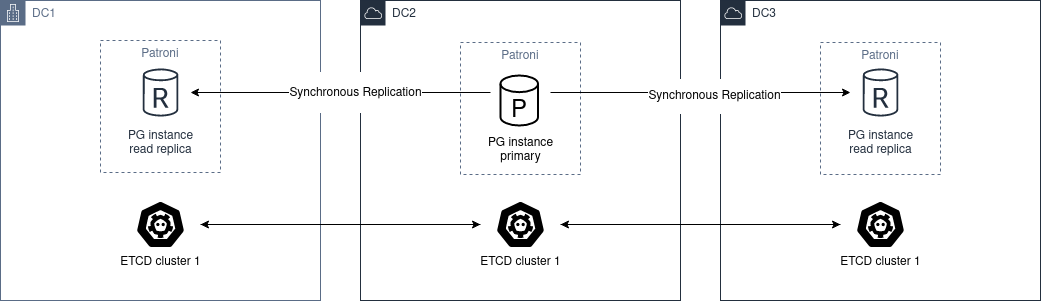
We must deploy a cluster of etcd, ZooKeeper or Consul through the different DC, with a minimum of 3 nodes, one in each zone.
Regarding postgres, we must deploy at least 2 nodes, in different DC. Then you have to set synchronous_mode: true in the global dynamic configuration.
This enables sync replication and the primary node will choose one of the nodes as synchronous.
Asynchronous Replication
With only two data centers, it is better to have two independent etcd clusters and run a Patroni standby cluster in the second data center. If the first site goes down, you can MANUALLY promote the standby_cluster.
The architecture diagram would be the following:
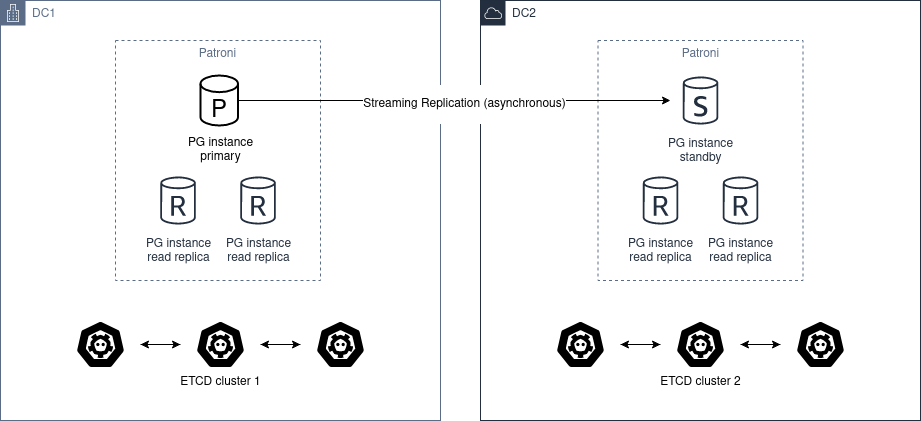
Automatic promotion is not possible, because DC2 will never able to figure out the state of DC1.
You should not use pg_ctl promote in this scenario, you need “manually promote” the healthy cluster by removing standby_cluster section from the dynamic configuration.
If the source cluster is still up and running and you promote the standby cluster you create a split-brain.
In case you want to return to the “initial” state, there are only two ways of resolving it:
- Add the standby_cluster section back and it will trigger
pg_rewind; however, forpg_rewindto function properly, either the cluster must be initialized withdata page checksums(--data-checksumsoption forinitdb) and/orwal_log_hintsmust be set toon, but there are still chances thatpg_rewindmight fail due to other factors. - Rebuild the standby cluster from scratch.
Before promoting standby cluster one have to manually ensure that the source cluster is down (STONITH). When DC1 recovers, the cluster has to be converted to a standby cluster.
Before doing that you may manually examine the database and extract all changes that happened between the time when network between DC1 and DC2 has stopped working and the time when you manually stopped the cluster in DC1.
Once extracted, you may also manually apply these changes to the cluster in DC2.
18 - FAQ
In this section you will find answers for the most frequently asked questions about Patroni. Each sub-section attempts to focus on different kinds of questions.
We hope that this helps you to clarify most of your questions. If you still have further concerns or find yourself facing an unexpected issue, please refer to chatting and reporting_bugs for instructions on how to get help or report issues.
Comparison with other HA solutions
Why does Patroni require a separate cluster of DCS nodes while other solutions like repmgr do not?
There are different ways of implementing HA solutions, each of them with their pros and cons.
Software like repmgr performs communication among the nodes to decide when actions should be taken.
Patroni on the other hand relies on the state stored in the DCS. The DCS acts as a source of truth for Patroni to decide what it should do.
While having a separate DCS cluster can make you bloat your architecture, this approach also makes it less likely for split-brain scenarios to happen in your Postgres cluster.
What is the difference between Patroni and other HA solutions in regards to Postgres management?
Patroni does not just manage the high availability of the Postgres cluster but also manages Postgres itself.
If Postgres nodes do not exist yet, it takes care of bootstrapping the primary and the standby nodes, and also manages Postgres configuration of the nodes. If the Postgres nodes already exist, Patroni will take over management of the cluster.
Besides the above, Patroni also has self-healing capabilities. In other words, if a primary node fails, Patroni will not only fail over to a replica, but also attempt to rejoin the former primary as a replica of the new primary. Similarly, if a replica fails, Patroni will attempt to rejoin that replica.
That is way we call Patroni as a “template for HA solutions”. It goes further than just managing physical replication: it manages Postgres as a whole.
DCS
Can I use the same etcd cluster to store data from two or more Patroni clusters?
Yes, you can!
Information about a Patroni cluster is stored in the DCS under a path prefixed with the namespace and scope Patroni settings.
As long as you do not have conflicting namespace and scope across different Patroni clusters, you should be able to use the same DCS cluster to store information from multiple Patroni clusters.
What occurs if I attempt to use the same combination of namespace and scope for different Patroni clusters that point to the same DCS cluster?
The second Patroni cluster that attempts to use the same namespace and scope will not be able to manage Postgres because it will find information related with that same combination in the DCS, but with an incompatible Postgres system identifier. The mismatch on the system identifier causes Patroni to abort the management of the second cluster, as it assumes that refers to a different cluster and that the user has misconfigured Patroni.
Make sure to use different namespace / scope when dealing with different Patroni clusters that share the same DCS cluster.
What occurs if I lose my DCS cluster?
The DCS is used to store basically status and the dynamic configuration of the Patroni cluster.
They very first consequence is that all the Patroni clusters that rely on that DCS will go to read-only mode – unless dcs_failsafe_mode is enabled.
What should I do if I lose my DCS cluster?
There are three possible outcomes upon losing your DCS cluster:
- The DCS cluster is fully recovered: this requires no action from the Patroni side. Once the DCS cluster is recovered, Patroni should be able to recover too;
- The DCS cluster is re-created in place, and the endpoints remain the same. No changes are required on the Patroni side;
- A new DCS cluster is created with different endpoints. You will need to update the DCS endpoints in the Patroni configuration of each Patroni node.
If you face scenario 2. or 3. Patroni will take care of creating the status information again based on the current status of the cluster, and recreate the dynamic configuration on the DCS based on a backup file named patroni.dynamic.json which is stored inside the Postgres data directory of each member of the Patroni cluster.
What occurs if I lose majority in my DCS cluster?
The DCS will become unresponsive, which will cause Patroni to demote the current read/write Postgres node.
Remember: Patroni relies on the state of the DCS to take actions on the cluster.
You can use the dcs_failsafe_mode to alleviate that situation.
patronictl
Do I need to run patronictl in the Patroni host?
No, you do not need to do that.
Running patronictl in the Patroni host is handy if you have access to the Patroni host because you can use the very same configuration file from the patroni agent for the patronictl application.
However, patronictl is basically a client and it can be executed from remote machines. You just need to provide it with enough configuration so it can reach the DCS and the REST API of the Patroni member(s).
Why did the information from one of my Patroni members disappear from the output of patronictl_list command?
Information shown by patronictl_list is based on the contents of the DCS.
If information about a member disappeared from the DCS it is very likely that the Patroni agent on that node is not running anymore, or it is not able to communicate with the DCS.
As the member is not able to update the information, the information eventually expires from the DCS, and consequently the member is not shown anymore in the output of patronictl_list.
Why is the information about one of my Patroni members not up-to-date in the output of patronictl_list command?
Information shown by patronictl_list is based on the contents of the DCS.
By default, that information is updated by Patroni roughly every loop_wait seconds. In other words, even if everything is normally functional you may still see a “delay” of up to loop_wait seconds in the information stored in the DCS.
Be aware that this is not a rule, though. Some operations performed by Patroni cause it to immediately update the DCS information.
Configuration
What is the difference between dynamic configuration and local configuration?
Dynamic configuration (or global configuration) is the configuration stored in the DCS, and which is applied to all members of the Patroni cluster. This is primarily where you should store your configuration.
Settings that are specific to a node, or settings that you would like to overwrite the global configuration with, you should set only on the desired Patroni member as a local configuration. That local configuration can be specified either through the configuration file or through environment variables.
See more in config.
What are the types of configuration in Patroni, and what is the precedence?
The types are:
- Dynamic configuration: applied to all members;
- Local configuration: applied to the local member, overrides dynamic configuration;
- Environment configuration: applied to the local member, overrides both dynamic and local configuration.
Note: some Postgres GUCs can only be set globally, i.e., through dynamic configuration. Besides that, there are GUCs which Patroni enforces a hard-coded value.
See more in config.
Is there any facility to help me create my Patroni configuration file?
Yes, there is.
You can use patroni --generate-sample-config or patroni --generate-config commands to generate a sample Patroni configuration or a Patroni configuration based on an existing Postgres instance, respectively.
Please refer to generate_sample_config and generate_config for more details.
I changed my parameters under bootstrap.dcs configuration but Patroni is not applying the changes to the cluster members. What is wrong?
The values configured under bootstrap.dcs are only used when bootstrapping a fresh cluster. Those values will be written to the DCS during the bootstrap.
After the bootstrap phase finishes, you will only be able to change the dynamic configuration through the DCS.
Refer to the next question for more details.
How can I change my dynamic configuration?
You need to change the configuration in the DCS. That is accomplished either through:
- patronictl_edit_config; or
- A
PATCHrequest to config_endpoint.
How can I change my local configuration?
You need to change the configuration file of the corresponding Patroni member and signal the Patroni agent with SIHGUP. You can do that using either of these approaches:
-
Send a
POSTrequest to the REST API reload_endpoint; or -
Run patronictl_reload; or
-
Locally signal the Patroni process with
SIGHUP:- If you started Patroni through systemd, you can use the command
systemctl reload PATRONI_UNIT.service,PATRONI_UNITbeing the name of the Patroni service; or - If you started Patroni through other means, you will need to identify the
patroniprocess and runkill -s HUP PID,PIDbeing the process ID of thepatroniprocess.
- If you started Patroni through systemd, you can use the command
Note: there are cases where a reload through the patronictl_reload may not work:
- Expired REST API certificates: you can mitigate that by using the
-koption of the patronictl; - Wrong credentials: for example when changing
restapiorctlcredentials in the configuration file, and using that same configuration file for Patroni and patronictl.
How can I change my environment configuration?
The environment configuration is only read by Patroni during startup.
With that in mind, if you change the environment configuration you will need to restart the corresponding Patroni agent.
Take care to not cause a failover in the cluster! You might be interested in checking patronictl_pause.
How can I reduce repetitive heartbeat log lines during normal operation?
If your logs are too noisy because of repeated lines like Lock owner: ... and no action. I am ..., configure log.deduplicate_heartbeat_logs: true.
You can set it either in the Patroni YAML file (log settings) or with PATRONI_LOG_DEDUPLICATE_HEARTBEAT_LOGS=true.
Keep in mind this reduces log volume by suppressing repeated heartbeat messages, but you also lose per-loop heartbeat visibility that can help during failover diagnostics.
What occurs if I change a Postgres GUC that requires a reload?
When you change the dynamic or the local configuration as explained in the previous questions, Patroni will take care of reloading the Postgres configuration for you.
What occurs if I change a Postgres GUC that requires a restart?
Patroni will mark the affected members with a flag of pending restart.
It is up to you to determine when and how to restart the members. That can be accomplished either through:
- patronictl_restart; or
- A
POSTrequest to restart_endpoint.
Note: some Postgres GUCs require a special management in terms of the order for restarting the Postgres nodes. Refer to shared_memory_gucs for more details.
What is the difference between etcd and etcd3 in Patroni configuration?
etcd uses the API version 2 of etcd, while etcd3 uses the API version 3 of etcd.
Be aware that information stored by the API version 2 is not manageable by API version 3 and vice-versa.
We recommend that you configure etcd3 instead of etcd because:
- API version 2 is disabled by default from Etcd v3.4 onward;
- API version 2 will be completely removed on Etcd v3.6.
I have use_slots enabled in my Patroni configuration, but when a cluster member goes offline for some time, the replication slot used by that member is dropped on the upstream node. What can I do to avoid that issue?
There are two options:
- You can tune
member_slots_ttl(default value30min, available since Patroni4.0.0and PostgreSQL 11 onwards) and replication slots for absent members will not be removed when the members downtime is shorter than the configured threshold. - You can configure permanent physical replication slots for the members.
Since Patroni 3.2.0 it is now possible to have member slots as permanent slots managed by Patroni.
Patroni will create the permanent physical slots on all nodes, and make sure to not remove the slots, as well as to advance the slots’ LSN on all nodes according to the LSN that has been consumed by the member.
Later, if you decide to remove the corresponding member, it’s your responsibility to adjust the permanent slots configuration, otherwise Patroni will keep the slots around forever.
Note: on Patroni older than 3.2.0 you could still have member slots configured as permanent physical slots, however they would be managed only on the current leader. That is, in case of failover/switchover these slots would be created on the new leader, but that wouldn’t guarantee that it had all WAL segments for the absent node.
Note: even with Patroni 3.2.0 there might be a small race condition. In the very beginning, when the slot is created on the replica it could be ahead of the same slot on the leader and in case if nobody is consuming the slot there is still a chance that some files could be missing after failover. With that in mind, it is recommended that you configure continuous archiving, which makes it possible to restore required WALs or perform PITR.
What is the difference between loop_wait, retry_timeout and ttl?
Patroni performs what we call a HA cycle from time to time. On each HA cycle it takes care of performing a series of checks on the cluster to determine its healthiness, and depending on the status it may take actions, like failing over to a standby.
loop_wait determines for how long, in seconds, Patroni should sleep before performing a new cycle of HA checks.
retry_timeout sets the timeout for retry operations on the DCS and on Postgres. For example: if the DCS is unresponsive for more than retry_timeout seconds, Patroni might demote the primary node as a security action.
ttl sets the lease time on the leader lock in the DCS. If the current leader of the cluster is not able to renew the lease during its HA cycles for longer than ttl, then the lease will expire and that will trigger a leader race in the cluster.
Note: when modifying these settings, please keep in mind that Patroni enforces the rule and minimal values described in dynamic section of the docs.
Postgres management
Can I change Postgres GUCs directly in Postgres configuration?
You can, but you should avoid that.
Postgres configuration is managed by Patroni, and attempts to edit the configuration files may end up being frustrated by Patroni as it may eventually overwrite them.
There are a few options available to overcome the management performed by Patroni:
- Change Postgres GUCs through
$PGDATA/postgresql.base.conf; or - Define a
postgresql.custom_confwhich will be used instead ofpostgresql.base.confso you can manage that externally; or - Change GUCs using
ALTER SYSTEM/ALTER DATABASE/ALTER USER.
You can find more information about that in the section important_configuration_rules.
In any case we recommend that you manage all the Postgres configuration through Patroni. That will centralize the management and make it easier to debug Patroni when needed.
Can I restart Postgres nodes directly?
No, you should not attempt to manage Postgres directly!
Any attempt of bouncing the Postgres server without Patroni can lead your cluster to face failovers.
If you need to manage the Postgres server, do that through the ways exposed by Patroni.
Is Patroni able to take over management of an already existing Postgres cluster?
Yes, it can!
Please refer to existing_data for detailed instructions.
How does Patroni manage Postgres?
Patroni takes care of bringing Postgres up and down by running the Postgres binaries, like pg_ctl and postgres.
With that in mind you MUST disable any other sources that could manage the Postgres clusters, like the systemd units, e.g. postgresql.service. Only Patroni should be able to start, stop and promote Postgres instances in the cluster. Not doing so may result in split-brain scenarios. For example: if the node running as a primary failed and the unit postgresql.service is enabled, it may bring Postgres back up and cause a split-brain.
Concepts and requirements
Which are the applications that make part of Patroni?
Patroni basically ships a couple applications:
patroni: This is the Patroni agent, which takes care of managing a Postgres node;- patronictl: This is a command-line utility used to interact with a Patroni cluster (perform switchovers, restarts, changes in the configuration, etc.). Please find more information in patronictl.
What is a standby cluster in Patroni?
It is a cluster that does not have any primary Postgres node running, i.e., there is no read/write member in the cluster.
These kinds of clusters exist to replicate data from another cluster and are usually useful when you want to replicate data across data centers.
There will be a leader in the cluster which will be a standby in charge of replicating changes from a remote Postgres node. Then, there will be a set of standbys configured with cascading replication from such leader member.
Note: the standby cluster doesn’t know anything about the source cluster which it is replicating from – it can even use restore_command instead of WAL streaming, and may use an absolutely independent DCS cluster.
Refer to standby_cluster for more details.
What is a leader in Patroni?
A leader in Patroni is like a coordinator of the cluster.
In a regular Patroni cluster, the leader will be the read/write node.
In a standby Patroni cluster, the leader (AKA standby leader) will be in charge of replicating from a remote Postgres node, and cascading those changes to the other members of the standby cluster.
Does Patroni require a minimum number of Postgres nodes in the cluster?
No, you can run Patroni with any number of Postgres nodes.
Remember: Patroni is decoupled from the DCS.
What does pause mean in Patroni?
Pause is an operation exposed by Patroni so the user can ask Patroni to step back in regards to Postgres management.
That is mainly useful when you want to perform maintenance on the cluster, and would like to avoid that Patroni takes decisions related with HA, like failing over to a standby when you stop the primary.
You can find more information about that in pause.
Automatic failover
How does the automatic failover mechanism of Patroni work?
Patroni automatic failover is based on what we call leader race.
Patroni stores the cluster’s status in the DCS, among them a leader lock which holds the name of the Patroni member which is the current leader of the cluster.
That leader lock has a time-to-live associated with it. If the leader node fails to update the lease of the leader lock in time, the key will eventually expire from the DCS.
When the leader lock expires, it triggers what Patroni calls a leader race: all nodes start performing checks to determine if they are the best candidates for taking over the leader role. Some of these checks include calls to the REST API of all other Patroni members.
All Patroni members that find themselves as the best candidate for taking over the leader lock will attempt to do so. The first Patroni member that is able to take the leader lock will promote itself to a read/write node (or standby leader), and the others will be configured to follow it.
Can I temporarily disable automatic failover in the Patroni cluster?
Yes, you can!
You can achieve that by temporarily pausing the cluster. This is typically useful for performing maintenance.
When you want to resume the automatic failover of the cluster, you just need to unpause it.
You can find more information about that in pause.
Bootstrapping and standbys creation
How does Patroni create a primary Postgres node? What about a standby Postgres node?
By default Patroni will use initdb to bootstrap a fresh cluster, and pg_basebackup to create standby nodes from a copy of the leader member.
You can customize that behavior by writing your custom bootstrap methods, and your custom replica creation methods.
Custom methods are usually useful when you want to restore backups created by backup tools like pgBackRest or Barman, for example.
For detailed information please refer to custom_bootstrap and custom_replica_creation.
Monitoring
How can I monitor my Patroni cluster?
Patroni exposes a couple handy endpoints in its rest_api:
/metrics: exposes monitoring metrics in a format that can be consumed by Prometheus;/patroni: exposes the status of the cluster in a JSON format. The information shown here is very similar to what is shown by the/metricsendpoint.
You can use those endpoints to implement monitoring checks.
19 - Release notes
Source: https://patroni.readthedocs.io/en/latest/releases.html
Version 4.1.5
Released 2026-08-12
Compatibility improvements
-
Compatibility with PostgreSQL 14.24, 15.19, 16.15, 17.11, 18.6 (Alexander Kukushkin)
Add the new
output_plugin_librariesGUC, which restricts logical decoding output plugins.
Improvements
-
Log REST API connection resets at
DEBUGinstead ofWARNING(Kyle McLaren)Ensure the common “client went away mid-write” variants are silenced without affecting the handling of genuine (non-connection) errors.
Bugfixes
-
Fix
thread_stack_sizevalidation alignment (Sundong Kim)Correct the
alignedvalue from65535to65536in thethread_stack_sizeschema entry. Previously,patroni --validate-configrejected almost every realistic value, including the524288default applied by the daemon itself. -
Allow validation of
synchronous_modeto accept'quorum'and boolean-like strings (Eray Araz)patroni --validate-configpreviously rejectedsynchronous_modevalues such asquorumand the PostgreSQL-style boolean strings that are accepted at runtime.
Version 4.1.4
Released 2026-07-07
Bugfixes
-
Check
NOTIFY_SOCKETenvironment variable before usingsystemdpackage (Polina Bungina)Only try to import and use the package when the
NOTIFY_SOCKETenvironment variable is set to avoidFileNotFoundError: [Errno 2] No such file or directoryexception. -
Unify
pg_replication_slotsquery (Polina Bungina)Incorrect handling of the
failoverandsyncedvalues was resulting inKeyErrorexceptions during removal of the incorrect logical replication slots. -
Consider version-specific authentication parameters in configuration generation (Polina Bungina)
In the
patroni --generate-configcommand, remove all inapplicable authentication parameters that were accidentally picked up from the environment, based on the version retrieved from a PostgreSQL connection. -
Handle
pg_rewindwhile a PostgreSQL instance is starting as a standby (Alexander Kukushkin)Fallback to
pg_controldatainformation when a PostgreSQL instance is running but is not yet accepting connections. -
Fix Prometheus metric type for
patroni_postgres_timeline(Huseyin Demir)Declare the
patroni_postgres_timelinemetric asgaugeinstead ofcounter, as it is not always monotonically increasing (e.g., it can be reset to 0 if a PostgreSQL instance is not running). -
Don’t stop watchdog until client backends are fully stopped (Alexander Kukushkin)
Previously, if
primary_stop_timeoutwas shorter than the minimum watchdog timeout, and the stop timeout actually expired, Patroni disabled the watchdog before all client backends had exited. -
Handle statement timeout error for monitoring query (Alexander Kukushkin)
In case of a statement timeout error, use the cached role as a fallback to avoid demoting the primary. Additionally, forcibly set
pg_stat_statements.tracktononefor the monitoring query to avoid expensivepg_stat_statementsGC calls. -
Drop Patroni-managed replication slots with
wal_status=lost(Alexander Kukushkin)Replication slots with
wal_status=lostare no longer usable. Patroni will now drop such slots and recreate them if needed. -
Fix role representation in patronictl member validation error (Polina Bungina)
Ensures the correct string representation is used within the exception message, preventing errors from being formatted like
Error: No CtlPostgresqlRole.REPLICA among provided members.
Version 4.1.3
Released 2026-05-05
Stability improvements
-
Properly handle mislabeled Etcd error (Ants Aasma)
Current Etcd versions raise
Unknownerror when Etcd leader is lost while updating the lease. Patroni will now override the reported error code toUnavailable.
Bugfixes
-
Use binary version when
PG_VERSIONfile does not exist (Polina Bungina)In some cases, for example when using custom bootstrap, the
PG_VERSIONfile may not be present in the data directory. In this case, Patroni was treating the version as 0.0, which was causing issues with some of the version-specific logic. With this fix, Patroni will try to get the version from the binary in such cases. -
Refactor logger initialization to avoid missing early log messages (Alexander Kukushkin)
Create
PatroniLoggerbefore loadingConfigto capture early log messages. -
Include
MONOTONIC_USECinRELOADING=1systemd notification (Alexander Kukushkin)systemd 257+ requires
MONOTONIC_USECalongsideRELOADING=1forType=notify-reloadservices. Without it,systemctl reloadhangs indefinitely.
Improvements
-
Skip single-user crash recovery when
backup_labelexists (Vadim Ponomarev)Skip single-user crash recovery and let PostgreSQL handle it during normal startup when starting a replica restored from an external backup (not using a custom bootstrap method).
-
Warn when running under
systemdwithoutpython-systemdpackage (Alexander Kukushkin)Instead of logging “systemd integration is not supported” at startup, check for
NOTIFY_SOCKETand warn only when actually running undersystemdwithout thepython-systemdpackage installed.
Version 4.1.2
Released 2026-04-21
Systemd support improvements
-
Add support for
notify-reloadsystemd unit type (Ronan Dunklau)Allows
systemctl reloadto wait until Patroni has actually processed the configuration reload by sendingRELOADING=1andREADY=1notifications to systemd. -
Send
STOPPING=1notification to systemd on shutdown (Alexander Kukushkin)Patroni now properly notifies systemd that it is shutting down, following the systemd notify protocol.
-
Do not let PostgreSQL to notify systemd (Alexander Kukushkin)
Remove
NotifyAccess=allfrom the example systemd unit file. FilterNOTIFY_SOCKETfrom the environment when starting PostgreSQL so it doesn’t sendREADY=1orSTOPPING=1to systemd. When taking over a PostgreSQL that was started before Patroni and already hasNOTIFY_SOCKET, re-assertREADY=1during PostgreSQL shutdown to counteract itsSTOPPING=1.
Version 4.1.1
Released 2026-04-08
Stability improvements
-
Compatibility with threading changes in python 3.11+ (Alexander Kukushkin)
Avoid starting/stopping threads at runtime. Introduce thread pools for REST API and for executing async tasks. Allow configuring global
thread_pool_sizeandrestapi.thread_pool_size. -
Compatibility with python 3.14 (Alexander Kukushkin)
Run tests against python 3.14 and fix compatibility issues.
-
Compatibility with Etcd security fixes in v3.6.9, v3.5.28, and v3.4.42 (Alexander Kukushkin)
These Etcd releases addressed CVEs and changed behavior so cluster topology reads and lease keepalive are no longer allowed without authentication. Patroni now handles this by authenticating in member-discovery and lease-keepalive paths, re-authenticating on auth failures, and retrying requests accordingly.
-
Improvements for Etcd3 error handling (Alexander Kukushkin)
Handle broken JSON responses, be flexible in how JSON error is parsed, and improve reporting for etcd internal errors.
Bugfixes
-
Retry leader update on temporary Kubernetes
403error (Sophia Ruan, Alexander Kukushkin)When the Kubernetes API temporarily returns
403 Permission Denied(for example during transient RBAC issues), Patroni now verifies whether the current node still holds leadership and retries the leader update withinretry_timeoutinstead of immediately demoting. -
Fix issue with renaming leader node in sync mode and pause (Alexander Kukushkin)
/synckey wasn’t updated after renaming the leader node with Patroni restart in pause (without Postgres restart). It prevented Patroni from promoting after the next restart without pause. -
Trigger
pg_rewindcheck when the same primary increased timeline (Alexander Kukushkin)Such timeline increase may happen as a result of crash recovery in a single-user mode plus promote after taking a leader key while other replica nodes are isolated from DCS. In this case replica nodes didn’t trigger
pg_rewindstate machine because the leader and thereforeprimary_conninfodidn’t change. -
Only write superuser password during
initdbbootstrap if it is non-empty (Michael Banck)Writing an empty password during
initdbbootstrap was causing issues. -
Fix bug with
failover_prioritywithsynchronous_mode=on(Alexander Kukushkin)tag.failover_priorityvalues were ignored whensynchronous_node_count > 1. -
Fix bug with
primary_conninfopassword comparison (Alexander Kukushkin)Starting from PostgreSQL 10, Patroni uses passfile in
primary_conninfoand failed to update the passfile after the replication password was updated in yaml-file configuration with reload. -
Don’t restart replica with
nofailovertag in pause mode (Alexander Kukushkin)Patroni used to start a manually shut down PostgreSQL replica in pause mode when it had
nofailovertag set totrue. -
Fix
check_recovery_conf()when PostgreSQL is in the starting state (Alexander Kukushkin)For PostgreSQL v12 and newer,
pg_settingscannot be queried while the server is still starting and not yet accepting connections. Missing recovery parameters are now added to the internal state when writingpostgresql.conf. Additionally, restore thePostgresql.is_starting()check inHa.is_healthiest_node(). -
Validate user options in dictionary format for
initdb/basebackup(m4rrypro)When
initdborbasebackupoptions were provided as a dictionary (instead of a list), theoption_is_allowed()validation was bypassed, allowing blocked options to be used. -
Allow server-side compression for
basebackupoption (m4rrypro)The
compressoption was completely blocked forbasebackup, but since PostgreSQL 15, server-side compression is useful and works transparently with plain format. Client-side compression is still rejected. -
Don’t reload PostgreSQL config while running custom bootstrap (Alexander Kukushkin)
Custom bootstrap could be complex and involve PostgreSQL starting and stopping multiple times. Reloads of PostgreSQL config during this process could lead to unexpected behavior.
-
Check that
postgresql.parametersis a dictionary (Alexander Kukushkin)Discard new config if
postgresql.parametersis not a dictionary.
Version 4.1.0
Released 2025-09-23
New features
-
Add support for systemd “notify” unit type (Ronan Dunklau)
Without a notify unit type, it is possible to start Patroni and immediately send it a SIGHUP signal using systemd, effectively killing it before it had time to set up its signal handlers.
-
Provide receive and replay LSN/lag information in API and ctl (Polina Bungina)
Patroni REST API
/clusterendpoint andpatronictl listcommand now provide receive LSN, replay LSN, receive lag, and replay lag information for each replica member. -
Ensure clean demotion to standby cluster (Polina Bungina)
Make sure the introduction of the standby_cluster section in the dynamic configuration leads to a clean cluster demotion.
-
Implement
patronictl demote-clusterandpromote-clustercommands (Polina Bungina)New commands for cluster demotion and promotion handle both the dynamic configuration editing and checking the result status.
-
Implement
sync_prioritytag (Polina Bungina)This parameter controls the priority a member should have during synchronous replica selection when synchronous_mode is set to
on. -
Implement
--printoption for--validate-config(Polina Bungina)Print out local configuration (including environment configuration overrides) after it has been successfully validated.
-
Implement
kubernetes.bootstrap_labels(Polina Bungina)This feature allows you to define labels that will be assigned to a member pod when in
initializing new cluster,running custom bootstrap script,starting after custom bootstrap, orcreating replicastate. -
Add configuration option to suppress duplicate heartbeat logs (Michael Morris)
If set to
true, successive heartbeat logs that are identical shall not be output. -
Add optional
cluster_typeattribute to permanent replication slots (Michael Banck)This allows you to set whether a particular permanent replication slot should always be created, or just on a primary or standby cluster.
-
Make HTTP Server header configurable (David Grierson)
Introduce the
restapi.server_tokensconfiguration parameter that allows you to restrict information disclosed in the HTTP Server header. -
Implement readiness API checks for replication on replica members (Ants Aasma)
The previous implementation considered replicas ready as soon as PostgreSQL was started. With this change, a replica pod is only considered ready when PostgreSQL is replicating and is not too far behind the leader.
Improvements
-
Reduce log level of watchdog configuration failure (Ants Aasma)
Show the
Could not activate Linux watchdog devicelog line on debug logging level, unless the watchdog is configured withrequiredmode. It was previously shown on info level. -
Take advantage of
written_lsnandlatest_end_lsnfrompg_stat_wal_receiver(Alexander Kukushkin)written_lsn, the actual write LSN, is now preferred over the one returned bypg_last_wal_receive_lsn(), which is in fact the flush LSN.latest_end_lsnpoints to WAL flush on the source host. In case of a primary, it allows better calculation of the replay lag, because values stored in DCS are updated only everyloop_waitseconds. -
Avoid interactions with slots created with the
failover=trueoption (Alexander Kukushkin)This change is required to make the logical failover slots feature fully functional.
-
Add PostgreSQL state to
/metricsREST API endpoint (Ivan Filianin)PostgreSQL instance state information is now available in the Prometheus format output of the
/metricsREST API endpoint.
Version 4.0.7
Released 2025-09-22
New features
-
Add support for PostgreSQL 18 RC1 (Alexander Kukushkin)
GUC’s validator rules were extended. Patroni now properly handles the new background I/O worker.
Bugfixes
-
Fix potential issue around resolving localhost to IPv6 on Windows (András Váczi)
When configuring
listen_addressesin PostgreSQL, using0.0.0.0or127.0.0.1will restrict listening to IPv4 only, excluding IPv6. On typical Windows systems, however,localhostoften resolves to the IPv6 address::1by default. To ensure compatibility, Patroni now configures PostgreSQL to listen on127.0.0.1, instead oflocalhost, on Windows systems. -
Return global config only when
/configkey exists in DCS (Alexander Kukushkin)Patroni REST API was returning an empty configuration instead of raising an error if the
/configkey was missing in DCS. -
Fix the issue of failsafe mode not being triggered in case of Etcd unavailability (Alexander Kukushkin)
Patroni was not always properly handling
etcd3exceptions, which resulted in failsafe mode not being triggered. -
Fix signal handler reentrancy deadlock (Waynerv)
Patroni running in a Docker container with
PID=1in some special cases was experiencing deadlock after receivingSIGCHLD. -
Recreate (permanent) physical slot when it doesn’t reserve WAL (Israel Barth Rubio)
Permanent physical replication slots created outside of Patroni scope without reserving WALs were causing a
replication slot cannot be advancederror. To avoid this, Patroni now recreates such slots. -
Handle watch cancellation messages in
etcd3properly (Alexander Kukushkin)When
etcd3sends a cancellation message to the watch channel, it doesn’t close the connection. This results in Patroni using stale data. Patroni now solves it by breaking a loop of reading chunked response and closing the connection on the Patroni side. -
Handle case when
HTTPConnectionsocket is wrapped withpyopenssl(Alexander Kukushkin)Patroni was not correctly using
pyopensslinterfaces, enforced inpython-etcd.
Documentation improvements
-
Improve 2-node cluster guidance (Nikolay Samokhvalov)
Clarify behaviour during failover and DCS requirements.
Version 4.0.6
Released 2025-06-06
Bugfixes
-
Fix bug in failover from a leader with a higher priority (Alexander Kukushkin)
Make sure Patroni ignores the former leader with higher priority when it reports the same
LSNas the current node. -
Fix permissions for the
postgresql.conffile created outside ofPGDATA(Michael Banck)Respect the system-wide umask value when creating the
postgresql.conffile outside of thePGDATAdirectory. -
Fix bug with switchover in
synchronous_mode=quorum(Alexander Kukushkin)Do not check quorum requirements when a candidate is specified.
-
Ignore stale Etcd nodes by comparing cluster term (Alexander Kukushkin)
Memorize the last known “raft_term” of the Etcd cluster, and when executing client requests, compare it with the “raft_term” reported by an Etcd node.
-
Update PostgreSQL configuration files on
SIGHUP(Alexander Kukushkin)Previously, Patroni was only replacing PostgreSQL configuration files if a change in global or local configuration was detected.
-
Properly handle
Unavailableexception raised byetcd3(Alexander Kukushkin)Patroni used to retry such requests on the same
etcd3node, while switching to another node is a better strategy. -
Improve
etcd3lease handling (Alexander Kukushkin)Make sure Patroni refreshes the
etcd3lease at least once per HA loop. -
Recheck annotations on 409 status code when attempting to acquire leader lock (Alexander Kukushkin)
Implement the same behavior as was done for the leader object read in Patroni version 4.0.3.
-
Consider
replay_lsnwhen advancing slots (Polina Bungina)Do not try to advance slots on replicas past the
replay_lsn. Additionally, advance the slot to thereplay_lsnposition if it is already past theconfirmed_flush_lsnof this slot on the replica but the replica has still not replayed the actualLSNat which this slot is on the primary. -
Make sure
CHECKPOINTis executed after promote (Alexander Kukushkin)It was possible that checkpoint task wasn’t reset on demote because
CHECKPOINTwasn’t yet finished. This resulted in using a staleresultwhen the next promote is triggered. -
Avoid running “offline” demotion concurrently (Alexander Kukushkin)
In case of a slow shutdown, it might happen that the next heartbeat loop hits the DCS error handling method again, resulting in
AsyncExecutor is busy, demoting from the main threadwarning and starting offline demotion again. -
Normalize the
data_dirvalue before renaming the data directory on initialization failure (Waynerv)Prevent a trailing slash in the
data_dirparameter value from breaking the renaming process after an initialization failure. -
Check that
synchronous_standby_namescontains the expected value (Alexander Kukushkin)Previously, the mechanism implementing the state machine for non-quorum synchronous replication didn’t check the actual value of
synchronous_standby_names, what resulted in a stale value ofsynchronous_standby_namesbeing used whenpg_stat_replicationis a subset ofsynchronous_standby_names.
Version 4.0.5
Released 2025-02-20
Stability improvements
-
Compatibility with
python-json-logger>=3.1(Alexander Kukushkin)Get rid of the warnings produced by the old API usage.
-
Compatibility with Python 3.13 (Alexander Kukushkin)
Run tests against Python 3.13.
-
Compatibility with
pyinstaller>=4.4(Joe Jensen)Fall back to the default
iter_modulesifpyinstallertocattribute is not present. -
Fix issues with PostgreSQL 9.5 support (Alexander Kukushkin)
- Properly handle
pg_rewindoutput format. - Consider
synchronous_standby_namesformat not supporting “num” specification.
- Properly handle
-
Compatibility with the latest changes in
urlparse(Alexander Kukushkin)urlparsedoesn’t accept multiple hosts with[]character in URL anymore. To mitigate the problem, switch to the native wrappers ofPQconninfoParse()fromlibpq, when it is possible, and use our implementation only for olderpsycopg2versions that are linked with an outdated version oflibpq.
Bugfixes
-
Show only the members to be restarted upon restart confirmation (András Váczi)
Previously, when doing
patronictl restart <clustername> --pending, the confirmation listed all members, regardless of whether their restart is pending. -
Cancel long-running jobs on Patroni stop and remove data directory on replica bootstrap failure (Alexander Kukushkin)
Previously, Patroni could be doing replica bootstrap, while
pg_basebackup/wal-g/pgBackRest/barmanor similar keep running. -
Properly handle cluster names with a slash in
patronictl edit-config(Antoni Mur)Replace a forward slash in
cluster_namewith an underscore. -
Avoid dropping physical slots too early (Alexander Kukushkin)
Postpone removal of physical replication slots containing
xminafter a failover: on the new primary – until this member is promoted, on replicas – until there is a leader in the cluster. -
Handle all exceptions raised by subprocess in
controldata()(Alexander Kukushkin)Patroni was not properly handling all exceptions possibly raised when calling
pg_controldatautility. -
Fix bug with a slot for a former leader not retained on failover (Alexander Kukushkin)
Avoid falsely relying on members being present in DCS, while on failover
/memberkey for the former leader is expiring exactly at the same time. -
Fix a couple of bugs in the quorum state machine (Alexander Kukushkin)
- When evaluating whether there are healthy nodes for a leader race, before demoting we need to take into account quorum requirements. Without it, the former leader may end up in recovery surrounded by asynchronous nodes.
QuorumStateResolverwasn’t correctly handling the case when a replica node quickly joined and disconnected.
Improvements
-
Improve error on am empty or non-dictionary configuration file (Julian)
Throw a more explicit exception when validating if Patroni configuration file contains a valid
Mappingobject.
Version 4.0.4
Released 2024-11-22
Stability improvements
-
Add compatibility with the
py-consulmodule (Alexander Kukushkin)python-consulmodule is unmaintained for a long time, whilepy-consulis the official replacement. Backward compatibility with python-consul is retained. -
Add compatibility with the
prettytable>=3.12.0module (Alexander Kukushkin)Address deprecation warnings.
-
Compatibility with the
ydiff==1.4.2module (Alexander Kukushkin)Fix compatibility issues for the latest version, constrain version in
requirements.txt, and introduce latest version compatibility test.
Bugfixes
-
Run
on_role_changecallback after a failed primary recovery (Polina Bungina, Alexander Kukushkin)Additionally run
on_role_changecallback for a primary that failed to start after a crash to increase chances the callback is executed, even if the further start as a replica fails. -
Fix a thread leak in
patronictl list -W(Alexander Kukushkin)Cache DCS instance object to avoid thread leak.
-
Ensure only supported parameters are written to the connection string (Alexander Kukushkin)
Patroni used to pass parameters introduced in newer versions to the connection string, which had been leading to connection errors.
Version 4.0.3
Released 2024-10-18
Bugfixes
-
Disable
pgauditwhen creating users not to expose password (kviset)Patroni was logging
superuser,replication, andrewindpasswords on their creation whenpgauditextension was enabled. -
Fix issue with mixed setups: primary on pre-Patroni v4 and replicas on v4+ (Alexander Kukushkin)
Use
xlog_locationextracted from/memberskey instead of trying to get a member’s slot position from/statuskey if Patroni version running on the leader is pre-4.0.0. Not doing so has been causing WALs accumulation on replicas. -
Do not ignore valid PostgreSQL GUCs that don’t have Patroni validator (Polina Bungina)
Still check against
postgres --describe-configif a GUC does not have a Patroni validator but is, in fact, a valid GUC.
Improvements
-
Recheck annotations on 409 status code when reading leader object in K8s (Alexander Kukushkin)
Avoid an additional update if
PATCHrequest was canceled by Patroni, while the request successfully updated the target. -
Add support of
sslnegotiationclient-side connection option (Alexander Kukushkin)sslnegotiationwas added to the final PostgreSQL 17 release.
Version 4.0.2
Released 2024-09-17
Bugfixes
-
Handle exceptions while discovering configuration validation files (Alexander Kukushkin)
Skip directories for which Patroni does not have sufficient permissions to perform list operations.
-
Make sure inactive hot physical replication slots don’t hold
xmin(Alexander Kukushkin, Polina Bungina)Since version 3.2.0 Patroni creates physical replication slots for all members on replicas and periodically moves them forward using
pg_replication_slot_advance()function. However if for any reasonhot_standby_feedbackis enabled and the primary is demoted to replica, the now inactive slots haveNOT NULLxminvalue propagated back to the new primary. This results inxminhorizon not being moved forward and vacuum not being able to clean up dead tuples. With this fix, Patroni recreates the physical replication slots that are supposed to be inactive but haveNOT NULLxminvalue. -
Fix unhandled
DCSErrorduring the startup phase (Waynerv)Ensure DCS connectivity before trying to check the uniqueness of the node name.
-
Explicitly include
CMDLINE_OPTIONSGUCs when queryingpg_settings(Alexander Kukushkin)Make sure all GUCs that are passed to postmaster as command line parameters are restored when Patroni is joining a running standby. This is a follow-up for the bug fixed in Patroni 3.2.2.
-
Fix bug in
synchronous_standby_namesquoting logic (Alexander Kukushkin)According to PostgreSQL documentation,
ANYandFIRSTkeywords are supposed to be double-quoted, which Patroni did not do before. -
Fix keepalive connection out-of-range issue (hadizamani021)
Ensure that
keepaliveoption value calculated based on thettlset does not exceed the maximum allowed value for the current platform.
Version 4.0.1
Released 2024-08-30
Bugfix
-
Patroni was creating unnecessary replication slots for itself (Alexander Kukushkin)
It was happening if
namecontains upper-case or special characters.
Version 4.0.0
Released 2024-08-29
- This version completes work on getting rid of the “master” term, in favor of “primary”. This means a couple of breaking changes, please read the release notes carefully. Upgrading to the Patroni 4+ will work reliably only if you run Patroni 3.1.0 or newer. Upgrading from an older version directly to 4+ is possible but may lead to unexpected behavior if the primary fails while the rest of the nodes are running on other Patroni versions.
Breaking changes
- The following breaking changes were introduced when getting rid of the non-inclusive “master” term in the Patroni code:
- On Kubernetes, Patroni by default will set
rolelabel toprimary. In case if you want to keep the old behavior and avoid downtime or lengthy complex migrations, you can configure parameterskubernetes.leader_label_valueandkubernetes.standby_leader_label_valuetomaster. Read more here. - Patroni role is written to DCS as
primaryinstead ofmaster. - Patroni role returned by Patroni REST API has been changed from
mastertoprimary. - Patroni REST API no longer accepts
role=masterin requests to/switchover,/failover,/restartendpoints. /metricsREST API endpoint will no longer reportpatroni_mastermetric.- patronictl no longer accepts
--masteroption for any command.--leaderor--primaryoptions should be used instead. no_masteroption in the declarative configuration of custom replica creation methods is no longer treated as a special option, please useno_leaderinstead.patroni_wale_restorescript doesn’t accept--no_masteroption anymore.patroni_barmanscript doesn’t accept--role=masteroption anymore.- All callback scripts are executed with
role=primaryoption passed instead ofrole=master.
- On Kubernetes, Patroni by default will set
patronictl failoverdoes not accept--leaderoption that was deprecated since Patroni 3.2.0.- User creation functionality (
bootstrap.usersconfiguration section) deprecated since Patroni 3.2.0 has been removed.
New features
-
Quorum-based failover (Ants Aasma, Alexander Kukushkin)
The feature implements quorum-based synchronous replication (available from PostgreSQL v10) which helps to reduce worst-case latencies, even during normal operation, as a higher latency of replicating to one standby can be compensated by other standbys. Patroni implements additional safeguards to prevent any user-visible data loss by choosing a failover candidate based on the latest transaction received.
-
Register Citus secondaries in
pg_dist_node(Alexander Kukushkin)Patroni now maintains the list of nodes with
role==replica,state==runningand withoutnoloadbalancetag inpg_dist_node. -
Configurable retention of members’ replication slots (Alexander Kukushkin)
Implements support of
member_slots_ttlglobal configuration parameter that controls for how long member replication slots should be kept around when the member key is absent. -
Make permissions of log files created by Patroni configurable (Alexander Kukushkin)
Allows to set specific permissions for log files created by Patroni. If not specified, permissions are set based on the current
umaskvalue. -
Compatibility with PostgreSQL 17 beta3 (Alexander Kukushkin)
GUC’s validator rules were extended. Patroni handles all the new auxiliary backends during shutdown and sets
dbnameinprimary_conninfo, as it is required for logical replication slots synchronization. -
Implement
--ignore-listen-portoption for Patroni config validation (Sahil Naphade)Make it possible to ignore already bound ports when running
patroni --validate-config.
Improvements
-
Make
wal_log_hintsconfigurable (Paul_Kim)Allows to avoid the overhead of
wal_log_hintsconfiguration being enabled in caseuse_pg_rewindis set tooff. -
Log
pg_basebackupcommand inDEBUGlevel (Waynerv)Facilitates failed initialization debugging.
Bugfixes
-
Advance permanent slots for cascading nodes while in failsafe (Alexander Kukushkin)
Ensure that slots for cascading replicas are properly advanced on the primary when failsafe mode is activated. It is done by extending replicas response on
POST /failsafeREST API request with theirxlog_location. -
Don’t let the current node be chosen as synchronous (Alexander Kukushkin)
There may be “something” streaming from the current primary node with
application_namethat matches the name of the current primary. Patroni was not properly handling this situation, which could end up in the primary being declared as a synchronous node and consequently was blocking switchovers. -
Ignore
restapi.allowlist_include_membersfor POST /failsafe (Alexander Kukushkin) -
Improve GUCs validation (Polina Bungina)
Due to additional validation through running
postgres --describe-configcommand, it was previously not possible to set GUCs not listed there through Patroni configuration. This limitation is now removed. -
Add line with
localhostto.pgpassfile when unix sockets are detected (Alexander Kukushkin)Patroni will add an additional line to
.pgpassfile ifhostparameter specified starts with/character. This allows to cover a corner case whenhostmatches the default socket directory path. -
Fix logging issues (Waynerv)
Defined proper request URL in failsafe handling logs and fixed the order of timestamps in postmaster check log.
Version 3.3.2
Released 2024-07-11
Bugfixes
-
Fix plain Postgres synchronous replication mode (Israel Barth Rubio)
Since synchronous_mode was introduced to Patroni, the plain Postgres synchronous replication was not working. With this bugfix, Patroni sets the value of
synchronous_standby_namesas configured by the user, if that is the case, when synchronous_mode is disabled. -
Handle logical slots invalidation on a standby (Polina Bungina)
Since PG16 logical replication slots on a standby can be invalidated due to horizon: from now on, Patroni forces copy (i.e., recreation) of invalidated slots.
-
Fix race condition with logical slot advance and copy (Alexander Kukushkin)
Due to this bug, it was a possible situation when an invalidated logical replication slot was copied with PostgreSQL restart more than once.
Version 3.3.1
Released 2024-06-17
Stability improvements
-
Compatibility with Python 3.12 (Alexander Kukushkin)
Handle a new attribute added to
logging.LogRecord.
Bugfixes
-
Fix infinite recursion in
replicatefromtags handling (Alexander Kukushkin)As a part of this fix, also improve
is_physical_slot()check and adjust documentation. -
Fix wrong role reporting in standby clusters (Alexander Kukushkin)
synchronous_standby_namesand synchronous replication only work on a real primary node and in the case of cascading replication are simply ignored by Postgres. Before this fix,patronictl listandGET /clusterwere falsely reporting some nodes as synchronous. -
Fix availability of the
allow_in_place_tablespacesGUC (Polina Bungina)allow_in_place_tablespaceswas not only added to PostgreSQL 15 but also backpatched to PostgreSQL 10-14.
Version 3.3.0
Released 2024-04-04
All older Partoni versions are not compatible with ydiff>=1.3.
There are the following options available to “fix” the problem:
- upgrade Patroni to the latest version
- install
ydiff<1.3after installing Patroni - install
cdiffmodule
New features
-
Add ability to pass
auth_datato Zookeeper client (Aras Mumcuyan)It allows to specify the authentication credentials to use for the connection.
-
Add a contrib script for
Barmanintegration (Israel Barth Rubio)Provide an application
patroni_barmanthat allows to performBarmanoperations remotely and can be used as a custom bootstrap/custom replica method or as anon_role_changecallback. Please check here for more information. -
Support
JSONlog format (alisalemmi)Apart from
plain(default), Patroni now also supportsjsonlog format. Requirespython-json-logger>=2.0.2library to be installed. -
Show
pending_restart_reasoninformation (Polina Bungina)Provide extended information about the PostgreSQL parameters that caused
pending_restartflag to be set. Bothpatronictl listand/patroniREST API endpoint now show the parameters names and their “diff” aspending_restart_reason. -
Implement
nostreamtag (Grigory Smolkin)If
nostreamtag is set totrue, the node will not use replication protocol to stream WAL but instead rely on archive recovery (ifrestore_commandis configured). It also disables copying and synchronization of permanent logical replication slots on the node itself and all its cascading replicas.
Improvements
-
Implement validation of the
logsection (Alexander Kukushkin)Until now validator was not checking the correctness of the logging configuration provided.
-
Improve logging for PostgreSQL parameters change (Polina Bungina)
Convert old values to a human-readable format and log information about the
pg_controldatavs Patroni global configuration mismatch.
Bugfixes
-
Properly filter out not allowed
pg_basebackupoptions (Israel Barth Rubio)Due to a bug, Patroni was not properly filtering out the not allowed options configured for the
basebackupreplica bootstrap method, when provided in the- setting: valueformat. -
Fix
etcd3authentication error handling (Alexander Kukushkin)Always retry one time on
etcd3authentication error if authentication was not done right before executing the request. Also, do not restart watchers on reauthentication. -
Improve logic of the validator files discovery (Waynerv)
Use
importliblibrary to discover the files with available configuration parameters when possible (for Python 3.9+). This implementation is more stable and doesn’t break the Patroni distributions based onziparchives. -
Use
target_session_attrsonly when multiple hosts are specified in the standby_cluster section (Alexander Kukushkin)target_session_attrs=read-writeis now added to theprimary_conninfoon the standby leader node only whenstandby_cluster.hostsection contains multiple hosts separated by commas. -
Add compatibility code for
ydifflibrary version 1.3+ (Alexander Kukushkin)Patroni is relying on some API from
ydiffthat is not public because it is supposed to be just a terminal tool rather than a python module. Unfortunately, the API change in 1.3 broke old Patroni versions.
Version 3.2.2
Released 2024-01-17
Bugfixes
-
Don’t let replica restore initialize key when DCS was wiped (Alexander Kukushkin)
It was happening in the method where Patroni was supposed to take over a standalone PG cluster.
-
Use consistent read when fetching just updated sync key from Consul (Alexander Kukushkin)
Consul doesn’t provide any interface to immediately get
ModifyIndexfor the key that we just updated, therefore we have to perform an explicit read operation. Since stale reads are allowed by default, we sometimes used to get an outdated version of the key. -
Reload Postgres config if a parameter that requires restart was reset to the original value (Polina Bungina)
Previously Patroni wasn’t updating the config, but only resetting the
pending_restart. -
Fix erroneous inverted logic of the confirmation prompt message when doing a failover to an async candidate in synchronous mode (Polina Bungina)
The problem existed only in patronictl.
-
Exclude leader from failover candidates in patronictl (Polina Bungina)
If the cluster is healthy, failing over to an existing leader is no-op.
-
Create Citus database and extension idempotently (Alexander Kukushkin, Zhao Junwang)
It will allow to create them in the
post_bootstrapscript in case if there is a need to add some more dependencies to the Citus database. -
Don’t filter our contradictory
nofailovertag (Polina Bungina)The configuration
{nofailover: false, failover_priority: 0}set on a node didn’t allow it to participate in the race, while it should, becausenofailovertag should take precedence. -
Fixed PyInstaller frozen issue (Sophia Ruan)
The
freeze_support()was called afterargparseand as a result, Patroni wasn’t able to start Postgres. -
Fixed bug in the config generator for patronictl and Citus configuration (Israel Barth Rubio)
It prevented patronictl and Citus configuration parameters set via environment variables from being written into the generated config.
-
Restore recovery GUCs and some Patroni-managed parameters when joining a running standby (Alexander Kukushkin)
Patroni was failing to restart Postgres v12 onwards with an error about missing
portin one of the internal structures. -
Fixes around
pending_restartflag (Polina Bungina)Don’t expose
pending_restartwhen in custom bootstrap withrecovery_target_action = promoteor when someone changedhot_standbyorwal_log_hintsusing for exampleALTER SYSTEM.
Version 3.2.1
Released 2023-11-30
Bugfixes
-
Limit accepted values for
--formatargument in patronictl (Alexander Kukushkin)It used to accept any arbitrary string and produce no output if the value wasn’t recognized.
-
Verify that replica nodes received checkpoint LSN on shutdown before releasing the leader key (Alexander Kukushkin)
Previously in some cases, we were using LSN of the SWITCH record that is followed by CHECKPOINT (if archiving mode is enabled). As a result the former primary sometimes had to do
pg_rewind, but there would be no data loss involved. -
Do a real HTTP request when performing node name uniqueness check (Alexander Kukushkin)
When running Patroni in containers it is possible that the traffic is routed using
docker-proxy, which listens on the port and accepts incoming connections. It was causing false positives. -
Fixed Citus support with Etcd v2 (Alexander Kukushkin)
Patroni was failing to deploy a new Citus cluster with Etcd v2.
-
Fixed
pg_rewindbehavior with Postgres v16+ (Alexander Kukushkin)The error message format of
pg_waldumpchanged in v16 which causedpg_rewindto be called by Patroni even when it was not necessary. -
Fixed bug with custom bootstrap (Alexander Kukushkin)
Patroni was falsely applying
--commandargument, which is a bootstrap command itself. -
Fixed the issue with REST API health check endpoints (Sophia Ruan)
There were chances that after Postgres restart it could return
unknownstate for Postgres because connections were not properly closed. -
Cache
postgres --describe-configoutput results (Waynerv)They are used to figure out which GUCs are available to validate PostgreSQL configuration and we don’t expect this list to change while Patroni is running.
Version 3.2.0
Released 2023-10-25
Deprecation notice
- The
bootstrap.userssupport will be removed in version 4.0.0. If you need to create users after deploying a new cluster please use thebootstrap.post_bootstraphook for that.
Breaking changes
-
Enforce
loop_wait + 2*retry_timeout <= ttlrule and hard-code minimal possible values (Alexander Kukushkin)Minimal values:
loop_wait=2,retry_timeout=3,ttl=20. In case values are smaller or violate the rule they are adjusted and a warning is written to Patroni logs.
New features
-
Failover priority (Mark Pekala)
With the help of
tags.failover_priorityit’s now possible to make a node more preferred during the leader race. More details in the documentation (ref tags). -
Implemented
patroni --generate-config [--dsn DSN]andpatroni --generate-sample-config(Polina Bungina)It allows to generate a config file for the running PostgreSQL cluster or a sample config file for the new Patroni cluster.
-
Use a dedicated connection to Postgres for Patroni REST API (Alexander Kukushkin)
It helps to avoid blocking the main heartbeat loop if the system is under stress.
-
Enrich some endpoints with the
nameof the node (sskserk)For the monitoring endpoint
nameis added next to thescopeand for metrics endpoint thenameis added to tags. -
Ensure strict failover/switchover difference (Polina Bungina)
Be more precise in log messages and allow failing over to an asynchronous node in a healthy synchronous cluster.
-
Make permanent physical replication slots behave similarly to permanent logical slots (Alexander Kukushkin)
Create permanent physical replication slots on all nodes that are allowed to become the leader and use
pg_replication_slot_advance()function to advancerestart_lsnfor slots on standby nodes. -
Add capability of specifying namespace through
--dcsargument in patronictl (Israel Barth Rubio)It could be handy if patronictl is used without a configuration file.
-
Add support for additional parameters in custom bootstrap configuration (Israel Barth Rubio)
Previously it was only possible to add custom arguments to the
commandand now one could list them as a mapping.
Improvements
-
Set
citus.local_hostnameGUC to the same value which is used by Patroni to connect to the Postgres (Alexander Kukushkin)There are cases when Citus wants to have a connection to the local Postgres. By default it uses
localhost, which is not always available.
Bugfixes
-
Ignore synchronous_mode setting in a standby cluster (Polina Bungina)
Postgres doesn’t support cascading synchronous replication and not ignoring synchronous_mode was breaking a switchover in a standby cluster.
-
Handle SIGCHLD for
on_reloadcallback (Alexander Kukushkin)Not doing so results in a zombie process, which is reaped only when the next
on_reloadis executed. -
Handle
AuthOldRevisionerror when working with Etcd v3 (Alexander Kukushkin, Kenny Do)The error is raised if Etcd is configured to use JWT and when the user database in Etcd is updated.
Version 3.1.2
Released 2023-09-26
Bugfixes
-
Fixed bug with
wal_keep_sizechecks (Alexander Kukushkin)The
wal_keep_sizeis a GUC that normally has a unit and Patroni was failing to cast its value toint. As a result the value ofbootstrap.dcswas not written to the/configkey afterwards. -
Detect and resolve inconsistencies between
/synckey andsynchronous_standby_names(Alexander Kukushkin)Normally, Patroni updates
/syncandsynchronous_standby_namesin a very specific order, but in case of a bug or when someone manually resetsynchronous_standby_names, Patroni was getting into an inconsistent state. As a result it was possible that the failover happens to an asynchronous node. -
Read GUC’s values when joining running Postgres (Alexander Kukushkin)
When restarted in pause, Patroni was discarding the
synchronous_standby_namesGUC from thepostgresql.conf. To solve it and avoid similar issues, Patroni will read GUC’s value if it is joining an already running Postgres. -
Silenced annoying warnings when checking for node uniqueness (Alexander Kukushkin)
WARNINGmessages are produced byurllib3if Patroni is quickly restarted.
Version 3.1.1
Released 2023-09-20
Bugfixes
-
Reset failsafe state on promote (ChenChangAo)
If switchover/failover happened shortly after failsafe mode had been activated, the newly promoted primary was demoting itself after failsafe becomes inactive.
-
Silence useless warnings in patronictl (Alexander Kukushkin)
If patronictl uses the same patroni.yaml file as Patroni and can access
PGDATAdirectory it might have been showing annoying warnings about incorrect values in the global configuration. -
Explicitly enable synchronous mode for a corner case (Alexander Kukushkin)
Synchronous mode effectively was never activated if there are no replicas streaming from the primary.
-
Fixed bug with
0integer values validation (Israel Barth Rubio)In most cases, it didn’t cause any issues, just warnings.
-
Don’t return logical slots for standby cluster (Alexander Kukushkin)
Patroni can’t create logical replication slots in the standby cluster, thus they should be ignored if they are defined in the global configuration.
-
Avoid showing docstring in
patronictl --helpoutput (Israel Barth Rubio)The
clickmodule needs to get a special hint for that. -
Fixed bug with
kubernetes.standby_leader_label_value(Alexander Kukushkin)This feature effectively never worked.
-
Returned cluster system identifier to the
patronictl listoutput (Polina Bungina)The problem was introduced while implementing the support for Citus, where we need to hide the identifier because it is different for coordinator and all workers.
-
Override
write_leader_optimemethod in Kubernetes implementation (Alexander Kukushkin)The method is supposed to write shutdown LSN to the leader Endpoint/ConfigMap when there are no healthy replicas available to become the new primary.
-
Don’t start stopped postgres in pause (Alexander Kukushkin)
Due to a race condition, Patroni was falsely assuming that the standby should be restarted because some recovery parameters (
primary_conninfoor similar) were changed. -
Fixed bug in
patronictl querycommand (Israel Barth Rubio)It didn’t work when only
-margument was provided or when none of-ror-mwere provided. -
Properly treat integer parameters that are used in the command line to start postgres (Polina Bungina)
If values are supplied as strings and not casted to integer it was resulting in an incorrect calculation of
max_prepared_transactionsbased onmax_connectionsfor Citus clusters. -
Don’t rely on
pg_stat_wal_receiverwhen deciding onpg_rewind(Alexander Kukushkin)It could happen that
received_tlireported bypg_stat_wal_receiveris ahead of the actual replayed timeline, while the timeline reported byDENTIFY_SYSTEMvia replication connection is always correct.
Version 3.1.0
Released 2023-08-03
Breaking changes
-
Changed semantic of
restapi.keyfileandrestapi.certfile(Alexander Kukushkin)Previously Patroni was using
restapi.keyfileandrestapi.certfileas client certificates as a fallback if there were no respective configuration parameters in thectlsection.
If you enabled client certificates validation (restapi.verify_client is set to required), you also must provide valid client certificates in the ctl.certfile, ctl.keyfile, ctl.keyfile_password. If not provided, Patroni will not work correctly.
New features
-
Make Pod role label configurable (Waynerv)
Values could be customized using
kubernetes.leader_label_value,kubernetes.follower_label_valueandkubernetes.standby_leader_label_valueparameters. This feature will be very useful when we change themasterrole to theprimary. You can read more about the feature and migration steps here.
Improvements
-
Various improvements of
patroni --validate-config(Alexander Kukushkin)Improved parameter validation for different DCS,
bootstrap.dcs,ctl,restapi, and watchdog sections. -
Start Postgres not in recovery if it crashed during recovery while Patroni is running (Alexander Kukushkin)
It may reduce recovery time and will help to prevent unnecessary timeline increments.
-
Avoid unnecessary updates of
/statuskey (Alexander Kukushkin)When there are no permanent logical slots Patroni was updating the
/statuson every heartbeat loop even when LSN on the primary didn’t move forward. -
Don’t allow stale primary to win the leader race (Alexander Kukushkin)
If Patroni was hanging during a significant time due to lack of resources it will additionally check that no other nodes promoted Postgres before acquiring the leader lock.
-
Implemented visibility of certain PostgreSQL parameters validation (Alexander Kukushkin, Feike Steenbergen)
If validation of
max_connections,max_wal_senders,max_prepared_transactions,max_locks_per_transaction,max_replication_slots, ormax_worker_processesfailed Patroni was using some sane default value. Now in addition to that it will also show a warning. -
Set permissions for files and directories created in
PGDATA(Alexander Kukushkin)All files created by Patroni had only owner read/write permissions. This behaviour was breaking backup tools that run under a different user and relying on group read permissions. Now Patroni honors permissions on
PGDATAand correctly sets permissions on all directories and files it creates insidePGDATA.
Bugfixes
-
Run
archive_commandthrough shell (Waynerv)Patroni might archive some WAL segments before doing crash recovery in a single-user mode or before
pg_rewind. If the archive_command contains some shell operators, like&&it didn’t work with Patroni. -
Fixed “on switchover” shutdown checks (Polina Bungina)
It was possible that specified candidate is still streaming and didn’t received shut down checking but the leader key was removed because some other nodes were healthy.
-
Fixed “is primary” check (Alexander Kukushkin)
During the leader race replicas were not able to recognize that Postgres on the old leader is still running as a primary.
-
Fixed
patronictl list(Alexander Kukushkin)The Cluster name field was missing in
tsv,json, andyamloutput formats. -
Fixed
pg_rewindbehaviour after pause (Alexander Kukushkin)Under certain conditions, Patroni wasn’t able to join the false primary back to the cluster with
pg_rewindafter coming out of maintenance mode. -
Fixed bug in Etcd v3 implementation (Alexander Kukushkin)
Invalidate internal KV cache if key update performed using
create_revision/mod_revisionfield due to revision mismatch. -
Fixed behaviour of replicas in standby cluster in pause (Alexander Kukushkin)
When the leader key expires replicas in standby cluster will not follow the remote node but keep
primary_conninfoas it is.
Version 3.0.4
Released 2023-07-13
New features
-
Make the replication status of standby nodes visible (Alexander Kukushkin)
For PostgreSQL 9.6+ Patroni will report the replication state as
streamingwhen the standby is streaming from the other node orin archive recoverywhen there is no replication connection andrestore_commandis set. The state is visible inmemberkeys in DCS, in the REST API, and inpatronictl listoutput.
Improvements
-
Improved error messages with Etcd v3 (Alexander Kukushkin)
When Etcd v3 cluster isn’t accessible Patroni was reporting that it can’t access
/v2endpoints. -
Use quorum read in patronictl if it is possible (Alexander Kukushkin)
Etcd or Consul clusters could be degraded to read-only, but from the patronictl view everything was fine. Now it will fail with the error.
-
Prevent splitbrain from duplicate names in configuration (Mark Pekala)
When starting Patroni will check if node with the same name is registered in DCS, and try to query its REST API. If REST API is accessible Patroni exits with an error. It will help to protect from the human error.
-
Start Postgres not in recovery if it crashed while Patroni is running (Alexander Kukushkin)
It may reduce recovery time and will help from unnecessary timeline increments.
Bugfixes
-
REST API SSL certificate were not reloaded upon receiving a SIGHUP (Israel Barth Rubio)
Regression was introduced in 3.0.3.
-
Fixed integer GUCs validation for parameters like
max_connections(Feike Steenbergen)Patroni didn’t like quoted numeric values. Regression was introduced in 3.0.3.
-
Fix issue with synchronous_mode (Alexander Kukushkin)
Execute
txid_current()withsynchronous_commit=offso it doesn’t accidentally wait for absent synchronous standbys whensynchronous_mode_strictis enabled.
Version 3.0.3
Released 2023-06-22
New features
-
Compatibility with PostgreSQL 16 beta1 (Alexander Kukushkin)
Extended GUC’s validator rules.
-
Make PostgreSQL GUC’s validator extensible (Israel Barth Rubio)
Validator rules are loaded from YAML files located in
patroni/postgresql/available_parameters/directory. Files are ordered in alphabetical order and applied one after another. It makes possible to have custom validators for non-standard Postgres distributions. -
Added
restapi.request_queue_sizeoption (Andrey Zhidenkov, Aleksei Sukhov)Sets request queue size for TCP socket used by Patroni REST API. Once the queue is full, further requests get a “Connection denied” error. The default value is 5.
-
Call
initdbdirectly when initializing a new cluster (Matt Baker)Previously it was called via
pg_ctl, what required a special quoting of parameters passed toinitdb. -
Added before stop hook (Le Duane)
The hook could be configured via
postgresql.before_stopand is executed right beforepg_ctl stop. The exit code doesn’t impact shutdown process. -
Added support for custom Postgres binary names (Israel Barth Rubio, Polina Bungina)
When using a custom Postgres distribution it may be the case that the Postgres binaries are compiled with different names other than the ones used by the community Postgres distribution. Custom binary names could be configured using
postgresql.bin_name.*andPATRONI_POSTGRESQL_BIN_*environment variables.
Improvements
-
Various improvements of
patroni --validate-config(Polina Bungina)- Make
bootstrap.initdboptional. It is only required for new clusters, butpatroni --validate-configwas complaining if it was missing in the config. - Don’t error out when
postgresql.bin_diris empty or not set. Try to first find Postgres binaries in the default PATH instead. - Make
postgresql.authentication.rewindsection optional. If it is missing, Patroni is using the superuser.
- Make
-
Improved error reporting in patronictl (Israel Barth Rubio)
The
\nsymbol was rendered as it is, instead of the actual newline symbol.
Bugfixes
-
Fixed issue in Citus support (Alexander Kukushkin)
If the REST API call from the promoted worker to the coordinator failed during switchover it was leaving the given Citus group blocked during indefinite time.
-
Allow
etcd3URL in--dcs-urloption of patronictl (Israel Barth Rubio)If users attempted to pass a
etcd3URL through--dcs-urloption of patronictl they would face an exception.
Version 3.0.2
Released 2023-03-24
Version 3.0.2 dropped support of Python older than 3.6.
New features
-
Added sync standby replica status to
/metricsendpoint (Thomas von Dein, Alexander Kukushkin)Before were only reporting
primary/standby_leader/replica. -
User-friendly handling of
PAGERin patronictl (Israel Barth Rubio)It makes pager configurable via
PAGERenvironment variable, which overrides defaultlessandmore. -
Make K8s retriable HTTP status code configurable (Alexander Kukushkin)
On some managed platforms it is possible to get status code
401 Unauthorized, which sometimes gets resolved after a few retries.
Improvements
-
Set
hot_standbytooffduring custom bootstrap only ifrecovery_target_actionis set topromote(Alexander Kukushkin)It was necessary to make
recovery_target_action=pausework correctly. -
Don’t allow
on_reloadcallback to kill other callbacks (Alexander Kukushkin)on_start/on_stop/on_role_changeare usually used to add/remove Virtual IP andon_reloadshould not interfere with them. -
Switched to
IMDSFetcherin aws callback example script (Polina Bungina)The
IMDSv2requires a token to work with and theIMDSFetcherhandles it transparently.
Bugfixes
-
Fixed
patronictl switchoveron Citus cluster running on Kubernetes (Lukáš Lalinský)It didn’t work for namespaces different from
default. -
Don’t write to
PGDATAif major version is not known (Alexander Kukushkin)If right after the start
PGDATAwas empty (maybe wasn’t yet mounted), Patroni was making a false assumption about PostgreSQL version and falsely creatingrecovery.conffile even if the actual major version is v10+. -
Fixed bug with Citus metadata after coordinator failover (Alexander Kukushkin)
The
citus_set_coordinator_host()call doesn’t cause metadata sync and the change was invisible on worker nodes. The issue is solved by switching tocitus_update_node(). -
Use etcd hosts listed in the config file as a fallback when all etcd nodes “failed” (Alexander Kukushkin)
The etcd cluster may change topology over time and Patroni tries to follow it. If at some point all nodes became unreachable Patroni will use a combination of nodes from the config plus the last known topology when trying to reconnect.
Version 3.0.1
Released 2023-02-16
Bugfixes
-
Pass proper role name to an
on_role_changecallback script’. (Alexander Kukushkin, Polina Bungina)Patroni used to erroneously pass
promotedrole to anon_role_changecallback script on promotion. The passed role name changed back tomaster. This regression was introduced in 3.0.0.
Version 3.0.0
Released 2023-01-30
This version adds integration with Citus and makes it possible to survive temporary DCS outages without demoting primary.
-
Version 3.0.0 is the last release supporting Python 2.7. Upcoming release will drop support of Python versions older than 3.7.
-
The RAFT support is deprecated. We will do our best to maintain it, but take neither guarantee nor responsibility for possible issues.
-
This version is the first step in getting rid of the “master”, in favor of “primary”. Upgrading to the next major release will work reliably only if you run at least 3.0.0.
New features
-
DCS failsafe mode (Alexander Kukushkin, Polina Bungina)
If the feature is enabled it will allow Patroni cluster to survive temporary DCS outages. You can find more details in the documentation.
-
Citus support (Alexander Kukushkin, Polina Bungina, Jelte Fennema)
Patroni enables easy deployment and management of Citus clusters with HA. Please check here page for more information.
Improvements
-
Suppress recurring errors when dropping unknown but active replication slots (Michael Banck)
Patroni will still write these logs, but only in DEBUG.
-
Run only one monitoring query per HA loop (Alexander Kukushkin)
It wasn’t the case if synchronous replication is enabled.
-
Keep only latest failed data directory (William Albertus Dembo)
If bootstrap failed Patroni used to rename $PGDATA folder with timestamp suffix. From now on the suffix will be
.failedand if such folder exists it is removed before renaming. -
Improved check of synchronous replication connections (Alexander Kukushkin)
When the new host is added to the
synchronous_standby_namesit will be set as synchronous in DCS only when it managed to catch up with the primary in addition topg_stat_replication.sync_state = 'sync'.
Removed functionality
-
Remove
patronictl scaffold(Alexander Kukushkin)The only reason for having it was a hacky way of running standby clusters.
Version 2.1.7
Released 2023-01-04
Bugfixes
-
Fixed little incompatibilities with legacy python modules (Alexander Kukushkin)
They prevented from building/running Patroni on Debian buster/Ubuntu bionic.
Version 2.1.6
Released 2022-12-30
Improvements
-
Fix annoying exceptions on ssl socket shutdown (Alexander Kukushkin)
The HAProxy is closing connections as soon as it got the HTTP Status code leaving no time for Patroni to properly shutdown SSL connection.
-
Adjust example Dockerfile for arm64 (Polina Bungina)
Remove explicit
amd64andx86_64, don’t removelibnss_files.so.*.
Security improvements
-
Enforce
search_path=pg_catalogfor non-replication connections (Alexander Kukushkin)Since Patroni is heavily relying on superuser connections, we want to protect it from the possible attacks carried out using user-defined functions and/or operators in
publicschema with the same name and signature as the corresponding objects inpg_catalog. For that,search_path=pg_catalogis enforced for all connections created by Patroni (except replication connections). -
Prevent passwords from being recorded in
pg_stat_statements(Feike Steenbergen)It is achieved by setting
pg_stat_statements.track_utility=offwhen creating users.
Bugfixes
-
Declare
proxy_addressas optional (Denis Laxalde)As it is effectively a non-required option.
-
Improve behaviour of the insecure option (Alexander Kukushkin)
Ctl’s
insecureoption didn’t work properly when client certificates were used for REST API requests. -
Take watchdog configuration from
bootstrap.dcswhen the new cluster is bootstrapped (Matt Baker)Patroni used to initially configure watchdog with defaults when bootstrapping a new cluster rather than taking configuration used to bootstrap the DCS.
-
Fix the way file extensions are treated while finding executables in WIN32 (Martín Marqués)
Only add
.exeto a file name if it has no extension yet. -
Fix Consul TTL setup (Alexander Kukushkin)
We used
ttl/2.0when setting the value on the HTTPClient, but forgot to multiply the current value by 2 in the class’ property. It was resulting in Consul TTL off by twice.
Removed functionality
-
Remove
patronictl configure(Polina Bungina)There is no more need for a separate patronictl config creation.
Version 2.1.5
Released 2022-11-28
This version enhances compatibility with PostgreSQL 15 and declares Etcd v3 support as production ready. The Patroni on Raft remains in Beta.
New features
-
Improve
patroni --validate-config(Denis Laxalde)Exit with code 1 if config is invalid and print errors to stderr.
-
Don’t drop replication slots in pause (Alexander Kukushkin)
Patroni is automatically creating/removing physical replication slots when members are joining/leaving the cluster. In pause slots will no longer be removed.
-
Support the
HEADrequest method for monitoring endpoints (Robert Cutajar)If used instead of
GETPatroni will return only the HTTP Status Code. -
Support behave tests on Windows (Alexander Kukushkin)
Emulate graceful Patroni shutdown (
SIGTERM) on Windows by introduce the new REST API endpointPOST /sigterm. -
Introduce
postgresql.proxy_address(Alexander Kukushkin)It will be written to the member key in DCS as the
proxy_urland could be used/useful for service discovery.
Stability improvements
-
Call
pg_replication_slot_advance()from a thread (Alexander Kukushkin)On busy clusters with many logical replication slots the
pg_replication_slot_advance()call was affecting the main HA loop and could result in the member key expiration. -
Archive possibly missing WALs before calling
pg_rewindon the old primary (Polina Bungina)If the primary crashed and was down during considerable time, some WAL files could be missing from archive and from the new primary. There is a chance that
pg_rewindcould remove these WAL files from the old primary making it impossible to start it as a standby. By archivingreadyWAL files we not only mitigate this problem but in general improving continues archiving experience. -
Ignore
403errors when trying to create Kubernetes Service (Nick Hudson, Polina Bungina)Patroni was spamming logs by unsuccessful attempts to create the service, which in fact could already exist.
-
Improve liveness probe (Alexander Kukushkin)
The liveness problem will start failing if the heartbeat loop is running longer than
ttlon the primary or2\*ttlon the replica. That will allow us to use it as an alternative for watchdog on Kubernetes. -
Make sure only sync node tries to grab the lock when switchover (Alexander Kukushkin, Polina Bungina)
Previously there was a slim chance that up-to-date async member could become the leader if the manual switchover was performed without specifying the target.
-
Avoid cloning while bootstrap is running (Ants Aasma)
Do not allow a create replica method that does not require a leader to be triggered while the cluster bootstrap is running.
-
Compatibility with kazoo-2.9.0 (Alexander Kukushkin)
Depending on python version the
SequentialThreadingHandler.select()method may raiseTypeErrorandIOErrorexceptions ifselect()is called on the closed socket. -
Explicitly shut down SSL connection before socket shutdown (Alexander Kukushkin)
Not doing it resulted in
unexpected eof while readingerrors with OpenSSL 3.0. -
Compatibility with
prettytable\>=2.2.0(Alexander Kukushkin)Due to the internal API changes the cluster name header was shown on the incorrect line.
Bugfixes
-
Handle expired token for Etcd lease_grant (monsterxx03)
In case of error get the new token and retry request.
-
Fix bug in the
GET /read-only-syncendpoint (Alexander Kukushkin)It was introduced in previous release and effectively never worked.
-
Handle the case when data dir storage disappeared (Alexander Kukushkin)
Patroni is periodically checking that the PGDATA is there and not empty, but in case of issues with storage the
os.listdir()is raising theOSErrorexception, breaking the heart-beat loop. -
Apply
master_stop_timeoutwhen waiting for user backends to close (Alexander Kukushkin)Something that looks like user backend could be in fact a background worker (e.g., Citus Maintenance Daemon) that is failing to stop.
-
Accept
*:<port>forpostgresql.listen(Denis Laxalde)The
patroni --validate-configwas complaining about it being invalid. -
Timeouts fixes in Raft (Alexander Kukushkin)
When Patroni or patronictl are starting they try to get Raft cluster topology from known members. These calls were made without proper timeouts.
-
Forcefully update consul service if token was changed (John A. Lotoski)
Not doing so results in errors “rpc error making call: rpc error making call: ACL not found”.
Version 2.1.4
Released 2022-06-01
New features
-
Improve
pg_rewindbehavior on typical Debian/Ubuntu systems (Gunnar “Nick” Bluth)On Postgres setups that keep
postgresql.confoutside of the data directory (e.g. Ubuntu/Debian packages),pg_rewind --restore-target-walfails to figure out the value of therestore_command. -
Allow setting
TLSServerNameon Consul service checks (Michael Gmelin)Useful when checks are performed by IP and the Consul
node_nameis not a FQDN. -
Added
ppc64lesupport in watchdog (Jean-Michel Scheiwiler)And fixed watchdog support on some non-x86 platforms.
-
Switched aws.py callback from
bototoboto3(Alexander Kukushkin)
boto2.x is abandoned since 2018 and fails with python 3.9.
-
Periodically refresh service account token on K8s (Haitao Li)
Since Kubernetes v1.21 service account tokens expire in 1 hour.
-
Added
/read-only-syncmonitoring endpoint (Dennis4b)It is similar to the
/read-onlybut includes only synchronous replicas.
Stability improvements
-
Don’t copy the logical replication slot to a replica if there is a configuration mismatch in the logical decoding setup with the primary (Alexander Kukushkin)
A replica won’t copy a logical replication slot from the primary anymore if the slot doesn’t match the
pluginordatabaseconfiguration options. Previously, the check for whether the slot matches those configuration options was not performed until after the replica copied the slot and started with it, resulting in unnecessary and repeated restarts. -
Special handling of recovery configuration parameters for PostgreSQL v12+ (Alexander Kukushkin)
While starting as replica Patroni should be able to update
postgresql.confand restart/reload if the leader address has changed by caching current parameters values instead of querying them frompg_settings. -
Better handling of IPv6 addresses in the
postgresql.listenparameters (Alexander Kukushkin)Since the
listenparameter has a port, people try to put IPv6 addresses into square brackets, which were not correctly stripped when there is more than one IP in the list. -
Use
replicationcredentials when performing divergence check only on PostgreSQL v10 and older (Alexander Kukushkin)If
rewindis enabled, Patroni will again use eithersuperuserorrewindcredentials on newer Postgres versions.
Bugfixes
-
Fixed missing import of
dateutil.parser(Wesley Mendes)Tests weren’t failing only because it was also imported from other modules.
-
Ensure that
optimeannotation is a string (Sebastian Hasler)In certain cases Patroni was trying to pass it as numeric.
-
Better handling of failed
pg_rewindattempt (Alexander Kukushkin)If the primary becomes unavailable during
pg_rewind,$PGDATAwill be left in a broken state. Following that, Patroni will remove the data directory even if this is not allowed by the configuration. -
Don’t remove
slotsannotations from the leaderConfigMap/Endpointwhen PostgreSQL isn’t ready (Alexander Kukushkin)If
slotsvalue isn’t passed the annotation will keep the current value. -
Handle concurrency problem with K8s API watchers (Alexander Kukushkin)
Under certain (unknown) conditions watchers might become stale; as a result,
attempt_to_acquire_leader()method could fail due to the HTTP status code 409. In that case we reset watchers connections and restart from scratch.
Version 2.1.3
Released 2022-02-18
New features
-
Added support for encrypted TLS keys for patronictl (Alexander Kukushkin)
It could be configured via
ctl.keyfile_passwordor thePATRONI_CTL_KEYFILE_PASSWORDenvironment variable. -
Added more metrics to the /metrics endpoint (Alexandre Pereira)
Specifically,
patroni_pending_restartandpatroni_is_paused. -
Make it possible to specify multiple hosts in the standby cluster configuration (Michael Banck)
If the standby cluster is replicating from the Patroni cluster it might be nice to rely on client-side failover which is available in
libpqsince PostgreSQL v10. That is, theprimary_conninfoon the standby leader andpg_rewindsettingtarget_session_attrs=read-writein the connection string. Thepgpassfile will be generated with multiple lines (one line per host), and instead of callingCHECKPOINTon the primary cluster nodes the standby cluster will wait forpg_controlto be updated.
Stability improvements
-
Compatibility with legacy
psycopg2(Alexander Kukushkin)For example, the
psycopg2installed from Ubuntu 18.04 packages doesn’t have theUndefinedFileexception yet. -
Restart
etcd3watcher if all Etcd nodes don’t respond (Alexander Kukushkin)If the watcher is alive the
get_cluster()method continues returning stale information even if all Etcd nodes are failing. -
Don’t remove the leader lock in the standby cluster while paused (Alexander Kukushkin)
Previously the lock was maintained only by the node that was running as a primary and not a standby leader.
Bugfixes
-
Fixed bug in the standby-leader bootstrap (Alexander Kukushkin)
Patroni was considering bootstrap as failed if Postgres didn’t start accepting connections after 60 seconds. The bug was introduced in the 2.1.2 release.
-
Fixed bug with failover to a cascading standby (Alexander Kukushkin)
When figuring out which slots should be created on cascading standby we forgot to take into account that the leader might be absent.
-
Fixed small issues in Postgres config validator (Alexander Kukushkin)
Integer parameters introduced in PostgreSQL v14 were failing to validate because min and max values were quoted in the validator.py
-
Use replication credentials when checking leader status (Alexander Kukushkin)
It could be that the
remove_data_directory_on_diverged_timelinesis set, but there is norewind_credentialsdefined and superuser access between nodes is not allowed. -
Fixed “port in use” error on REST API certificate replacement (Ants Aasma)
When switching certificates there was a race condition with a concurrent API request. If there is one active during the replacement period then the replacement will error out with a port in use error and Patroni gets stuck in a state without an active API server.
-
Fixed a bug in cluster bootstrap if passwords contain
%characters (Bastien Wirtz)The bootstrap method executes the
DOblock, with all parameters properly quoted, but thecursor.execute()method didn’t like an empty list with parameters passed. -
Fixed the “AttributeError: no attribute ’leader’” exception (Hrvoje Milković)
It could happen if the synchronous mode is enabled and the DCS content was wiped out.
-
Fix bug in divergence timeline check (Alexander Kukushkin)
Patroni was falsely assuming that timelines have diverged. For pg_rewind it didn’t create any problem, but if pg_rewind is not allowed and the
remove_data_directory_on_diverged_timelinesis set, it resulted in reinitializing the former leader.
Version 2.1.2
Released 2021-12-03
New features
-
Compatibility with
psycopg>=3.0(Alexander Kukushkin)By default
psycopg2is preferred.psycopg\>=3.0will be used only ifpsycopg2is not available or its version is too old. -
Add
dcs_last_seenfield to the REST API (Michael Banck)This field notes the last time (as unix epoch) a cluster member has successfully communicated with the DCS. This is useful to identify and/or analyze network partitions.
-
Release the leader lock when
pg_controldatareports “shut down” (Alexander Kukushkin)To solve the problem of slow switchover/shutdown in case
archive_commandis slow/failing, Patroni will remove the leader key immediately afterpg_controldatastarted reporting PGDATA asshut downcleanly and it verified that there is at least one replica that received all changes. If there are no replicas that fulfill this condition the leader key is not removed and the old behavior is retained, i.e. Patroni will keep updating the lock. -
Add
sslcrldirconnection parameter support (Kostiantyn Nemchenko)The new connection parameter was introduced in the PostgreSQL v14.
-
Allow setting ACLs for ZNodes in Zookeeper (Alwyn Davis)
Introduce a new configuration option
zookeeper.set_aclsso that Kazoo will apply a default ACL for each ZNode that it creates.
Stability improvements
-
Delay the next attempt of recovery till next HA loop (Alexander Kukushkin)
If Postgres crashed due to out of disk space (for example) and fails to start because of that Patroni is too eagerly trying to recover it flooding logs.
-
Add log before demoting, which can take some time (Michael Banck)
It can take some time for the demote to finish and it might not be obvious from looking at the logs what exactly is going on.
-
Improve “I am” status messages (Michael Banck)
no action. I am a secondary ({0})vsno action. I am ({0}), a secondary -
Cast to int
wal_keep_segmentswhen converting towal_keep_size(Jorge Solórzano)It is possible to specify
wal_keep_segmentsas a string in the global dynamic configuration and due to Python being a dynamically typed language the string was simply multiplied. Example:wal_keep_segments: "100"was converted to100100100100100100100100100100100100100100100100MB. -
Allow switchover only to sync nodes when synchronous replication is enabled (Alexander Kukushkin)
In addition to that do the leader race only against known synchronous nodes.
-
Use cached role as a fallback when Postgres is slow (Alexander Kukushkin)
In some extreme cases Postgres could be so slow that the normal monitoring query does not finish in a few seconds. The
statement_timeoutexception not being properly handled could lead to the situation where Postgres was not demoted on time when the leader key expired or the update failed. In case of such exception Patroni will use the cachedroleto determine whether Postgres is running as a primary. -
Avoid unnecessary updates of the member ZNode (Alexander Kukushkin)
If no values have changed in the members data, the update should not happen.
-
Optimize checkpoint after promote (Alexander Kukushkin)
Avoid doing
CHECKPOINTif the latest timeline is already stored inpg_control. It helps to avoid unnecessaryCHECKPOINTright after initializing the new cluster withinitdb. -
Prefer members without
nofailoverwhen picking sync nodes (Alexander Kukushkin)Previously sync nodes were selected only based on the replication lag, hence the node with
nofailovertag had the same chances to become synchronous as any other node. That behavior was confusing and dangerous at the same time because in case of a failed primary the failover could not happen automatically. -
Remove duplicate hosts from the etcd machine cache (Michael Banck)
Advertised client URLs in the etcd cluster could be misconfigured. Removing duplicates in Patroni in this case is a low-hanging fruit.
Bugfixes
-
Skip temporary replication slots while doing slot management (Alexander Kukushkin)
Starting from v10
pg_basebackupcreates a temporary replication slot for WAL streaming and Patroni was trying to drop it because the slot name looks unknown. In order to fix it, we skip all temporary slots when queryingpg_stat_replication_slotsview. -
Ensure
pg_replication_slot_advance()doesn’t timeout (Alexander Kukushkin)Patroni was using the default
statement_timeoutin this case and once the call failed there are very high chances that it will never recover, resulting in increased size ofpg_walandpg_catalogbloat. -
The
/statuswasn’t updated on demote (Alexander Kukushkin)After demoting PostgreSQL the old leader updates the last LSN in DCS. Starting from
2.1.0the new/statuskey was introduced, but the optime was still written to the/optime/leader. -
Handle DCS exceptions when demoting (Alexander Kukushkin)
While demoting the master due to failure to update the leader lock it could happen that DCS goes completely down and the
get_cluster()call raises an exception. Not being handled properly it results in Postgres remaining stopped until DCS recovers. -
The
use_unix_socket_repldidn’t work is some cases (Alexander Kukushkin)Specifically, if
postgresql.unix_socket_directoriesis not set. In this case Patroni is supposed to use the default value fromlibpq. -
Fix a few issues with Patroni REST API (Alexander Kukushkin)
The
clusters_unlockedsometimes could be not defined, what resulted in exceptions in theGET /metricsendpoint. In addition to that the error handling method was assuming that theconnect_addresstuple always has two elements, while in fact there could be more in case of IPv6. -
Wait for newly promoted node to finish recovery before deciding to rewind (Alexander Kukushkin)
It could take some time before the actual promote happens and the new timeline is created. Without waiting replicas could come to the conclusion that rewind isn’t required.
-
Handle missing timelines in a history file when deciding to rewind (Alexander Kukushkin)
If the current replica timeline is missing in the history file on the primary the replica was falsely assuming that rewind isn’t required.
Version 2.1.1
Released 2021-08-19
New features
-
Support for ETCD SRV name suffix (David Pavlicek)
Etcd allows to differentiate between multiple Etcd clusters under the same domain and from now on Patroni also supports it.
-
Enrich history with the new leader (huiyalin525)
It adds the new column to the
patronictl historyoutput. -
Make the CA bundle configurable for in-cluster Kubernetes config (Aron Parsons)
By default Patroni is using
/var/run/secrets/kubernetes.io/serviceaccount/ca.crtand this new feature allows specifying the customkubernetes.cacert. -
Support dynamically registering/deregistering as a Consul service and changing tags (Tommy Li)
Previously it required Patroni restart.
Bugfixes
-
Avoid unnecessary reload of REST API (Alexander Kukushkin)
The previous release added a feature of reloading REST API certificates if changed on disk. Unfortunately, the reload was happening unconditionally right after the start.
-
Don’t resolve cluster members when
etcd.use_proxiesis set (Alexander Kukushkin)When starting up Patroni checks the healthiness of Etcd cluster by querying the list of members. In addition to that, it also tried to resolve their hostnames, which is not necessary when working with Etcd via proxy and was causing unnecessary warnings.
-
Skip rows with NULL values in the
pg_stat_replication(Alexander Kukushkin)It seems that the
pg_stat_replicationview could contain NULL values in thereplay_lsn,flush_lsn, orwrite_lsnfields even whenstate = 'streaming'.
Version 2.1.0
Released 2021-07-06
This version adds compatibility with PostgreSQL v14, makes logical replication slots to survive failover/switchover, implements support of allowlist for REST API, and also reducing the number of logs to one line per heart-beat.
New features
-
Compatibility with PostgreSQL v14 (Alexander Kukushkin)
Unpause WAL replay if Patroni is not in a “pause” mode itself. It could be “paused” due to the change of certain parameters like for example
max_connectionson the primary. -
Failover logical slots (Alexander Kukushkin)
Make logical replication slots survive failover/switchover on PostgreSQL v11+. The replication slot if copied from the primary to the replica with restart and later the pg_replication_slot_advance() function is used to move it forward. As a result, the slot will already exist before the failover and no events should be lost, but, there is a chance that some events could be delivered more than once.
-
Implemented allowlist for Patroni REST API (Alexander Kukushkin)
If configured, only IP’s that matching rules would be allowed to call unsafe endpoints. In addition to that, it is possible to automatically include IP’s of members of the cluster to the list.
-
Added support of replication connections via unix socket (Mohamad El-Rifai)
Previously Patroni was always using TCP for replication connection what could cause some issues with SSL verification. Using unix sockets allows exempt replication user from SSL verification.
-
Health check on user-defined tags (Arman Jafari Tehrani)
Along with predefined tags: it is possible to specify any number of custom tags that become visible in the
patronictl listoutput and in the REST API. From now on it is possible to use custom tags in health checks. -
Added Prometheus
/metricsendpoint (Mark Mercado, Michael Banck)The endpoint exposing the same metrics as
/patroni. -
Reduced chattiness of Patroni logs (Alexander Kukushkin)
When everything goes normal, only one line will be written for every run of HA loop.
Breaking changes
-
The old
permanent logical replication slotsfeature will no longer work with PostgreSQL v10 and older (Alexander Kukushkin)The strategy of creating the logical slots after performing a promotion can’t guaranty that no logical events are lost and therefore disabled.
-
The
/leaderendpoint always returns 200 if the node holds the lock (Alexander Kukushkin)Promoting the standby cluster requires updating load-balancer health checks, which is not very convenient and easy to forget. To solve it, we change the behavior of the
/leaderhealth check endpoint. It will return 200 without taking into account whether the cluster is normal or the standby_cluster.
Improvements in Raft support
-
Reliable support of Raft traffic encryption (Alexander Kukushkin)
Due to the different issues in the
PySyncObjthe encryption support was very unstable -
Handle DNS issues in Raft implementation (Alexander Kukushkin)
If
self_addrand/orpartner_addrsare configured using the DNS name instead of IP’s thePySyncObjwas effectively doing resolve only once when the object is created. It was causing problems when the same node was coming back online with a different IP.
Stability improvements
-
Compatibility with
psycopg2-2.9+(Alexander Kukushkin)In
psycopg2theautocommit = Trueis ignored in thewith connectionblock, which breaks replication protocol connections. -
Fix excessive HA loop runs with Zookeeper (Alexander Kukushkin)
Update of member ZNodes was causing a chain reaction and resulted in running the HA loops multiple times in a row.
-
Reload if REST API certificate is changed on disk (Michael Todorovic)
If the REST API certificate file was updated in place Patroni didn’t perform a reload.
-
Don’t create pgpass dir if kerberos auth is used (Kostiantyn Nemchenko)
Kerberos and password authentication are mutually exclusive.
-
Fixed little issues with custom bootstrap (Alexander Kukushkin)
Start Postgres with
hot_standby=offonly when we do a PITR and restart it after PITR is done.
Bugfixes
-
Compatibility with
kazoo-2.7+(Alexander Kukushkin)Since Patroni is handling retries on its own, it is relying on the old behavior of
kazoothat requests to a Zookeeper cluster are immediately discarded when there are no connections available. -
Explicitly request the version of Etcd v3 cluster when it is known that we are connecting via proxy (Alexander Kukushkin)
Patroni is working with Etcd v3 cluster via gPRC-gateway and it depending on the cluster version different endpoints (
/v3,/v3beta, or/v3alpha) must be used. The version was resolved only together with the cluster topology, but since the latter was never done when connecting via proxy.
Version 2.0.2
Released 2021-02-22
New features
-
Ability to ignore externally managed replication slots (James Coleman)
Patroni is trying to remove any replication slot which is unknown to it, but there are certainly cases when replication slots should be managed externally. From now on it is possible to configure slots that should not be removed.
-
Added support for cipher suite limitation for REST API (Gunnar “Nick” Bluth)
It could be configured via
restapi.ciphersor thePATRONI_RESTAPI_CIPHERSenvironment variable. -
Added support for encrypted TLS keys for REST API (Jonathan S. Katz)
It could be configured via
restapi.keyfile_passwordor thePATRONI_RESTAPI_KEYFILE_PASSWORDenvironment variable. -
Constant time comparison of REST API authentication credentials (Alex Brasetvik)
Use
hmac.compare_digest()instead of==, which is vulnerable to timing attack. -
Choose synchronous nodes based on replication lag (Krishna Sarabu)
If the replication lag on the synchronous node starts exceeding the configured threshold it could be demoted to asynchronous and/or replaced by the other node. Behaviour is controlled with
maximum_lag_on_syncnode.
Stability improvements
-
Start postgres with
hot_standby = offwhen doing custom bootstrap (Igor Yanchenko)During custom bootstrap Patroni is restoring the basebackup, starting Postgres up, and waiting until recovery finishes. Some PostgreSQL parameters on the standby can’t be smaller than on the primary and if the new value (restored from WAL) is higher than the configured one, Postgres panics and stops. In order to avoid such behavior we will do custom bootstrap without
hot_standbymode. -
Warn the user if the required watchdog is not healthy (Nicolas Thauvin)
When the watchdog device is not writable or missing in required mode, the member cannot be promoted. Added a warning to show the user where to search for this misconfiguration.
-
Better verbosity for single-user mode recovery (Alexander Kukushkin)
If Patroni notices that PostgreSQL wasn’t shutdown clearly, in certain cases the crash-recovery is executed by starting Postgres in single-user mode. It could happen that the recovery failed (for example due to the lack of space on disk) but errors were swallowed.
-
Added compatibility with
python-consul2module (Alexander Kukushkin, Wilfried Roset)The good old
python-consulis not maintained since a few years, therefore someone created a fork with new features and bug-fixes. -
Don’t use
bypass_api_servicewhen running patronictl (Alexander Kukushkin)When a K8s pod is running in a non-
defaultnamespace it does not necessarily have enough permissions to query the kubernetes endpoint. In this case Patroni shows the warning and ignores thebypass_api_servicesetting. In case of patronictl the warning was a bit annoying. -
Create
raft.data_dirif it doesn’t exists or make sure that it is writable (Mark Mercado)Improves user-friendliness and usability.
Bugfixes
-
Don’t interrupt restart or promote if lost leader lock in pause (Alexander Kukushkin)
In pause it is allowed to run postgres as primary without lock.
-
Fixed issue with
shutdown_request()in the REST API (Nicolas Limage)In order to improve handling of SSL connections and delay the handshake until thread is started Patroni overrides a few methods in the
HTTPServer. Theshutdown_request()method was forgotten. -
Fixed issue with sleep time when using Zookeeper (Alexander Kukushkin)
There were chances that Patroni was sleeping up to twice longer between running HA code.
-
Fixed invalid
os.symlink()calls when moving data directory after failed bootstrap (Andrew L’Ecuyer)If the bootstrap failed Patroni is renaming data directory, pg_wal, and all tablespaces. After that it updates symlinks so filesystem remains consistent. The symlink creation was failing due to the
srcanddstarguments being swapped. -
Fixed bug in the post_bootstrap() method (Alexander Kukushkin)
If the superuser password wasn’t configured Patroni was failing to call the
post_initscript and therefore the whole bootstrap was failing. -
Fixed an issues with pg_rewind in the standby cluster (Alexander Kukushkin)
If the superuser name is different from Postgres, the
pg_rewindin the standby cluster was failing because the connection string didn’t contain the database name. -
Exit only if authentication with Etcd v3 explicitly failed (Alexander Kukushkin)
On start Patroni performs discovery of Etcd cluster topology and authenticates if it is necessarily. It could happen that one of etcd servers is not accessible, Patroni was trying to perform authentication on this server and failing instead of retrying with the next node.
-
Handle case with psutil cmdline() returning empty list (Alexander Kukushkin)
Zombie processes are still postmasters children, but they don’t have cmdline()
-
Treat
PATRONI_KUBERNETES_USE_ENDPOINTSenvironment variable as boolean (Alexander Kukushkin)Not doing so was making impossible disabling
kubernetes.use_endpointsvia environment. -
Improve handling of concurrent endpoint update errors (Alexander Kukushkin)
Patroni will explicitly query the current endpoint object, verify that the current pod still holds the leader lock and repeat the update.
Version 2.0.1
Released 2020-10-01
New features
-
Use
moreas pager inpatronictl edit-configiflessis not available (Pavel Golub)On Windows it would be the
more.com. In addition to that,cdiffwas changed toydiffinrequirements.txt, but patronictl still supports both for compatibility. -
Added support of
raftbind_addrandpassword(Alexander Kukushkin)raft.bind_addrmight be useful when running behind NAT.raft.passwordenables traffic encryption (requires thecryptographymodule). -
Added
sslpasswordconnection parameter support (Kostiantyn Nemchenko)The connection parameter was introduced in PostgreSQL 13.
Stability improvements
-
Changed the behavior in pause (Alexander Kukushkin)
- Patroni will not call the
bootstrapmethod if thePGDATAdirectory is missing/empty. - Patroni will not exit on sysid mismatch in pause, only log a warning.
- The node will not try to grab the leader key in pause mode if Postgres is running not in recovery (accepting writes) but the sysid doesn’t match with the initialize key.
- Patroni will not call the
-
Apply
master_start_timeoutwhen executing crash recovery (Alexander Kukushkin)If Postgres crashed on the leader node, Patroni does a crash-recovery by starting Postgres in single-user mode. During the crash-recovery the leader lock is being updated. If the crash-recovery didn’t finish in
master_start_timeoutseconds, Patroni will stop it forcefully and release the leader lock. -
Removed the
secureextra from theurllib3requirements (Alexander Kukushkin)The only reason for adding it there was the
ipaddressdependency for python 2.7.
Bugfixes
-
Fixed a bug in the
Kubernetes.update_leader()(Alexander Kukushkin)An unhandled exception was preventing demoting the primary when the update of the leader object failed.
-
Fixed hanging patronictl when RAFT is being used (Alexander Kukushkin)
When using patronictl with Patroni config,
self_addrshould be added to thepartner_addrs. -
Fixed bug in
get_guc_value()(Alexander Kukushkin)Patroni was failing to get the value of
restore_commandon PostgreSQL 12, therefore fetching missing WALs forpg_rewinddidn’t work.
Version 2.0.0
Released 2020-09-02
This version enhances compatibility with PostgreSQL 13, adds support of multiple synchronous standbys, has significant improvements in handling of pg_rewind, adds support of Etcd v3 and Patroni on pure RAFT (without Etcd, Consul, or Zookeeper), and makes it possible to optionally call the pre_promote (fencing) script.
PostgreSQL 13 support
-
Don’t fire
on_reloadwhen promoting tostandby_leaderon PostgreSQL 13+ (Alexander Kukushkin)When promoting to
standby_leaderwe changeprimary_conninfo, update the role and reload Postgres. Sinceon_role_changeandon_reloadeffectively duplicate each other, Patroni will call onlyon_role_change. -
Added support for
gssencmodeandchannel_bindingconnection parameters (Alexander Kukushkin)PostgreSQL 12 introduced
gssencmodeand 13channel_bindingconnection parameters and now they can be used if defined in thepostgresql.authenticationsection. -
Handle renaming of
wal_keep_segmentstowal_keep_size(Alexander Kukushkin)In case of misconfiguration (
wal_keep_segmentson 13 andwal_keep_sizeon older versions) Patroni will automatically adjust the configuration. -
Use
pg_rewindwith--restore-target-walon 13 if possible (Alexander Kukushkin)On PostgreSQL 13 Patroni checks if
restore_commandis configured and tellspg_rewindto use it.
New features
-
Implemented support of Patroni on pure RAFT (Alexander Kukushkin)
This makes it possible to run Patroni without 3rd party dependencies, like Etcd, Consul, or Zookeeper. For HA you will have to run either three Patroni nodes or two nodes with Patroni and one node with
patroni_raft_controller. For more information please check the documentation. -
Implemented support for Etcd v3 protocol via gPRC-gateway (Alexander Kukushkin)
Etcd 3.0 was released more than four years ago and Etcd 3.4 has v2 disabled by default. There are also chances that v2 will be completely removed from Etcd, therefore we implemented support of Etcd v3 in Patroni. In order to start using it you have to explicitly create the
etcd3section is the Patroni configuration file. -
Supporting multiple synchronous standbys (Krishna Sarabu)
It allows running a cluster with more than one synchronous replicas. The maximum number of synchronous replicas is controlled by the new parameter
synchronous_node_count. It is set to 1 by default and has no effect when the synchronous_mode is set tooff. -
Added possibility to call the
pre_promotescript (Sergey Dudoladov)Unlike callbacks, the
pre_promotescript is called synchronously after acquiring the leader lock, but before promoting Postgres. If the script fails or exits with a non-zero exitcode, the current node will release the leader lock. -
Added support for configuration directories (Floris van Nee)
YAML files in the directory loaded and applied in alphabetical order.
-
Advanced validation of PostgreSQL parameters (Alexander Kukushkin)
In case the specific parameter is not supported by the current PostgreSQL version or when its value is incorrect, Patroni will remove the parameter completely or try to fix the value.
-
Wake up the main thread when the forced checkpoint after promote completed (Alexander Kukushkin)
Replicas are waiting for checkpoint indication via member key of the leader in DCS. The key is normally updated only once per HA loop. Without waking the main thread up, replicas will have to wait up to
loop_waitseconds longer than necessary. -
Use of
pg_stat_wal_receiverview on 9.6+ (Alexander Kukushkin)The view contains up-to-date values of
primary_conninfoandprimary_slot_name, while the contents ofrecovery.confcould be stale. -
Improved handing of IPv6 addresses in the Patroni config file (Mateusz Kowalski)
The IPv6 address is supposed to be enclosed into square brackets, but Patroni was expecting to get it plain. Now both formats are supported.
-
Added Consul
service_tagsconfiguration parameter (Robert Edström)They are useful for dynamic service discovery, for example by load balancers.
-
Implemented SSL support for Zookeeper (Kostiantyn Nemchenko)
It requires
kazoo>=2.6.0. -
Implemented
no_paramsoption for custom bootstrap method (Kostiantyn Nemchenko)It allows calling
wal-g,pgBackRestand other backup tools without wrapping them into shell scripts. -
Move WAL and tablespaces after a failed init (Feike Steenbergen)
When doing
reinit, Patroni was already removing not onlyPGDATAbut also the symlinked WAL directory and tablespaces. Now themove_data_directory()method will do a similar job, i.e. rename WAL directory and tablespaces and update symlinks in PGDATA.
Improved in pg_rewind support
-
Improved timeline divergence check (Alexander Kukushkin)
We don’t need to rewind when the replayed location on the replica is not ahead of the switchpoint or the end of the checkpoint record on the former primary is the same as the switchpoint. In order to get the end of the checkpoint record we use
pg_waldumpand parse its output. -
Try to fetch missing WAL if
pg_rewindcomplains about it (Alexander Kukushkin)It could happen that the WAL segment required for
pg_rewinddoesn’t exist in thepg_waldirectory anymore and thereforepg_rewindcan’t find the checkpoint location before the divergence point. Starting from PostgreSQL 13pg_rewindcould userestore_commandfor fetching missing WALs. For older PostgreSQL versions Patroni parses the errors of a failed rewind attempt and tries to fetch the missing WAL by calling therestore_commandon its own. -
Detect a new timeline in the standby cluster and trigger rewind/reinitialize if necessary (Alexander Kukushkin)
The standby_cluster is decoupled from the primary cluster and therefore doesn’t immediately know about leader elections and timeline switches. In order to detect the fact, the
standby_leaderperiodically checks for new history files inpg_wal. -
Shorten and beautify history log output (Alexander Kukushkin)
When Patroni is trying to figure out the necessity of
pg_rewind, it could write the content of the history file from the primary into the log. The history file is growing with every failover/switchover and eventually starts taking up too many lines, most of which are not so useful. Instead of showing the raw data, Patroni will show only 3 lines before the current replica timeline and 2 lines after.
Improvements on K8s
-
Get rid of kubernetes python module (Alexander Kukushkin)
The official python kubernetes client contains a lot of auto-generated code and therefore very heavy. Patroni uses only a small fraction of K8s API endpoints and implementing support for them wasn’t hard.
-
Make it possible to bypass the kubernetes service (Alexander Kukushkin)
When running on K8s, Patroni is usually communicating with the K8s API via the kubernetes service, the address of which is exposed in the
KUBERNETES_SERVICE_HOSTenvironment variable. Like any other service, the kubernetes service is handled bykube-proxy, which in turn, depending on the configuration, is either relying on a userspace program oriptablesfor traffic routing. Skipping the intermediate component and connecting directly to the K8s master nodes allows us to implement a better retry strategy and mitigate risks of demoting Postgres when K8s master nodes are upgraded. -
Sync HA loops of all pods of a Patroni cluster (Alexander Kukushkin)
Not doing so was increasing failure detection time from
ttltottl + loop_wait. -
Populate
referencesandnodenamein the subsets addresses on K8s (Alexander Kukushkin)Some load-balancers are relying on this information.
-
Fix possible race conditions in the
update_leader()(Alexander Kukushkin)The concurrent update of the leader configmap or endpoint happening outside of Patroni might cause the
update_leader()call to fail. In this case Patroni rechecks that the current node is still owning the leader lock and repeats the update. -
Explicitly disallow patching non-existent config (Alexander Kukushkin)
For DCS other than kubernetes the PATCH call is failing with an exception due to
cluster.configbeingNone, but on Kubernetes it was happily creating the config annotation and preventing writing bootstrap configuration after the bootstrap finished. -
Fix bug in pause (Alexander Kukushkin)
Replicas were removing
primary_conninfoand restarting Postgres when the leader key was absent, but they should do nothing.
Improvements in REST API
-
Defer TLS handshake until worker thread has started (Alexander Kukushkin, Ben Harris)
If the TLS handshake was done in the API thread and the client-side didn’t send any data, the API thread was blocked (risking DoS).
-
Check
basic-authindependently from client certificate in REST API (Alexander Kukushkin)Previously only the client certificate was validated. Doing two checks independently is an absolutely valid use-case.
-
Write double
CRLFafter HTTP headers of theOPTIONSrequest (Sergey Burladyan)HAProxy was happy with a single
CRLF, while Consul health-check complained about broken connection and unexpected EOF. -
GET /clusterwas showing stale members info for Zookeeper (Alexander Kukushkin)The endpoint was using the Patroni internal cluster view. For Patroni itself it didn’t cause any issues, but when exposed to the outside world we need to show up-to-date information, especially replication lag.
-
Fixed health-checks for standby cluster (Alexander Kukushkin)
The
GET /standby-leaderfor a master andGET /masterfor astandby_leaderwere incorrectly responding with 200. -
Implemented
DELETE /switchover(Alexander Kukushkin)The REST API call deletes the scheduled switchover.
-
Created
/readinessand/livenessendpoints (Alexander Kukushkin)They could be useful to eliminate “unhealthy” pods from subsets addresses when the K8s service is used with label selectors.
-
Enhanced
GET /replicaandGET /asyncREST API health-checks (Krishna Sarabu, Alexander Kukushkin)Checks now support optional keyword
?lag=<max-lag>and will respond with 200 only if the lag is smaller than the supplied value. If relying on this feature please keep in mind that information about WAL position on the leader is updated only everyloop_waitseconds! -
Added support for user defined HTTP headers in the REST API response (Yogesh Sharma)
This feature might be useful if requests are made from a browser.
Improvements in patronictl
-
Don’t try to call non-existing leader in
patronictl pause(Alexander Kukushkin)While pausing a cluster without a leader on K8s, patronictl was showing warnings that member “None” could not be accessed.
-
Handle the case when member
conn_urlis missing (Alexander Kukushkin)On K8s it is possible that the pod doesn’t have the necessary annotations because Patroni is not yet running. It was making patronictl to fail.
-
Added ability to print ASCII cluster topology (Maxim Fedotov, Alexander Kukushkin)
It is very useful to get overview of the cluster with cascading replication.
-
Implement
patronictl flush switchover(Alexander Kukushkin)Before that
patronictl flushonly supported cancelling scheduled restarts.
Bugfixes
-
Attribute error during bootstrap of the cluster with existing PGDATA (Krishna Sarabu)
When trying to create/update the
/historykey, Patroni was accessing theClusterConfigobject which wasn’t created in DCS yet. -
Improved exception handling in Consul (Alexander Kukushkin)
Unhandled exception in the
touch_member()method caused the whole Patroni process to crash. -
Enforce
synchronous_commit=localfor thepost_initscript (Alexander Kukushkin)Patroni was already doing that when creating users (
replication,rewind), but missing it in the case ofpost_initwas an oversight. As a result, if the script wasn’t doing it internally on it’s own the bootstrap in synchronous_mode wasn’t able to finish. -
Increased
maxsizein the Consul pool manager (ponvenkates)With the default
size=1some warnings were generated. -
Patroni was wrongly reporting Postgres as running (Alexander Kukushkin)
The state wasn’t updated when for example Postgres crashed due to an out-of-disk error.
-
Put
*intopgpassinstead of missing or empty values (Alexander Kukushkin)If for example the
standby_cluster.portis not specified, thepgpassfile was incorrectly generated. -
Skip physical replication slot creation on the leader node with special characters (Krishna Sarabu)
Patroni appeared to be creating a dormant slot (when
slotsdefined) for the leader node when the name contained special chars such as ‘-’ (for e.g. “abc-us-1”). -
Avoid removing non-existent
pg_hba.confin the custom bootstrap (Krishna Sarabu)Patroni was failing if
pg_hba.confhappened to be located outside of thepgdatadir after custom bootstrap.
Version 1.6.5
Released 2020-08-23
New features
-
Master stop timeout (Krishna Sarabu)
The number of seconds Patroni is allowed to wait when stopping Postgres. Effective only when synchronous_mode is enabled. When set to value greater than 0 and the synchronous_mode is enabled, Patroni sends
SIGKILLto the postmaster if the stop operation is running for more than the value set bymaster_stop_timeout. Set the value according to your durability/availability tradeoff. If the parameter is not set or set to non-positive value,master_stop_timeoutdoes not have an effect. -
Don’t create permanent physical slot with name of the primary (Alexander Kukushkin)
It is a common problem that the primary recycles WAL segments while the replica is down. Now we have a good solution for static clusters, with a fixed number of nodes and names that never change. You just need to list the names of all nodes in the
slotsso the primary will not remove the slot when the node is down (not registered in DCS). -
First draft of Config Validator (Igor Yanchenko)
Use
patroni --validate-config patroni.yamlin order to validate Patroni configuration. -
Possibility to configure max length of timelines history (Krishna Sarabu)
Patroni writes the history of failovers/switchovers into the
/historykey in DCS. Over time the size of this key becomes big, but in most cases only the last few lines are interesting. Themax_timelines_historyparameter allows to specify the maximum number of timeline history items to be kept in DCS. -
Kazoo 2.7.0 compatibility (Danyal Prout)
Some non-public methods in Kazoo changed their signatures, but Patroni was relying on them.
Improvements in patronictl
-
Show member tags (Kostiantyn Nemchenko, Alexander Kukushkin)
Tags are configured individually for every node and there was no easy way to get an overview of them
-
Improve members output (Alexander Kukushkin)
The redundant cluster name won’t be shown anymore on every line, only in the table header.
-
Fail if a config file is specified explicitly but not found (Kaarel Moppel)
Previously patronictl was only reporting a
DEBUGmessage. -
Solved the problem of not initialized K8s pod breaking patronictl (Alexander Kukushkin)
Patroni is relying on certain pod annotations on K8s. When one of the Patroni pods is stopping or starting there is no valid annotation yet and patronictl was failing with an exception.
Stability improvements
-
Apply 1 second backoff if LIST call to K8s API server failed (Alexander Kukushkin)
It is mostly necessary to avoid flooding logs, but also helps to prevent starvation of the main thread.
-
Retry if the
retry-afterHTTP header is returned by K8s API (Alexander Kukushkin)If the K8s API server is overwhelmed with requests it might ask to retry.
-
Scrub
KUBERNETES_environment from the postmaster (Feike Steenbergen)The
KUBERNETES_environment variables are not required for PostgreSQL, yet having them exposed to the postmaster will also expose them to backends and to regular database users (using pl/perl for example). -
Clean up tablespaces on reinitialize (Krishna Sarabu)
During reinit, Patroni was removing only
PGDATAand leaving user-defined tablespace directories. This is causing Patroni to loop in reinit. The previous workaround for the problem was implementing the custom bootstrap script. -
Explicitly execute
CHECKPOINTafter promote happened (Alexander Kukushkin)It helps to reduce the time before the new primary is usable for
pg_rewind. -
Smart refresh of Etcd members (Alexander Kukushkin)
In case Patroni failed to execute a request on all members of the Etcd cluster, Patroni will re-check
AorSRVrecords for changes of IPs/hosts before retrying the next time. -
Skip missing values from
pg_controldata(Feike Steenbergen)Values are missing when trying to use binaries of a version that doesn’t match PGDATA. Patroni will try to start Postgres anyway, and Postgres will complain that the major version doesn’t match and abort with an error.
Bugfixes
-
Disable SSL verification for Consul when required (Julien Riou)
Starting from a certain version of
urllib3, thecert_reqsmust be explicitly set tossl.CERT_NONEin order to effectively disable SSL verification. -
Avoid opening replication connection on every cycle of HA loop (Alexander Kukushkin)
Regression was introduced in 1.6.4.
-
Call
on_role_changecallback on failed primary (Alexander Kukushkin)In certain cases it could lead to the virtual IP remaining attached to the old primary. Regression was introduced in 1.4.5.
-
Reset rewind state if postgres started after successful pg_rewind (Alexander Kukushkin)
As a result of this bug Patroni was starting up manually shut down postgres in the pause mode.
-
Convert
recovery_min_apply_delaytomswhen checkingrecovery.confPatroni was indefinitely restarting replica if
recovery_min_apply_delaywas configured on PostgreSQL older than 12. -
PyInstaller compatibility (Alexander Kukushkin)
PyInstaller freezes (packages) Python applications into stand-alone executables. The compatibility was broken when we switched to the
spawnmethod instead offorkformultiprocessing.
Version 1.6.4
Released 2020-01-27
New features
-
Implemented
--waitoption forpatronictl reinit(Igor Yanchenko)Patronictl will wait for
reinitto finish is the--waitoption is used. -
Further improvements of Windows support (Igor Yanchenko, Alexander Kukushkin)
- All shell scripts which are used for integration testing are rewritten in python
- The
pg_ctl killwill be used to stop postgres on non posix systems - Don’t try to use unix-domain sockets
Stability improvements
-
Make sure
unix_socket_directoriesandstats_temp_directoryexist (Igor Yanchenko)Upon the start of Patroni and Postgres make sure that
unix_socket_directoriesandstats_temp_directoryexist or try to create them. Patroni will exit if failed to create them. -
Make sure
postgresql.pgpassis located in the place where Patroni has write access (Igor Yanchenko)In case if it doesn’t have a write access Patroni will exit with exception.
-
Disable Consul
serfHealthcheck by default (Kostiantyn Nemchenko)Even in case of little network problems the failing
serfHealthleads to invalidation of all sessions associated with the node. Therefore, the leader key is lost much earlier thanttlwhich causes unwanted restarts of replicas and maybe demotion of the primary. -
Configure tcp keepalives for connections to K8s API (Alexander Kukushkin)
In case if we get nothing from the socket after TTL seconds it can be considered dead.
-
Avoid logging of passwords on user creation (Alexander Kukushkin)
If the password is rejected or logging is configured to verbose or not configured at all it might happen that the password is written into postgres logs. In order to avoid it Patroni will change
log_statement,log_min_duration_statement, andlog_min_error_statementto some safe values before doing the attempt to create/update user.
Bugfixes
-
Use
restore_commandfrom the standby_cluster config on cascading replicas (Alexander Kukushkin)The
standby_leaderwas already doing it from the beginning the feature existed. Not doing the same on replicas might prevent them from catching up with standby leader. -
Update timeline reported by the standby cluster (Alexander Kukushkin)
In case of timeline switch the standby cluster was correctly replicating from the primary but patronictl was reporting the old timeline.
-
Allow certain recovery parameters be defined in the custom_conf (Alexander Kukushkin)
When doing validation of recovery parameters on replica Patroni will skip
archive_cleanup_command,promote_trigger_file,recovery_end_command,recovery_min_apply_delay, andrestore_commandif they are not defined in the patroni config but in files other thanpostgresql.auto.conforpostgresql.conf. -
Improve handling of postgresql parameters with period in its name (Alexander Kukushkin)
Such parameters could be defined by extensions where the unit is not necessarily a string. Changing the value might require a restart (for example
pg_stat_statements.max). -
Improve exception handling during shutdown (Alexander Kukushkin)
During shutdown Patroni is trying to update its status in the DCS. If the DCS is inaccessible an exception might be raised. Lack of exception handling was preventing logger thread from stopping.
Version 1.6.3
Released 2019-12-05
Bugfixes
-
Don’t expose password when running
pg_rewind(Alexander Kukushkin)Bug was introduced in the #1301
-
Apply connection parameters specified in the
postgresql.authenticationtopg_basebackupand custom replica creation methods (Alexander Kukushkin)They were relying on url-like connection string and therefore parameters never applied.
Version 1.6.2
Released 2019-12-05
New features
-
Implemented
patroni --version(Igor Yanchenko)It prints the current version of Patroni and exits.
-
Set the
user-agenthttp header for all http requests (Alexander Kukushkin)Patroni is communicating with Consul, Etcd, and Kubernetes API via the http protocol. Having a specifically crafted
user-agent(example:Patroni/1.6.2 Python/3.6.8 Linux) might be useful for debugging and monitoring. -
Make it possible to configure log level for exception tracebacks (Igor Yanchenko)
If you set
log.traceback_level=DEBUGthe tracebacks will be visible only whenlog.level=DEBUG. The default behavior remains the same.
Stability improvements
-
Avoid importing all DCS modules when searching for the module required by the config file (Alexander Kukushkin)
There is no need to import modules for Etcd, Consul, and Kubernetes if we need only e.g. Zookeeper. It helps to reduce memory usage and solves the problem of having INFO messages
Failed to import smth. -
Removed python
requestsmodule from explicit requirements (Alexander Kukushkin)It wasn’t used for anything critical, but causing a lot of problems when the new version of
urllib3is released. -
Improve handling of
etcd.hostswritten as a comma-separated string instead of YAML array (Igor Yanchenko)Previously it was failing when written in format
host1:port1, host2:port2(the space character after the comma).
Usability improvements
-
Don’t force users to choose members from an empty list in patronictl (Igor Yanchenko)
If the user provides a wrong cluster name, we will raise an exception rather than ask to choose a member from an empty list.
-
Make the error message more helpful if the REST API cannot bind (Igor Yanchenko)
For an inexperienced user it might be hard to figure out what is wrong from the Python stacktrace.
Bugfixes
-
Fix calculation of
wal_buffers(Alexander Kukushkin)The base unit has been changed from 8 kB blocks to bytes in PostgreSQL 11.
-
Use
passfileinprimary_conninfoonly on PostgreSQL 10+ (Alexander Kukushkin)On older versions there is no guarantee that
passfilewill work, unless the latest version oflibpqis installed.
Version 1.6.1
Released 2019-11-15
New features
-
Added
PATRONICTL_CONFIG_FILEenvironment variable (msvechla)It allows configuring the
--config-fileargument for patronictl from the environment. -
Implement
patronictl history(Alexander Kukushkin)It shows the history of failovers/switchovers.
-
Pass
-c statement_timeout=0inPGOPTIONSwhen doingpg_rewind(Alexander Kukushkin)It protects from the case when
statement_timeouton the server is set to some small value and one of the statements executed by pg_rewind is canceled. -
Allow lower values for PostgreSQL configuration (Soulou)
Patroni didn’t allow some of the PostgreSQL configuration parameters be set smaller than some hardcoded values. Now the minimal allowed values are smaller, default values have not been changed.
-
Allow for certificate-based authentication (Jonathan S. Katz)
This feature enables certificate-based authentication for superuser, replication, rewind accounts and allows the user to specify the
sslmodethey wish to connect with. -
Use the
passfilein theprimary_conninfoinstead of password (Alexander Kukushkin)It allows to avoid setting
600permissions on postgresql.conf -
Perform
pg_ctl reloadregardless of config changes (Alexander Kukushkin)It is possible that some config files are not controlled by Patroni. When somebody is doing a reload via the REST API or by sending SIGHUP to the Patroni process, the usual expectation is that Postgres will also be reloaded. Previously it didn’t happen when there were no changes in the
postgresqlsection of Patroni config. -
Compare all recovery parameters, not only
primary_conninfo(Alexander Kukushkin)Previously the
check_recovery_conf()method was only checking whetherprimary_conninfohas changed, never taking into account all other recovery parameters. -
Make it possible to apply some recovery parameters without restart (Alexander Kukushkin)
Starting from PostgreSQL 12 the following recovery parameters could be changed without restart:
archive_cleanup_command,promote_trigger_file,recovery_end_command, andrecovery_min_apply_delay. In future Postgres releases this list will be extended and Patroni will support it automatically. -
Make it possible to change
use_slotsonline (Alexander Kukushkin)Previously it required restarting Patroni and removing slots manually.
-
Remove only
PATRONI_prefixed environment variables when starting up Postgres (Cody Coons)It will solve a lot of problems with running different Foreign Data Wrappers.
Stability improvements
-
Use LIST + WATCH when working with K8s API (Alexander Kukushkin)
It allows to efficiently receive object changes (pods, endpoints/configmaps) and makes less stress on K8s master nodes.
-
Improve the workflow when PGDATA is not empty during bootstrap (Alexander Kukushkin)
According to the
initdbsource code it might consider a PGDATA empty when there are onlylost+foundand.dotfilesin it. Now Patroni does the same. IfPGDATAhappens to be non-empty, and at the same time not valid from thepg_controldatapoint of view, Patroni will complain and exit. -
Avoid calling expensive
os.listdir()on every HA loop (Alexander Kukushkin)When the system is under IO stress,
os.listdir()could take a few seconds (or even minutes) to execute, badly affecting the HA loop of Patroni. This could even cause the leader key to disappear from DCS due to the lack of updates. There is a better and less expensive way to check that the PGDATA is not empty. Now we check the presence of theglobal/pg_controlfile in the PGDATA. -
Some improvements in logging infrastructure (Alexander Kukushkin)
Previously there was a possibility to loose the last few log lines on shutdown because the logging thread was a
daemonthread. -
Use
spawnmultiprocessing start method on python 3.4+ (Maciej Kowalczyk)It is a known issue in Python that threading and multiprocessing do not mix well. Switching from the default method
forkto thespawnis a recommended workaround. Not doing so might result in the Postmaster starting process hanging and Patroni indefinitely reportingINFO: restarting after failure in progress, while Postgres is actually up and running.
Improvements in REST API
-
Make it possible to check client certificates in the REST API (Alexander Kukushkin)
If the
verify_clientis set torequired, Patroni will check client certificates for all REST API calls. When it is set tooptional, client certificates are checked for all unsafe REST API endpoints. -
Return the response code 503 for the
GET /replicahealth check request if Postgres is not running (Alexander Anikin)Postgres might spend significant time in recovery before it starts accepting client connections.
-
Implement
/historyand/clusterendpoints (Alexander Kukushkin)The
/historyendpoint shows the content of thehistorykey in DCS. The/clusterendpoint shows all cluster members and some service info like pending and scheduled restarts or switchovers.
Improvements in Etcd support
-
Retry on Etcd RAFT internal error (Alexander Kukushkin)
When the Etcd node is being shut down, it sends
response code=300, data='etcdserver: server stopped', which was causing Patroni to demote the primary. -
Don’t give up on Etcd request retry too early (Alexander Kukushkin)
When there were some network problems, Patroni was quickly exhausting the list of Etcd nodes and giving up without using the whole
retry_timeout, potentially resulting in demoting the primary.
Bugfixes
-
Disable
synchronous_commitwhen granting execute permissions to thepg_rewinduser (kremius)If the bootstrap is done with
synchronous_mode_strict: truetheGRANT EXECUTEstatement was waiting indefinitely due to the non-synchronous nodes being available. -
Fix memory leak on python 3.7 (Alexander Kukushkin)
Patroni is using
ThreadingMixInto process REST API requests and python 3.7 made threads spawn for every request non-daemon by default. -
Fix race conditions in asynchronous actions (Alexander Kukushkin)
There was a chance that
patronictl reinit --forcecould be overwritten by the attempt to recover stopped Postgres. This ended up in a situation when Patroni was trying to start Postgres while basebackup was running. -
Fix race condition in
postmaster_start_time()method (Alexander Kukushkin)If the method is executed from the REST API thread, it requires a separate cursor object to be created.
-
Fix the problem of not promoting the sync standby that had a name containing upper case letters (Alexander Kukushkin)
We converted the name to the lower case because Postgres was doing the same while comparing the
application_namewith the value insynchronous_standby_names. -
Kill all children along with the callback process before starting the new one (Alexander Kukushkin)
Not doing so makes it hard to implement callbacks in bash and eventually can lead to the situation when two callbacks are running at the same time.
-
Fix ‘start failed’ issue (Alexander Kukushkin)
Under certain conditions the Postgres state might be set to ‘start failed’ despite Postgres being up and running.
Version 1.6.0
Released 2019-08-05
This version adds compatibility with PostgreSQL 12, makes is possible to run pg_rewind without superuser on PostgreSQL 11 and newer, and enables IPv6 support.
New features
-
Psycopg2 was removed from requirements and must be installed independently (Alexander Kukushkin)
Starting from 2.8.0
psycopg2was split into two different packages,psycopg2, andpsycopg2-binary, which could be installed at the same time into the same place on the filesystem. In order to decrease dependency hell problem, we let a user choose how to install it. There are a few options available, please consult the documentation. -
Compatibility with PostgreSQL 12 (Alexander Kukushkin)
Starting from PostgreSQL 12 there is no
recovery.confanymore and all former recovery parameters are converted into GUC. In order to protect fromALTER SYSTEM SET primary_conninfoor similar, Patroni will parsepostgresql.auto.confand remove all standby and recovery parameters from there. Patroni config remains backward compatible. For example despiterestore_commandbeing a GUC, one can still specify it in thepostgresql.recovery_conf.restore_commandsection and Patroni will write it intopostgresql.conffor PostgreSQL 12. -
Make it possible to use
pg_rewindwithout superuser on PostgreSQL 11 and newer (Alexander Kukushkin)If you want to use this feature please define
usernameandpasswordin thepostgresql.authentication.rewindsection of Patroni configuration file. For an already existing cluster you will have to create the user manually andGRANT EXECUTEpermission on a few functions. You can find more details in the PostgreSQL documentation. -
Do a smart comparison of actual and desired
primary_conninfovalues on replicas (Alexander Kukushkin)It might help to avoid replica restart when you are converting an already existing primary-standby cluster to one managed by Patroni
-
IPv6 support (Alexander Kukushkin)
There were two major issues. Patroni REST API service was listening only on
0.0.0.0and IPv6 IP addresses used in theapi_urlandconn_urlwere not properly quoted. -
Kerberos support (Ajith Vilas, Alexander Kukushkin)
It makes possible using Kerberos authentication between Postgres nodes instead of defining passwords in Patroni configuration file
-
Manage
pg_ident.conf(Alexander Kukushkin)This functionality works similarly to
pg_hba.conf: if thepostgresql.pg_identis defined in the config file or DCS, Patroni will write its value topg_ident.conf, however, ifpostgresql.parameters.ident_fileis defined, Patroni will assume thatpg_identis managed from outside and not update the file.
Improvements in REST API
-
Added
/healthendpoint (Wilfried Roset)It will return an HTTP status code only if PostgreSQL is running
-
Added
/read-onlyand/read-writeendpoints (Julien Riou)The
/read-onlyendpoint enables reads balanced across replicas and the primary. The/read-writeendpoint is an alias for/primary,/leaderand/master. -
Use
SSLContextto wrap the REST API socket (Julien Riou)Usage of
ssl.wrap_socket()is deprecated and was still allowing soon-to-be-deprecated protocols like TLS 1.1.
Logging improvements
-
Two-step logging (Alexander Kukushkin)
All log messages are first written into the in-memory queue and later they are asynchronously flushed into the stderr or file from a separate thread. The maximum queue size is limited (configurable). If the limit is reached, Patroni will start losing logs, which is still better than blocking the HA loop.
-
Enable debug logging for GET/OPTIONS API calls together with latency (Jan Tomsa)
It will help with debugging of health-checks performed by HAProxy, Consul or other tooling that decides which node is the primary/replica.
-
Log exceptions caught in Retry (Daniel Kucera)
Log the final exception when either the number of attempts or the timeout were reached. It will hopefully help to debug some issues when communication to DCS fails.
Improvements in patronictl
-
Enhance dialogues for scheduled switchover and restart (Rafia Sabih)
Previously dialogues did not take into account scheduled actions and therefore were misleading.
-
Check if config file exists (Wilfried Roset)
Be verbose about configuration file when the given filename does not exists, instead of ignoring silently (which can lead to misunderstanding).
-
Add fallback value for
EDITOR(Wilfried Roset)When the
EDITORenvironment variable was not defined,patronictl edit-configwas failing withPatroniCtlException. The new strategy is to tryeditorand thanvi, which should be available on most systems.
Improvements in Consul support
-
Allow to specify Consul consistency mode (Jan Tomsa)
You can read more about consistency mode here.
-
Reload Consul config on SIGHUP (Cameron Daniel Kucera, Alexander Kukushkin)
It is especially useful when somebody is changing the value of
token.
Bugfixes
-
Fix corner case in switchover/failover (Sharoon Thomas)
The variable
scheduled_atmay be undefined if REST API is not accessible and we are using DCS as a fallback. -
Open trust to localhost in
pg_hba.confduring custom bootstrap (Alexander Kukushkin)Previously it was open only to unix_socket, which was causing a lot of errors:
FATAL: no pg_hba.conf entry for replication connection from host "127.0.0.1", user "replicator" -
Consider synchronous node as healthy even when the former leader is ahead (Alexander Kukushkin)
If the primary loses access to the DCS, it restarts Postgres in read-only, but it might happen that other nodes can still access the old primary via the REST API. Such a situation was causing the synchronous standby not to promote because the old primary was reporting WAL position ahead of the synchronous standby.
-
Standby cluster bugfixes (Alexander Kukushkin)
Make it possible to bootstrap a replica in a standby cluster when the standby_leader is not accessible and a few other minor fixes.
Version 1.5.6
Released 2019-08-03
New features
-
Support work with etcd cluster via set of proxies (Alexander Kukushkin)
It might happen that etcd cluster is not accessible directly but via set of proxies. In this case Patroni will not perform etcd topology discovery but just round-robin via proxy hosts. Behavior is controlled by
etcd.use_proxies. -
Changed callbacks behavior when role on the node is changed (Alexander Kukushkin)
If the role was changed from
masterorstandby_leadertoreplicaor fromreplicatostandby_leader,on_restartcallback will not be called anymore in favor ofon_role_changecallback. -
Change the way how we start postgres (Alexander Kukushkin)
Use
multiprocessing.Processinstead of executing itself andmultiprocessing.Pipeto transmit the postmaster pid to the Patroni process. Before that we were using pipes, what was leaving postmaster process with stdin closed.
Bug fixes
-
Fix role returned by REST API for the standby leader (Alexander Kukushkin)
It was incorrectly returning
replicainstead ofstandby_leader -
Wait for callback end if it could not be killed (Julien Tachoires)
Patroni doesn’t have enough privileges to terminate the callback script running under
sudowhat was cancelling the new callback. If the running script could not be killed, Patroni will wait until it finishes and then run the next callback. -
Reduce lock time taken by dcs.get_cluster method (Alexander Kukushkin)
Due to the lock being held DCS slowness was affecting the REST API health checks causing false positives.
-
Improve cleaning of PGDATA when
pg_wal/`pg_xlog` is a symlink (Julien Tachoires)In this case Patroni will explicitly remove files from the target directory.
-
Remove unnecessary usage of os.path.relpath (Ants Aasma)
It depends on being able to resolve the working directory, what will fail if Patroni is started in a directory that is later unlinked from the filesystem.
-
Do not enforce ssl version when communicating with Etcd (Alexander Kukushkin)
For some unknown reason python3-etcd on debian and ubuntu are not based on the latest version of the package and therefore it enforces TLSv1 which is not supported by Etcd v3. We solved this problem on Patroni side.
Version 1.5.5
Released 2019-02-15
This version introduces the possibility of automatic reinit of the former master, improves patronictl list output and fixes a number of bugs.
New features
-
Add support of
PATRONI_ETCD_PROTOCOL,PATRONI_ETCD_USERNAMEandPATRONI_ETCD_PASSWORDenvironment variables (Étienne M)Before it was possible to configure them only in the config file or as a part of
PATRONI_ETCD_URL, which is not always convenient. -
Make it possible to automatically reinit the former master (Alexander Kukushkin)
If the pg_rewind is disabled or can’t be used, the former master could fail to start as a new replica due to diverged timelines. In this case, the only way to fix it is wiping the data directory and reinitializing. This behavior could be changed by setting
postgresql.remove_data_directory_on_diverged_timelines. When it is set, Patroni will wipe the data directory and reinitialize the former master automatically. -
Show information about timelines in patronictl list (Alexander Kukushkin)
It helps to detect stale replicas. In addition to that,
Hostwill include ‘:{port}’ if the port value isn’t default or there is more than one member running on the same host. -
Create a headless service associated with the $SCOPE-config endpoint (Alexander Kukushkin)
The “config” endpoint keeps information about the cluster-wide Patroni and Postgres configuration, history file, and last but the most important, it holds the
initializekey. When the Kubernetes master node is restarted or upgraded, it removes endpoints without services. The headless service will prevent it from being removed.
Bug fixes
-
Adjust the read timeout for the leader watch blocking query (Alexander Kukushkin)
According to the Consul documentation, the actual response timeout is increased by a small random amount of additional wait time added to the supplied maximum wait time to spread out the wake up time of any concurrent requests. It adds up to
wait / 16additional time to the maximum duration. In our case we are addingwait / 15or 1 second depending on what is bigger. -
Always use replication=1 when connecting via replication protocol to the postgres (Alexander Kukushkin)
Starting from Postgres 10 the line in the pg_hba.conf with database=replication doesn’t accept connections with the parameter replication=database.
-
Don’t write primary_conninfo into recovery.conf for wal-only standby cluster (Alexander Kukushkin)
Despite not having neither
hostnorportdefined in the standby_cluster config, Patroni was putting theprimary_conninfointo therecovery.conf, which is useless and generating a lot of errors.
Version 1.5.4
Released 2019-01-15
This version implements flexible logging and fixes a number of bugs.
New features
-
Improvements in logging infrastructure (Alexander Kukushkin, Lucas Capistrant, Alexander Anikin)
Logging configuration could be configured not only from environment variables but also from Patroni config file. It makes it possible to change logging configuration in runtime by updating config and doing reload or sending SIGHUP to the Patroni process. By default Patroni writes logs to stderr, but now it becomes possible to write logs directly into the file and rotate when it reaches a certain size. In addition to that added support of custom dateformat and the possibility to fine-tune log level for each python module.
-
Make it possible to take into account the current timeline during leader elections (Alexander Kukushkin)
It could happen that the node is considering itself as a healthiest one although it is currently not on the latest known timeline. In some cases we want to avoid promoting of such node, which could be achieved by setting
check_timelineparameter totrue(default behavior remains unchanged). -
Relaxed requirements on superuser credentials
Libpq allows opening connections without explicitly specifying neither username nor password. Depending on situation it relies either on pgpass file or trust authentication method in pg_hba.conf. Since pg_rewind is also using libpq, it will work the same way.
-
Implemented possibility to configure Consul Service registration and check interval via environment variables (Alexander Kukushkin)
Registration of service in Consul was added in the 1.5.0, but so far it was only possible to turn it on via patroni.yaml.
Stability Improvements
-
Set archive_mode to off during the custom bootstrap (Alexander Kukushkin)
We want to avoid archiving wals and history files until the cluster is fully functional. It really helps if the custom bootstrap involves pg_upgrade.
-
Apply five seconds backoff when loading global config on start (Alexander Kukushkin)
It helps to avoid hammering DCS when Patroni just starting up.
-
Reduce amount of error messages generated on shutdown (Alexander Kukushkin)
They were harmless but rather annoying and sometimes scary.
-
Explicitly secure rw perms for recovery.conf at creation time (Lucas Capistrant)
We don’t want anybody except patroni/postgres user reading this file, because it contains replication user and password.
-
Redirect HTTPServer exceptions to logger (Julien Riou)
By default, such exceptions were logged on standard output messing with regular logs.
Bug fixes
-
Removed stderr pipe to stdout on pg_ctl process (Cody Coons)
Inheriting stderr from the main Patroni process allows all Postgres logs to be seen along with all patroni logs. This is very useful in a container environment as Patroni and Postgres logs may be consumed using standard tools (docker logs, kubectl, etc). In addition to that, this change fixes a bug with Patroni not being able to catch postmaster pid when postgres writing some warnings into stderr.
-
Set Consul service check deregister timeout in Go time format (Pavel Kirillov)
Without explicitly mentioned time unit registration was failing.
-
Relax checks of standby_cluster cluster configuration (Dmitry Dolgov, Alexander Kukushkin)
It was accepting only strings as valid values and therefore it was not possible to specify the port as integer and create_replica_methods as a list.
Version 1.5.3
Released 2018-12-03
Compatibility and bugfix release.
-
Improve stability when running with python3 against zookeeper (Alexander Kukushkin)
Change of
loop_waitwas causing Patroni to disconnect from zookeeper and never reconnect back. -
Fix broken compatibility with postgres 9.3 (Alexander Kukushkin)
When opening a replication connection we should specify replication=1, because 9.3 does not understand replication=‘database’
-
Make sure we refresh Consul session at least once per HA loop and improve handling of consul sessions exceptions (Alexander Kukushkin)
Restart of local consul agent invalidates all sessions related to the node. Not calling session refresh on time and not doing proper handling of session errors was causing demote of the primary.
Version 1.5.2
Released 2018-11-26
Compatibility and bugfix release.
-
Compatibility with kazoo-2.6.0 (Alexander Kukushkin)
In order to make sure that requests are performed with an appropriate timeout, Patroni redefines create_connection method from python-kazoo module. The last release of kazoo slightly changed the way how create_connection method is called.
-
Fix Patroni crash when Consul cluster loses the leader (Alexander Kukushkin)
The crash was happening due to incorrect implementation of touch_member method, it should return boolean and not raise any exceptions.
Version 1.5.1
Released 2018-11-01
This version implements support of permanent replication slots, adds support of pgBackRest and fixes number of bugs.
New features
-
Permanent replication slots (Alexander Kukushkin)
Permanent replication slots are preserved on failover/switchover, that is, Patroni on the new primary will create configured replication slots right after doing promote. Slots could be configured with the help of
patronictl edit-config. The initial configuration could be also done in the bootstrap.dcs. -
Add pgbackrest support (Yogesh Sharma)
pgBackrest can restore in existing $PGDATA folder, this allows speedy restore as files which have not changed since last backup are skipped, to support this feature new parameter
keep_datahas been introduced. See replica creation method section for additional examples.
Bug fixes
-
A few bugfixes in the “standby cluster” workflow (Alexander Kukushkin)
Please see https://github.com/patroni/patroni/pull/823 for more details.
-
Fix REST API health check when cluster management is paused and DCS is not accessible (Alexander Kukushkin)
Regression was introduced in https://github.com/patroni/patroni/commit/90cf930036a9d5249265af15d2b787ec7517cf57
Version 1.5.0
Released 2018-09-20
This version enables Patroni HA cluster to operate in a standby mode, introduces experimental support for running on Windows, and provides a new configuration parameter to register PostgreSQL service in Consul.
New features
-
Standby cluster (Dmitry Dolgov)
One or more Patroni nodes can form a standby cluster that runs alongside the primary one (i.e. in another datacenter) and consists of standby nodes that replicate from the master in the primary cluster. All PostgreSQL nodes in the standby cluster are replicas; one of those replicas elects itself to replicate directly from the remote master, while the others replicate from it in a cascading manner. More detailed description of this feature and some configuration examples can be found at here.
-
Register Services in Consul (Pavel Kirillov, Alexander Kukushkin)
If
register_serviceparameter in the consul configuration is enabled, the node will register a service with the namescopeand the tagmaster,replicaorstandby-leader. -
Experimental Windows support (Pavel Golub)
From now on it is possible to run Patroni on Windows, although Windows support is brand-new and hasn’t received as much real-world testing as its Linux counterpart. We welcome your feedback!
Improvements in patronictl
-
Add patronictl -k/–insecure flag and support for restapi cert (Wilfried Roset)
In the past if the REST API was protected by the self-signed certificates patronictl would fail to verify them. There was no way to disable that verification. It is now possible to configure patronictl to skip the certificate verification altogether or provide CA and client certificates in the ctl: section of configuration.
-
Exclude members with nofailover tag from patronictl switchover/failover output (Alexander Anikin)
Previously, those members were incorrectly proposed as candidates when performing interactive switchover or failover via patronictl.
Stability improvements
-
Avoid parsing non-key-value output lines of pg_controldata (Alexander Anikin)
Under certain circuimstances pg_controldata outputs lines without a colon character. That would trigger an error in Patroni code that parsed pg_controldata output, hiding the actual problem; often such lines are emitted in a warning shown by pg_controldata before the regular output, i.e. when the binary major version does not match the one of the PostgreSQL data directory.
-
Add member name to the error message during the leader election (Jan Mussler)
During the leader election, Patroni connects to all known members of the cluster and requests their status. Such status is written to the Patroni log and includes the name of the member. Previously, if the member was not accessible, the error message did not indicate its name, containing only the URL.
-
Immediately reserve the WAL position upon creation of the replication slot (Alexander Kukushkin)
Starting from 9.6,
pg_create_physical_replication_slotfunction provides an additional boolean parameterimmediately_reserve. When it is set tofalse, which is also the default, the slot doesn’t reserve the WAL position until it receives the first client connection, potentially losing some segments required by the client in a time window between the slot creation and the initial client connection. -
Fix bug in strict synchronous replication (Alexander Kukushkin)
When running with
synchronous_mode_strict: true, in some cases Patroni puts\*into thesynchronous_standby_names, changing the sync state for most of the replication connections topotential. Previously, Patroni couldn’t pick a synchronous candidate under such curcuimstances, as it only considered those with the stateasync.
Version 1.4.6
Released 2018-08-14
Bug fixes and stability improvements
This release fixes a critical issue with Patroni API /master endpoint returning 200 for the non-master node. This is a reporting issue, no actual split-brain, but under certain circumstances clients might be directed to the read-only node.
-
Reset is_leader status on demote (Alexander Kukushkin, Oleksii Kliukin)
Make sure demoted cluster member stops responding with code 200 on the /master API call.
-
Add new “cluster_unlocked” field to the API output (Dmitry Dolgov)
This field indicates whether the cluster has the master running. It can be used when it is not possible to query any other node but one of the replicas.
Version 1.4.5
Released 2018-08-03
New features
-
Improve logging when applying new postgres configuration (Don Seiler)
Patroni logs changed parameter names and values.
-
Python 3.7 compatibility (Christoph Berg)
async is a reserved keyword in python3.7
-
Set state to “stopped” in the DCS when a member is shut down (Tony Sorrentino)
This shows the member state as “stopped” in “patronictl list” command.
-
Improve the message logged when stale postmaster.pid matches a running process (Ants Aasma)
The previous one was beyond confusing.
-
Implement patronictl reload functionality (Don Seiler)
Before that it was only possible to reload configuration by either calling REST API or by sending SIGHUP signal to the Patroni process.
-
Take and apply some parameters from controldata when starting as a replica (Alexander Kukushkin)
The value of
max_connectionsand some other parameters set in the global configuration may be lower than the one actually used by the primary; when this happens, the replica cannot start and should be fixed manually. Patroni takes care of that now by reading and applying the value frompg_controldata, starting postgres and settingpending_restartflag. -
If set, use LD_LIBRARY_PATH when starting postgres (Chris Fraser)
When starting up Postgres, Patroni was passing along PATH, LC_ALL and LANG env vars if they are set. Now it is doing the same with LD_LIBRARY_PATH. It should help if somebody installed PostgreSQL to non-standard place.
-
Rename create_replica_method to create_replica_methods (Dmitry Dolgov)
To make it clear that it’s actually an array. The old name is still supported for backward compatibility.
Bug fixes and stability improvements
-
Fix condition for the replica start due to pg_rewind in paused state (Oleksii Kliukin)
Avoid starting the replica that had already executed pg_rewind before.
-
Respond 200 to the master health-check only if update_lock has been successful (Alexander Kukushkin)
Prevent Patroni from reporting itself a master on the former (demoted) master if DCS is partitioned.
-
Fix compatibility with the new consul module (Alexander Kukushkin)
Starting from v1.1.0 python-consul changed internal API and started using
listinstead ofdictto pass query parameters. -
Catch exceptions from Patroni REST API thread during shutdown (Alexander Kukushkin)
Those uncaught exceptions kept PostgreSQL running at shutdown.
-
Do crash recovery only when Postgres runs as the master (Alexander Kukushkin)
Require
pg_controldatato report ‘in production’ or ‘shutting down’ or ‘in crash recovery’. In all other cases no crash recovery is necessary. -
Improve handling of configuration errors (Henning Jacobs, Alexander Kukushkin)
It is possible to change a lot of parameters in runtime (including
restapi.listen) by updating Patroni config file and sending SIGHUP to Patroni process. This fix eliminates obscure exceptions from the ‘restapi’ thread when some of the parameters receive invalid values.
Version 1.4.4
Released 2018-05-22
Stability improvements
-
Fix race condition in poll_failover_result (Alexander Kukushkin)
It didn’t affect directly neither failover nor switchover, but in some rare cases it was reporting success too early, when the former leader released the lock, producing a ‘Failed over to “None”’ instead of ‘Failed over to “desired-node”’ message.
-
Treat Postgres parameter names as case insensitive (Alexander Kukushkin)
Most of the Postgres parameters have snake_case names, but there are three exceptions from this rule: DateStyle, IntervalStyle and TimeZone. Postgres accepts those parameters when written in a different case (e.g. timezone = ‘some/tzn’); however, Patroni was unable to find case-insensitive matches of those parameter names in pg_settings and ignored such parameters as a result.
-
Abort start if attaching to running postgres and cluster not initialized (Alexander Kukushkin)
Patroni can attach itself to an already running Postgres instance. It is imperative to start running Patroni on the master node before getting to the replicas.
-
Fix behavior of patronictl scaffold (Alexander Kukushkin)
Pass a dict object to
touch_memberinstead of a JSON-encoded string; the DCS implementation will take care of encoding it. -
Don’t demote master if failed to update leader key in pause (Alexander Kukushkin)
During maintenance a DCS may start failing write requests while continuing to responds to read ones. In that case, Patroni used to put the Postgres master node to a read-only mode after failing to update the leader lock in DCS.
-
Sync replication slots when Patroni notices a new postmaster process (Alexander Kukushkin)
If Postgres has been restarted, Patroni has to make sure that list of replication slots matches its expectations.
-
Verify sysid and sync replication slots after coming out of pause (Alexander Kukushkin)
During the
maintenancemode it may happen that data directory was completely rewritten and therefore we have to make sure thatDatabase system identifierstill belongs to our cluster and replication slots are in sync with Patroni expectations. -
Fix a possible failure to start not running Postgres on a data directory with postmaster lock file present (Alexander Kukushkin)
Detect reuse of PID from the postmaster lock file. More likely to hit such problem if you run Patroni and Postgres in the docker container.
-
Improve protection of DCS being accidentally wiped (Alexander Kukushkin)
Patroni has a lot of logic in place to prevent failover in such case; it can also restore all keys back; however, until this change an accidental removal of /config key was switching off pause mode for 1 cycle of HA loop.
-
Do not exit when encountering invalid system ID (Oleksii Kliukin)
Do not exit when the cluster system ID is empty or the one that doesn’t pass the validation check. In that case, the cluster most likely needs a reinit; mention it in the result message. Avoid terminating Patroni, as otherwise reinit cannot happen.
Compatibility with Kubernetes 1.10+
-
Added check for empty subsets (Cody Coons)
Kubernetes 1.10.0+ started returning
Endpoints.subsetsset toNoneinstead of\[\].
Bootstrap improvements
-
Make deleting recovery.conf optional (Brad Nicholson)
If bootstrap.<custom_bootstrap_method_name>.keep_existing_recovery_conf is defined and set to
True, Patroni will not remove the existingrecovery.conffile. This is useful when bootstrapping from a backup with tools like pgBackRest that generate the appropriaterecovery.conffor you. -
Allow options to the basebackup built-in method (Oleksii Kliukin)
It is now possible to supply options to the built-in basebackup method by defining the
basebackupsection in the configuration, similar to how those are defined for custom replica creation methods. The difference is in the format accepted by thebasebackupsection: since pg_basebackup accepts both--key=valueand--keyoptions, the contents of the section could be either a dictionary of key-value pairs, or a list of either one-element dictionaries or just keys (for the options that don’t accept values). See replica creation method section for additional examples.
Version 1.4.3
Released 2018-03-05
Improvements in logging
-
Make log level configurable from environment variables (Andy Newton, Keyvan Hedayati)
PATRONI_LOGLEVEL- sets the general logging levelPATRONI_REQUESTS_LOGLEVEL- sets the logging level for all HTTP requests e.g. Kubernetes API calls See the docs for Python logging <https://docs.python.org/3.6/library/logging.html#levels> to get the names of possible log levels
Stability improvements and bug fixes
-
Don’t rediscover etcd cluster topology when watch timed out (Alexander Kukushkin)
If we have only one host in etcd configuration and exactly this host is not accessible, Patroni was starting discovery of cluster topology and never succeeding. Instead it should just switch to the next available node.
-
Write content of bootstrap.pg_hba into a pg_hba.conf after custom bootstrap (Alexander Kukushkin)
Now it behaves similarly to the usual bootstrap with
initdb -
Single user mode was waiting for user input and never finish (Alexander Kukushkin)
Regression was introduced in https://github.com/patroni/patroni/pull/576
Version 1.4.2
Released 2018-01-30
Improvements in patronictl
-
Rename scheduled failover to scheduled switchover (Alexander Kukushkin)
Failover and switchover functions were separated in version 1.4, but
patronictl listwas still reportingScheduled failoverinstead ofScheduled switchover. -
Show information about pending restarts (Alexander Kukushkin)
In order to apply some configuration changes sometimes it is necessary to restart postgres. Patroni was already giving a hint about that in the REST API and when writing node status into DCS, but there were no easy way to display it.
-
Make show-config to work with cluster_name from config file (Alexander Kukushkin)
It works similar to the
patronictl edit-config
Stability improvements
-
Avoid calling pg_controldata during bootstrap (Alexander Kukushkin)
During initdb or custom bootstrap there is a time window when pgdata is not empty but pg_controldata has not been written yet. In such case pg_controldata call was failing with error messages.
-
Handle exceptions raised from psutil (Alexander Kukushkin)
cmdline is read and parsed every time when
cmdline()method is called. It could happen that the process being examined has already disappeared, in that caseNoSuchProcessis raised.
Kubernetes support improvements
-
Don’t swallow errors from k8s API (Alexander Kukushkin)
A call to Kubernetes API could fail for a different number of reasons. In some cases such call should be retried, in some other cases we should log the error message and the exception stack trace. The change here will help debug Kubernetes permission issues.
-
Update Kubernetes example Dockerfile to install Patroni from the master branch (Maciej Szulik)
Before that it was using
feature/k8s, which became outdated. -
Add proper RBAC to run patroni on k8s (Maciej Szulik)
Add the Service account that is assigned to the pods of the cluster, the role that holds only the necessary permissions, and the rolebinding that connects the Service account and the Role.
Version 1.4.1
Released 2018-01-17
Fixes in patronictl
-
Don’t show current leader in suggested list of members to failover to. (Alexander Kukushkin)
patronictl failover could still work when there is leader in the cluster and it should be excluded from the list of member where it is possible to failover to.
-
Make patronictl switchover compatible with the old Patroni api (Alexander Kukushkin)
In case if POST /switchover REST API call has failed with status code 501 it will do it once again, but to /failover endpoint.
Version 1.4
Released 2018-01-10
This version adds support for using Kubernetes as a DCS, allowing to run Patroni as a cloud-native agent in Kubernetes without any additional deployments of Etcd, Zookeeper or Consul.
Upgrade notice
Installing Patroni via pip will no longer bring in dependencies for (such as libraries for Etcd, Zookeper, Consul or Kubernetes, or support for AWS). In order to enable them one need to list them in pip install command explicitly, for instance pip install patroni\[etcd,kubernetes\].
Kubernetes support
Implement Kubernetes-based DCS. The endpoints meta-data is used in order to store the configuration and the leader key. The meta-data field inside the pods definition is used to store the member-related data. In addition to using Endpoints, Patroni supports ConfigMaps. You can find more information about this feature in the Kubernetes chapter of the documentation
Stability improvements
-
Factor out postmaster process into a separate object (Ants Aasma)
This object identifies a running postmaster process via pid and start time and simplifies detection (and resolution) of situations when the postmaster was restarted behind our back or when postgres directory disappeared from the file system.
-
Minimize the amount of SELECT’s issued by Patroni on every loop of HA cycle (Alexander Kukushkin)
On every iteration of HA loop Patroni needs to know recovery status and absolute wal position. From now on Patroni will run only single SELECT to get this information instead of two on the replica and three on the master.
-
Remove leader key on shutdown only when we have the lock (Ants Aasma)
Unconditional removal was generating unnecessary and misleading exceptions.
Improvements in patronictl
-
Add version command to patronictl (Ants Aasma)
It will show the version of installed Patroni and versions of running Patroni instances (if the cluster name is specified).
-
Make optional specifying cluster_name argument for some of patronictl commands (Alexander Kukushkin, Ants Aasma)
It will work if patronictl is using usual Patroni configuration file with the
scopedefined. -
Show information about scheduled switchover and maintenance mode (Alexander Kukushkin)
Before that it was possible to get this information only from Patroni logs or directly from DCS.
-
Improve
patronictl reinit(Alexander Kukushkin)Sometimes
patronictl reinitrefused to proceed when Patroni was busy with other actions, namely trying to start postgres. patronictl didn’t provide any commands to cancel such long-running actions, and the only (dangerous) workaround was removing a data directory manually. The new implementation ofreinitforcefully cancels other long-running actions before proceeding with reinit. -
Implement
--waitflag inpatronictl pauseandpatronictl resume(Alexander Kukushkin)It will make patronictl wait until the requested action is acknowledged by all nodes in the cluster. Such behaviour is achieved by exposing the pause flag for every node in DCS and via the REST API.
-
Rename
patronictl failoverintopatronictl switchover(Alexander Kukushkin)The previous
failoverwas actually only capable of doing a switchover; it refused to proceed in a cluster without the leader. -
Alter the behavior of
patronictl failover(Alexander Kukushkin)It will work even if there is no leader, but in that case you will have to explicitly specify a node which should become the new leader.
Expose information about timeline and history
-
Expose current timeline in DCS and via API (Alexander Kukushkin)
Store information about the current timeline for each member of the cluster. This information is accessible via the API and is stored in the DCS
-
Store promotion history in the /history key in DCS (Alexander Kukushkin)
In addition, store the timeline history enriched with the timestamp of the corresponding promotion in the /history key in DCS and update it with each promote.
Add endpoints for getting synchronous and asynchronous replicas
- Add new /sync and /async endpoints (Alexander Kukushkin, Oleksii Kliukin)
Those endpoints (also accessible as /synchronous and /asynchronous) return 200 only for synchronous and asynchronous replicas correspondingly (excluding those marked as
noloadbalance).
Allow multiple hosts for Etcd
-
Add a new
hostsparameter to Etcd configuration (Alexander Kukushkin)This parameter should contain the initial list of hosts that will be used to discover and populate the list of the running etcd cluster members. If for some reason during work this list of discovered hosts is exhausted (no available hosts from that list), Patroni will return to the initial list from the
hostsparameter.
Version 1.3.6
Released 2017-11-10
Stability improvements
-
Verify process start time when checking if postgres is running. (Ants Aasma)
After a crash that doesn’t clean up postmaster.pid there could be a new process with the same pid, resulting in a false positive for is_running(), which will lead to all kinds of bad behavior.
-
Shutdown postgresql before bootstrap when we lost data directory (ainlolcat)
When data directory on the master is forcefully removed, postgres process can still stay alive for some time and prevent the replica created in place of that former master from starting or replicating. The fix makes Patroni cache the postmaster pid and its start time and let it terminate the old postmaster in case it is still running after the corresponding data directory has been removed.
-
Perform crash recovery in a single user mode if postgres master dies (Alexander Kukushkin)
It is unsafe to start immediately as a standby and not possible to run
pg_rewindif postgres hasn’t been shut down cleanly. The single user crash recovery only kicks in ifpg_rewindis enabled or there is no master at the moment.
Consul improvements
-
Make it possible to provide datacenter configuration for Consul (Vilius Okockis, Alexander Kukushkin)
Before that Patroni was always communicating with datacenter of the host it runs on.
-
Always send a token in X-Consul-Token http header (Alexander Kukushkin)
If
consul.tokenis defined in Patroni configuration, we will always send it in the ‘X-Consul-Token’ http header. python-consul module tries to be “consistent” with Consul REST API, which doesn’t accept token as a query parameter for session API, but it still works with ‘X-Consul-Token’ header. -
Adjust session TTL if supplied value is smaller than the minimum possible (Stas Fomin, Alexander Kukushkin)
It could happen that the TTL provided in the Patroni configuration is smaller than the minimum one supported by Consul. In that case, Consul agent fails to create a new session. Without a session Patroni cannot create member and leader keys in the Consul KV store, resulting in an unhealthy cluster.
Other improvements
-
Define custom log format via environment variable
PATRONI_LOGFORMAT(Stas Fomin)Allow disabling timestamps and other similar fields in Patroni logs if they are already added by the system logger (usually when Patroni runs as a service).
Version 1.3.5
Released 2017-10-12
Bugfix
-
Set role to ‘uninitialized’ if data directory was removed (Alexander Kukushkin)
If the node was running as a master it was preventing from failover.
Stability improvement
-
Try to run postmaster in a single-user mode if we tried and failed to start postgres (Alexander Kukushkin)
Usually such problem happens when node running as a master was terminated and timelines were diverged. If
recovery.confhasrestore_commanddefined, there are really high chances that postgres will abort startup and leave controldata unchanged. It makes impossible to usepg_rewind, which requires a clean shutdown.
Consul improvements
-
Make it possible to specify health checks when creating session (Alexander Kukushkin)
If not specified, Consul will use “serfHealth”. On the one hand, this allows fast detection of an isolated master; on the other hand, it makes it impossible for Patroni to tolerate short network lags.
Bugfix
-
Fix watchdog on Python 3 (Ants Aasma)
A misunderstanding of the ioctl() call interface. If mutable=False then fcntl.ioctl() actually returns the arg buffer back. This accidentally worked on Python2 because int and str comparison did not return an error. Error reporting is actually done by raising IOError on Python2 and OSError on Python3.
Version 1.3.4
Released 2017-09-08
Different Consul improvements
-
Pass the consul token as a header (Andrew Colin Kissa)
Headers are now the preferred way to pass the token to the consul API.
-
Advanced configuration for Consul (Alexander Kukushkin)
possibility to specify
scheme,token, client and ca certificates details. -
compatibility with python-consul-0.7.1 and above (Alexander Kukushkin)
new python-consul module has changed signature of some methods
-
“Could not take out TTL lock” message was never logged (Alexander Kukushkin)
Not a critical bug, but lack of proper logging complicates investigation in case of problems.
Quote synchronous_standby_names using quote_ident
-
When writing
synchronous_standby_namesinto thepostgresql.confits value must be quoted (Alexander Kukushkin)If it is not quoted properly, PostgreSQL will effectively disable synchronous replication and continue to work.
Different bugfixes around pause state, mostly related to watchdog (Alexander Kukushkin)
- Do not send keepalives if watchdog is not active
- Avoid activating watchdog in a pause mode
- Set correct postgres state in pause mode
- Do not try to run queries from API if postgres is stopped
Version 1.3.3
Released 2017-08-04
Bugfixes
- synchronous replication was disabled shortly after promotion even when synchronous_mode_strict was turned on (Alexander Kukushkin)
- create empty
pg_ident.conffile if it is missing after restoring from the backup (Alexander Kukushkin) - open access in
pg_hba.confto all databases, not only postgres (Franco Bellagamba)
Version 1.3.2
Released 2017-07-31
Bugfix
- patronictl edit-config didn’t work with ZooKeeper (Alexander Kukushkin)
Version 1.3.1
Released 2017-07-28
Bugfix
- failover via API was broken due to change in
_MemberStatus(Alexander Kukushkin)
Version 1.3
Released 2017-07-27
Version 1.3 adds custom bootstrap possibility, significantly improves support for pg_rewind, enhances the synchronous mode support, adds configuration editing to patronictl and implements watchdog support on Linux. In addition, this is the first version to work correctly with PostgreSQL 10.
Upgrade notice
There are no known compatibility issues with the new version of Patroni. Configuration from version 1.2 should work without any changes. It is possible to upgrade by installing new packages and either restarting Patroni (will cause PostgreSQL restart), or by putting Patroni into a pause mode first and then restarting Patroni on all nodes in the cluster (Patroni in a pause mode will not attempt to stop/start PostgreSQL), resuming from the pause mode at the end.
Custom bootstrap
-
Make the process of bootstrapping the cluster configurable (Alexander Kukushkin)
Allow custom bootstrap scripts instead of
initdbwhen initializing the very first node in the cluster. The bootstrap command receives the name of the cluster and the path to the data directory. The resulting cluster can be configured to perform recovery, making it possible to bootstrap from a backup and do point in time recovery. Refer to the documentation page for more detailed description of this feature.
Smarter pg_rewind support
-
Decide on whether to run pg_rewind by looking at the timeline differences from the current master (Alexander Kukushkin)
Previously, Patroni had a fixed set of conditions to trigger pg_rewind, namely when starting a former master, when doing a switchover to the designated node for every other node in the cluster or when there is a replica with the nofailover tag. All those cases have in common a chance that some replica may be ahead of the new master. In some cases, pg_rewind did nothing, in some other ones it was not running when necessary. Instead of relying on this limited list of rules make Patroni compare the master and the replica WAL positions (using the streaming replication protocol) in order to reliably decide if rewind is necessary for the replica.
Synchronous replication mode strict
-
Enhance synchronous replication support by adding the strict mode (James Sewell, Alexander Kukushkin)
Normally, when synchronous_mode is enabled and there are no replicas attached to the master, Patroni will disable synchronous replication in order to keep the master available for writes. The
synchronous_mode_strictoption changes that, when it is set Patroni will not disable the synchronous replication in a lack of replicas, effectively blocking all clients writing data to the master. In addition to the synchronous mode guarantee of preventing any data loss due to automatic failover, the strict mode ensures that each write is either durably stored on two nodes or not happening altogether if there is only one node in the cluster.
Configuration editing with patronictl
-
Add configuration editing to patronictl (Ants Aasma, Alexander Kukushkin)
Add the ability to patronictl of editing dynamic cluster configuration stored in DCS. Support either specifying the parameter/values from the command-line, invoking the $EDITOR, or applying configuration from the yaml file.
Linux watchdog support
-
Implement watchdog support for Linux (Ants Aasma)
Support Linux software watchdog in order to reboot the node where Patroni is not running or not responding (e.g because of the high load) The Linux software watchdog reboots the non-responsive node. It is possible to configure the watchdog device to use (
/dev/watchdogby default) and the mode (on, automatic, off) from the watchdog section of the Patroni configuration. You can get more information from the watchdog documentation.
Add support for PostgreSQL 10
- Patroni is compatible with all beta versions of PostgreSQL 10 released so far and we expect it to be compatible with the PostgreSQL 10 when it will be released.
PostgreSQL-related minor improvements
-
Define pg_hba.conf via the Patroni configuration file or the dynamic configuration in DCS (Alexander Kukushkin)
Allow to define the contents of
pg_hba.confin thepg_hbasub-section of thepostgresqlsection of the configuration. This simplifies managingpg_hba.confon multiple nodes, as one needs to define it only ones in DCS instead of logging to every node, changing it manually and reload the configuration.When defined, the contents of this section will replace the current
pg_hba.confcompletely. Patroni ignores it ifhba_filePostgreSQL parameter is set. -
Support connecting via a UNIX socket to the local PostgreSQL cluster (Alexander Kukushkin)
Add the
use_unix_socketoption to thepostgresqlsection of Patroni configuration. When set to true and the PostgreSQLunix_socket_directoriesoption is not empty, enables Patroni to use the first value from it to connect to the local PostgreSQL cluster. Ifunix_socket_directoriesis not defined, Patroni will assume its default value and omit thehostparameter in the PostgreSQL connection string altogether. -
Support change of superuser and replication credentials on reload (Alexander Kukushkin)
-
Support storing of configuration files outside of PostgreSQL data directory (@jouir)
Add the new configuration
postgresqlconfiguration directiveconfig_dir. It defaults to the data directory and must be writable by Patroni.
Bug fixes and stability improvements
-
Handle EtcdEventIndexCleared and EtcdWatcherCleared exceptions (Alexander Kukushkin)
Faster recovery when the watch operation is ended by Etcd by avoiding useless retries.
-
Remove error spinning on Etcd failure and reduce log spam (Ants Aasma)
Avoid immediate retrying and emitting stack traces in the log on the second and subsequent Etcd connection failures.
-
Export locale variables when forking PostgreSQL processes (Oleksii Kliukin)
Avoid the
postmaster became multithreaded during startupfatal error on non-English locales for PostgreSQL built with NLS. -
Extra checks when dropping the replication slot (Alexander Kukushkin)
In some cases Patroni is prevented from dropping the replication slot by the WAL sender.
-
Truncate the replication slot name to 63 (NAMEDATALEN - 1) characters to comply with PostgreSQL naming rules (Nick Scott)
-
Fix a race condition resulting in extra connections being opened to the PostgreSQL cluster from Patroni (Alexander Kukushkin)
-
Release the leader key when the node restarts with an empty data directory (Alex Kerney)
-
Set asynchronous executor busy when running bootstrap without a leader (Alexander Kukushkin)
Failure to do so could have resulted in errors stating the node belonged to a different cluster, as Patroni proceeded with the normal business while being bootstrapped by a bootstrap method that doesn’t require a leader to be present in the cluster.
-
Improve WAL-E replica creation method (Joar Wandborg, Alexander Kukushkin).
- Use csv.DictReader when parsing WAL-E base backup, accepting ISO dates with space-delimited date and time.
- Support fetching current WAL position from the replica to estimate the amount of WAL to restore. Previously, the code used to call system information functions that were available only on the master node.
Version 1.2
Released 2016-12-13
This version introduces significant improvements over the handling of synchronous replication, makes the startup process and failover more reliable, adds PostgreSQL 9.6 support and fixes plenty of bugs. In addition, the documentation, including these release notes, has been moved to </docs/patroni>.
Synchronous replication
-
Add synchronous replication support. (Ants Aasma)
Adds a new configuration variable synchronous_mode. When enabled, Patroni will manage
synchronous_standby_namesto enable synchronous replication whenever there are healthy standbys available. When synchronous mode is enabled, Patroni will automatically fail over only to a standby that was synchronously replicating at the time of the master failure. This effectively means that no user visible transaction gets lost in such a case. See the feature documentation for the detailed description and implementation details.
Reliability improvements
-
Do not try to update the leader position stored in the
leader optimekey when PostgreSQL is not 100% healthy. Demote immediately when the update of the leader key failed. (Alexander Kukushkin) -
Exclude unhealthy nodes from the list of targets to clone the new replica from. (Alexander Kukushkin)
-
Implement retry and timeout strategy for Consul similar to how it is done for Etcd. (Alexander Kukushkin)
-
Make
--dcsand--config-fileapply to all options in patronictl. (Alexander Kukushkin) -
Write all postgres parameters into postgresql.conf. (Alexander Kukushkin)
It allows starting PostgreSQL configured by Patroni with just
pg_ctl. -
Avoid exceptions when there are no users in the config. (Kirill Pushkin)
-
Allow pausing an unhealthy cluster. Before this fix, patronictl would bail out if the node it tries to execute pause on is unhealthy. (Alexander Kukushkin)
-
Improve the leader watch functionality. (Alexander Kukushkin)
Previously the replicas were always watching the leader key (sleeping until the timeout or the leader key changes). With this change, they only watch when the replica’s PostgreSQL is in the
runningstate and not when it is stopped/starting or restarting PostgreSQL. -
Avoid running into race conditions when handling SIGCHILD as a PID 1. (Alexander Kukushkin)
Previously a race condition could occur when running inside the Docker containers, since the same process inside Patroni both spawned new processes and handled SIGCHILD from them. This change uses fork/execs for Patroni and leaves the original PID 1 process responsible for handling signals from children.
-
Fix WAL-E restore. (Oleksii Kliukin)
Previously WAL-E restore used the
no_masterflag to avoid consulting with the master altogether, making Patroni always choose restoring from WAL over thepg_basebackup. This change reverts it to the original meaning ofno_master, namely Patroni WAL-E restore may be selected as a replication method if the master is not running. The latter is checked by examining the connection string passed to the method. In addition, it makes the retry mechanism more robust and handles other minutia. -
Implement asynchronous DNS resolver cache. (Alexander Kukushkin)
Avoid failing when DNS is temporary unavailable (for instance, due to an excessive traffic received by the node).
-
Implement starting state and master start timeout. (Ants Aasma, Alexander Kukushkin)
Previously
pg_ctlwaited for a timeout and then happily trodded on considering PostgreSQL to be running. This caused PostgreSQL to show up in listings as running when it was actually not and caused a race condition that resulted in either a failover, or a crash recovery, or a crash recovery interrupted by failover and a missed rewind. This change adds amaster_start_timeoutparameter and introduces a new state for the main HA loop:starting. Whenmaster_start_timeoutis 0 we will failover immediately when the master crashes as soon as there is a failover candidate. Otherwise, Patroni will wait after attempting to start PostgreSQL on the master for the duration of the timeout; when it expires, it will failover if possible. Manual failover requests will be honored during the crash of the master even before the timeout expiration.Introduce the
timeoutparameter to therestartAPI endpoint and patronictl. When it is set and restart takes longer than the timeout, PostgreSQL is considered unhealthy and the other nodes becomes eligible to take the leader lock. -
Fix
pg_rewindbehavior in a pause mode. (Ants Aasma)Avoid unnecessary restart in a pause mode when Patroni thinks it needs to rewind but rewind is not possible (i.e.
pg_rewindis not present). Fallback to defaultlibpqvalues for thesuperuser(default OS user) ifsuperuserauthentication is missing from thepg_rewindrelated Patroni configuration section. -
Serialize callback execution. Kill the previous callback of the same type when the new one is about to run. Fix the issue of spawning zombie processes when running callbacks. (Alexander Kukushkin)
-
Avoid promoting a former master when the leader key is set in DCS but update to this leader key fails. (Alexander Kukushkin)
This avoids the issue of a current master continuing to keep its role when it is partitioned together with the minority of nodes in Etcd and other DCSs that allow “inconsistent reads”.
Miscellaneous
-
Add
post_initconfiguration option on bootstrap. (Alejandro Martínez)Patroni will call the script argument of this option right after running
initdband starting up PostgreSQL for a new cluster. The script receives a connection URL withsuperuserand setsPGPASSFILEto point to the.pgpassfile containing the password. If the script fails, Patroni initialization fails as well. It is useful for adding new users or creating extensions in the new cluster. -
Implement PostgreSQL 9.6 support. (Alexander Kukushkin)
Use
wal_level = replicaas a synonym forhot_standby, avoiding pending_restart flag when it changes from one to another. (Alexander Kukushkin)
Documentation improvements
-
Add a Patroni main loop workflow diagram. (Alejandro Martínez, Alexander Kukushkin)
-
Improve README, adding the Helm chart and links to release notes. (Lauri Apple)
-
Move Patroni documentation to
Read the Docs. The up-to-date documentation is available at </docs/patroni>. (Oleksii Kliukin)Makes the documentation easily viewable from different devices (including smartphones) and searchable.
-
Move the package to the semantic versioning. (Oleksii Kliukin)
Patroni will follow the major.minor.patch version schema to avoid releasing the new minor version on small but critical bugfixes. We will only publish the release notes for the minor version, which will include all patches.

Version 1.1
Released 2016-09-07
This release improves management of Patroni cluster by bring in pause mode, improves maintenance with scheduled and conditional restarts, makes Patroni interaction with Etcd or Zookeeper more resilient and greatly enhances patronictl.
Upgrade notice
When upgrading from releases below 1.0 read about changing of credentials and configuration format at 1.0 release notes.
Pause mode
-
Introduce pause mode to temporary detach Patroni from managing PostgreSQL instance (Murat Kabilov, Alexander Kukushkin, Oleksii Kliukin).
Previously, one had to send SIGKILL signal to Patroni to stop it without terminating PostgreSQL. The new pause mode detaches Patroni from PostgreSQL cluster-wide without terminating Patroni. It is similar to the maintenance mode in Pacemaker. Patroni is still responsible for updating member and leader keys in DCS, but it will not start, stop or restart PostgreSQL server in the process. There are a few exceptions, for instance, manual failovers, reinitializes and restarts are still allowed. You can read a detailed description of this feature.
In addition, patronictl supports new pause and resume commands to toggle the pause mode.
Scheduled and conditional restarts
-
Add conditions to the restart API command (Oleksii Kliukin)
This change enhances Patroni restarts by adding a couple of conditions that can be verified in order to do the restart. Among the conditions are restarting when PostgreSQL role is either a master or a replica, checking the PostgreSQL version number or restarting only when restart is necessary in order to apply configuration changes.
-
Add scheduled restarts (Oleksii Kliukin)
It is now possible to schedule a restart in the future. Only one scheduled restart per node is supported. It is possible to clear the scheduled restart if it is not needed anymore. A combination of scheduled and conditional restarts is supported, making it possible, for instance, to scheduled minor PostgreSQL upgrades in the night, restarting only the instances that are running the outdated minor version without adding postgres-specific logic to administration scripts.
-
Add support for conditional and scheduled restarts to patronictl (Murat Kabilov).
patronictl restart supports several new options. There is also patronictl flush command to clean the scheduled actions.
Robust DCS interaction
-
Set Kazoo timeouts depending on the loop_wait (Alexander Kukushkin)
Originally, ping_timeout and connect_timeout values were calculated from the negotiated session timeout. Patroni loop_wait was not taken into account. As a result, a single retry could take more time than the session timeout, forcing Patroni to release the lock and demote.
This change set ping and connect timeout to half of the value of loop_wait, speeding up detection of connection issues and leaving enough time to retry the connection attempt before losing the lock.
-
Update Etcd topology only after original request succeed (Alexander Kukushkin)
Postpone updating the Etcd topology known to the client until after the original request. When retrieving the cluster topology, implement the retry timeouts depending on the known number of nodes in the Etcd cluster. This makes our client prefer to get the results of the request to having the up-to-date list of nodes.
Both changes make Patroni connections to DCS more robust in the face of network issues.
Patronictl, monitoring and configuration
- Return information about streaming replicas via the API (Feike Steenbergen)
Previously, there was no reliable way to query Patroni about PostgreSQL instances that fail to stream changes (for instance, due to connection issues). This change exposes the contents of pg_stat_replication via the /patroni endpoint.
-
Add patronictl scaffold command (Oleksii Kliukin)
Add a command to create cluster structure in Etcd. The cluster is created with user-specified sysid and leader, and both leader and member keys are made persistent. This command is useful to create so-called master-less configurations, where Patroni cluster consisting of only replicas replicate from the external master node that is unaware of Patroni. Subsequently, one may remove the leader key, promoting one of the Patroni nodes and replacing the original master with the Patroni-based HA cluster.
-
Add configuration option
bin_dirto locate PostgreSQL binaries (Ants Aasma)It is useful to be able to specify the location of PostgreSQL binaries explicitly when Linux distros that support installing multiple PostgreSQL versions at the same time.
-
Allow configuration file path to be overridden using
custom_confof (Alejandro Martínez)Allows for custom configuration file paths, which will be unmanaged by Patroni, details.
Bug fixes and code improvements
-
Make Patroni compatible with new version schema in PostgreSQL 10 and above (Feike Steenbergen)
Make sure that Patroni understand 2-digits version numbers when doing conditional restarts based on the PostgreSQL version.
-
Use pkgutil to find DCS modules (Alexander Kukushkin)
Use the dedicated python module instead of traversing directories manually in order to find DCS modules.
-
Always call on_start callback when starting Patroni (Alexander Kukushkin)
Previously, Patroni did not call any callbacks when attaching to the already running node with the correct role. Since callbacks are often used to route client connections that could result in the failure to register the running node in the connection routing scheme. With this fix, Patroni calls on_start callback even when attaching to the already running node.
-
Do not drop active replication slots (Murat Kabilov, Oleksii Kliukin)
Avoid dropping active physical replication slots on master. PostgreSQL cannot drop such slots anyway. This change makes possible to run non-Patroni managed replicas/consumers on the master.
-
Close Patroni connections during start of the PostgreSQL instance (Alexander Kukushkin)
Forces Patroni to close all former connections when PostgreSQL node is started. Avoids the trap of reusing former connections if postmaster was killed with SIGKILL.
-
Replace invalid characters when constructing slot names from member names (Ants Aasma)
Make sure that standby names that do not comply with the slot naming rules don’t cause the slot creation and standby startup to fail. Replace the dashes in the slot names with underscores and all other characters not allowed in slot names with their unicode codepoints.
Version 1.0
Released 2016-07-05
This release introduces the global dynamic configuration that allows dynamic changes of the PostgreSQL and Patroni configuration parameters for the entire HA cluster. It also delivers numerous bugfixes.
Upgrade notice
When upgrading from v0.90 or below, always upgrade all replicas before the master. Since we don’t store replication credentials in DCS anymore, an old replica won’t be able to connect to the new master.
Dynamic Configuration
-
Implement the dynamic global configuration (Alexander Kukushkin)
Introduce new REST API endpoint /config to provide PostgreSQL and Patroni configuration parameters that should be set globally for the entire HA cluster (master and all the replicas). Those parameters are set in DCS and in many cases can be applied without disrupting PostgreSQL or Patroni. Patroni sets a special flag called “pending restart” visible via the API when some of the values require the PostgreSQL restart. In that case, restart should be issued manually via the API.
Patroni SIGHUP or POST to /reload will make it re-read the configuration file.
See the Patroni configuration for the details on which parameters can be changed and the order of processing difference configuration sources.
The configuration file format has changed since the v0.90. Patroni is still compatible with the old configuration files, but in order to take advantage of the bootstrap parameters one needs to change it. Users are encourage to update them by referring to the dynamic configuration documentation page.
More flexible configuration*
-
Make postgresql configuration and database name Patroni connects to configurable (Misja Hoebe)
Introduce
databaseandconfig_base_nameconfiguration parameters. Among others, it makes possible to run Patroni with PipelineDB and other PostgreSQL forks. -
Implement possibility to configure some Patroni configuration parameters via environment (Alexander Kukushkin)
Those include the scope, the node name and the namespace, as well as the secrets and makes it easier to run Patroni in a dynamic environment, i.e. Kubernetes Please, refer to the supported environment variables for further details.
-
Update the built-in Patroni docker container to take advantage of environment-based configuration (Feike Steenbergen).
-
Add Zookeeper support to Patroni docker image (Alexander Kukushkin)
-
Split the Zookeeper and Exhibitor configuration options (Alexander Kukushkin)
-
Make patronictl reuse the code from Patroni to read configuration (Alexander Kukushkin)
This allows patronictl to take advantage of environment-based configuration.
-
Set application name to node name in primary_conninfo (Alexander Kukushkin)
This simplifies identification and configuration of synchronous replication for a given node.
Stability, security and usability improvements
-
Reset sysid and do not call pg_controldata when restore of backup in progress (Alexander Kukushkin)
This change reduces the amount of noise generated by Patroni API health checks during the lengthy initialization of this node from the backup.
-
Fix a bunch of pg_rewind corner-cases (Alexander Kukushkin)
Avoid running pg_rewind if the source cluster is not the master.
In addition, avoid removing the data directory on an unsuccessful rewind, unless the new parameter remove_data_directory_on_rewind_failure is set to true. By default it is false.
-
Remove passwords from the replication connection string in DCS (Alexander Kukushkin)
Previously, Patroni always used the replication credentials from the Postgres URL in DCS. That is now changed to take the credentials from the patroni configuration. The secrets (replication username and password) and no longer exposed in DCS.
-
Fix the asynchronous machinery around the demote call (Alexander Kukushkin)
Demote now runs totally asynchronously without blocking the DCS interactions.
-
Make patronictl always send the authorization header if it is configured (Alexander Kukushkin)
This allows patronictl to issue “protected” requests, i.e. restart or reinitialize, when Patroni is configured to require authorization on those.
-
Handle the SystemExit exception correctly (Alexander Kukushkin)
Avoids the issues of Patroni not stopping properly when receiving the SIGTERM
-
Sample haproxy templates for confd (Alexander Kukushkin)
Generates and dynamically changes haproxy configuration from the patroni state in the DCS using confide
-
Improve and restructure the documentation to make it more friendly to the new users (Lauri Apple)
-
API must report role=master during pg_ctl stop (Alexander Kukushkin)
Makes the callback calls more reliable, particularly in the cluster stop case. In addition, introduce the
pg_ctl_timeoutoption to set the timeout for the start, stop and restart calls via thepg_ctl. -
Fix the retry logic in etcd (Alexander Kukushkin)
Make retries more predictable and robust.
-
Make Zookeeper code more resilient against short network hiccups (Alexander Kukushkin)
Reduce the connection timeouts to make Zookeeper connection attempts more frequent.
Version 0.90
Released 2016-04-27
This releases adds support for Consul, includes a new noloadbalance tag, changes the behavior of the clonefrom tag, improves pg_rewind handling and improves patronictl control program.
Consul support
-
Implement Consul support (Alexander Kukushkin)
Patroni runs against Consul, in addition to Etcd and Zookeeper. the connection parameters can be configured in the YAML file.
New and improved tags
-
Implement noloadbalance tag (Alexander Kukushkin)
This tag makes Patroni always return that the replica is not available to the load balancer.
-
Change the implementation of the clonefrom tag (Alexander Kukushkin)
Previously, a node name had to be supplied to the clonefrom, forcing a tagged replica to clone from the specific node. The new implementation makes clonefrom a boolean tag: if it is set to true, the replica becomes a candidate for other replicas to clone from it. When multiple candidates are present, the replicas picks one randomly.
Stability and security improvements
-
Numerous reliability improvements (Alexander Kukushkin)
Removes some spurious error messages, improves the stability of the failover, addresses some corner cases with reading data from DCS, shutdown, demote and reattaching of the former leader.
-
Improve systems script to avoid killing Patroni children on stop (Jan Keirse, Alexander Kukushkin)
Previously, when stopping Patroni, systemd also sent a signal to PostgreSQL. Since Patroni also tried to stop PostgreSQL by itself, it resulted in sending to different shutdown requests (the smart shutdown, followed by the fast shutdown). That resulted in replicas disconnecting too early and a former master not being able to rejoin after demote. Fix by Jan with prior research by Alexander.
-
Eliminate some cases where the former master was unable to call pg_rewind before rejoining as a replica (Oleksii Kliukin)
Previously, we only called pg_rewind if the former master had crashed. Change this to always run pg_rewind for the former master as long as pg_rewind is present in the system. This fixes the case when the master is shut down before the replicas managed to get the latest changes (i.e. during the “smart” shutdown).
-
Numerous improvements to unit- and acceptance- tests, in particular, enable support for Zookeeper and Consul (Alexander Kukushkin).
-
Make Travis CI faster and implement support for running tests against Zookeeper (Exhibitor) and Consul (Alexander Kukushkin)
Both unit and acceptance tests run automatically against Etcd, Zookeeper and Consul on each commit or pull-request.
-
Clear environment variables before calling PostgreSQL commands from Patroni (Feike Steenbergen)
This prevents a possibility of reading system environment variables by connecting to the PostgreSQL cluster managed by Patroni.
Configuration and control changes
-
Unify patronictl and Patroni configuration (Feike Steenbergen)
patronictl can use the same configuration file as Patroni itself.
-
Enable Patroni to read the configuration from the environment variables (Oleksii Kliukin)
This simplifies generating configuration for Patroni automatically, or merging a single configuration from different sources.
-
Include database system identifier in the information returned by the API (Feike Steenbergen)
-
Implement delete_cluster for all available DCSs (Alexander Kukushkin)
Enables support for DCSs other than Etcd in patronictl.
Version 0.80
Released 2016-03-14
This release adds support for cascading replication and simplifies Patroni management by providing scheduled failovers. One may use older versions of Patroni (in particular, 0.78) combined with this one in order to migrate to the new release. Note that the scheduled failover and cascading replication related features will only work with Patroni 0.80 and above.
Cascading replication
- Add support for the replicatefrom and clonefrom tags for the patroni node (Oleksii Kliukin).
The tag replicatefrom allows a replica to use an arbitrary node a source, not necessary the master. The clonefrom does the same for the initial backup. Together, they enable Patroni to fully support cascading replication.
- Add support for running replication methods to initialize the replica even without a running replication connection (Oleksii Kliukin).
This is useful in order to create replicas from the snapshots stored on S3 or FTP. A replication method that does not require a running replication connection should supply no_master: true in the yaml configuration. Those scripts will still be called in order if the replication connection is present.
Patronictl, API and DCS improvements
-
Implement scheduled failovers (Feike Steenbergen).
Failovers can be scheduled to happen at a certain time in the future, using either patronictl, or API calls.
-
Add support for dbuser and password parameters in patronictl (Feike Steenbergen).
-
Add PostgreSQL version to the health check output (Feike Steenbergen).
-
Improve Zookeeper support in patronictl (Oleksandr Shulgin)
-
Migrate to python-etcd 0.43 (Alexander Kukushkin)
Configuration
- Add a sample systems configuration script for Patroni (Jan Keirse).
- Fix the problem of Patroni ignoring the superuser name specified in the configuration file for DB connections (Alexander Kukushkin).
- Fix the handling of CTRL-C by creating a separate session ID and process group for the postmaster launched by Patroni (Alexander Kukushkin).
Tests
-
Add acceptance tests with behave in order to check real-world scenarios of running Patroni (Alexander Kukushkin, Oleksii Kliukin).
The tests can be launched manually using the behave command. They are also launched automatically for pull requests and after commits.
Release notes for some older versions can be found on project’s github page.
20 - Contributing guidelines
Source: https://patroni.readthedocs.io/en/latest/contributing_guidelines.html
Chatting
If you have a question, looking for an interactive troubleshooting help or want to chat with other Patroni users, join us on channel #patroni in the PostgreSQL Slack.
Reporting bugs
Before reporting a bug please make sure to reproduce it with the latest Patroni version! Also please double check if the issue already exists in our Issues Tracker.
Running tests
Requirements for running behave tests:
- PostgreSQL packages including contrib modules need to be installed.
- PostgreSQL binaries must be available in your
PATH. You may need to add them to the path with something likePATH=/usr/lib/postgresql/11/bin:\$PATH python -m behave. - If you’d like to test with external DCSs (e.g., Etcd, Consul, and Zookeeper) you’ll need the packages installed and respective services running and accepting unencrypted/unprotected connections on localhost and default port. In the case of Etcd or Consul, the behave test suite could start them up if binaries are available in the
PATH.
Install dependencies:
After you have all dependencies installed, you can run the various test suites:
Testing with tox
To run tox tests you only need to install one dependency (other than Python)
If you wish to run behave tests then you also need docker installed.
Tox configuration in tox.ini has “environments” to run the following tasks:
- lint: Python code lint with
flake8 - test: unit tests for all available python interpreters with
pytest, generates XML reports or HTML reports if a TTY is detected - dep: detect package dependency conflicts using
pipdeptree - type: static type checking with
pyright - black: code formatting with
black - docker-build: build docker image used for the
behaveenv - docker-cmd: run arbitrary command with the above image
- docker-behave-etcd: run tox for behave tests with above image
- py*behave: run behave with available python interpreters (without docker, although this is what is called inside docker containers)
- docs: build docs with
sphinx
Running tox
To run the default env list; dep, lint, test, and docs, just run:
The test envs can be run with the label `test`:
The behave docker tests can be run with the label `behave`:
Similarly, docs has the label docs.
All other envs can be run with their respective env names:
It is also possible to select partial env lists using factors. For example, if you want to run all envs for python 3.10:
This is equivalent to running all the envs listed below:
You can list all configured combinations of environments with tox (>=v4) like so
The envs test and docs will attempt to open the HTML output files when the job completes, if tox is run with an active terminal. This is intended to be for benefit of the developer running this env locally. It will attempt to run open on a mac and xdg-open on Linux. To use a different command set the env var OPEN_CMD to the name or path of the command. If this step fails it will not fail the run overall. If you want to disable this facility set the env var OPEN_CMD to the : no-op command.
Behave tests
Behave tests with -m behave will build docker images based on PG_MAJOR version 11 through 16 and then run all behave tests. This can take quite a long time to run so you might want to limit the scope to a select version of Postgres or to a specific feature set or steps.
To specify the version of postgres include the full name of the dependent image build env that you want and then the behave env name. For instance if you want Postgres 14 use:
If on the other hand you want to test a specific feature you can pass positional arguments to behave. This will run the watchdog behave feature test scenario with all versions of Postgres.
Of course you can combine the two.
Contributing a pull request
- Fork the repository, develop and test your code changes.
- Reflect changes in the user documentation.
- Submit a pull request with a clear description of the changes objective. Link an existing issue if necessary.
You’ll get feedback about your pull request as soon as possible.
Happy Patroni hacking ;-)